


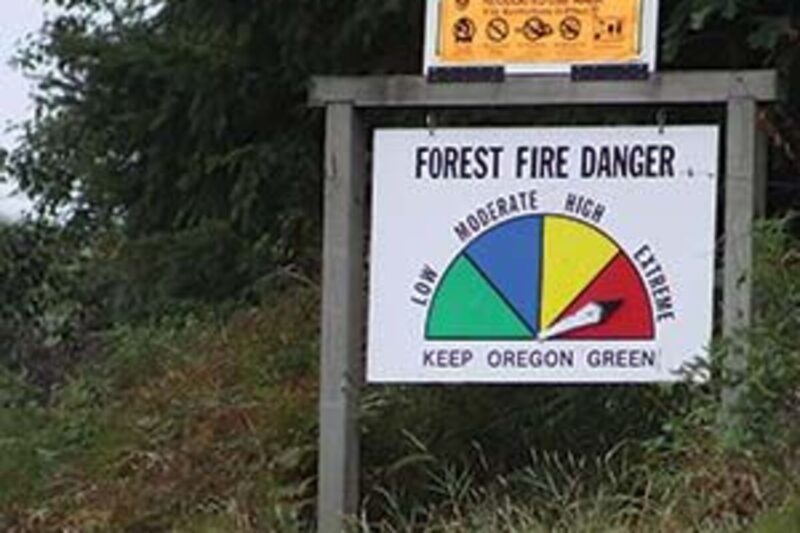
Fire dangers shut down forests

Sean C. Morgan

Ongoing drought and warm weather that have elevated wildfire danger this summer, with particularly severe conditions at the end of last week, have prompted public and private forest managers to shut down most of the woodlands in Linn County and ban all open fires and campgrounds.

The Willamette National Forest raised the Industrial Fire Precaution Level in the South Cascade district to a Four on Friday, July 30, considered a “general shutdown” of industrial activity before dropping back to Level 3 Monday.

The IFPL applies to permitted and industrial operations, including woodcutting, on federal lands. Under a Level 4 precaution, all industrial activities are prohibited.

Level 3 is a partial shutdown that limits operations to 8 a.m. to 1 p.m.

The Willamette National Forest has also stopped the sale of firewood permits until the fire danger decreases.

The conditions have also prompted local corporate owners to shut down their forestlands to public access.

“The potential for fires to start and then grow rapidly will be high due to hot temperatures and low humidity,” said Greg Wagenblast, Oregon Department of Forestry’s South Cascade District forester.

In Linn County, all timber companies have closed their lands to the public, due to the risk of human-caused fires, he said.

The biggest of those, Cascade Timber Consulting, which manages 145,000 acres of private timberland in the county, is usually one of the last to shut the door on non-motorized access. But CTC Vice President Milt Moran said late last week that the situation is too tenuous to allow public access.

“Right now it’s closed, closed,” he said. “It seems like we’re on the verge of a complete closure of the woods.”

In addition to CTC, other landowners in Linn County who have closed their properties to public access include Frank Timber, Freres Timber, Fruit Growers Supply, Giustina, Seneca, Starker and Weyerhaeuser. Those wishing to access corporate forestlands can visit http://www.oregon.gov/odf/FIRE/Closures/Corporate%20Closures.pdf for more information.

Wagenblast said it is important to remember that fuels in the wildland areas are primed to burn. The intensity of fire starts under the current conditions would require more firefighting resources. And once on site, firefighters will face limited sources of water in streams and reservoirs to extinguish the fires.

Jude McHugh, public affairs officer with the Willamette National Forest, said fire conditions are similar on U.S. Forest Service lands.

“Unfortunately, the Willamette National Forest this year as of July 21 has had 47 human-caused fires out of 103 total fires,” she said. The PIO advised visitors to the Willamette that “campfires are allowed only in designated campgrounds with fire rings and need to be ‘dead out’ when leaving your campsite.”

Wagenblast likewise reminded recreationists visiting state-protected forestlands and parks to be particularly aware of the wildfire risk.

As of Saturday, open fires are not permitted in any public developed campgrounds throughout Linn County. Those include campfires, charcoal fires, cooking fires and warming fires. The ban includes developed sites and campfire rings. Smoking is also prohibited, except in vehicles, trailers, and buildings.

“With these conditions, a small spark can become a big fire real quick,” said Sean Stafford, Fire Management Officer for the Willamette National Forest. “While we understand that this ban takes away from the camping experience, we must do everything possible to prevent more forest fires.”

Campers can still cook with portable cooking stoves using pressurized liquefied gas.

Under the restrictions, motorized vehicles must be operated only on established roads. Smoking is restricted to inside closed vehicles or buildings. Other fire safety restrictions can be obtained by contacting the jurisdictional agency.

Moran said if the recent weather conditions continue, it could have an impact on bowhunting season, which runs Aug. 29 through Sept. 27.

“It’s hard to tell,” he said. “Hunting’s a great management tool, but we’ve seen some real careless activity on the property. I’m continually amazed at some people’s lack of responsibility. That’s the big deal right there.”

Moran noted that CTC property has been closed in recent years, but only briefly. He said this year’s fire danger has been intensified by a succession of dry years.

“Fire season continues to get worse and worse,” he said. “We don’t have mountain snows and the relative humidity is in the teens. It will take something significant to change it.

“It’s pretty important to protect the resource.”

For more information on the industrial precaution levels, visit http://www.fs.usda.gov/willamette and click on Fire Information, or call (541) 225-6300.

Total
0
Share