


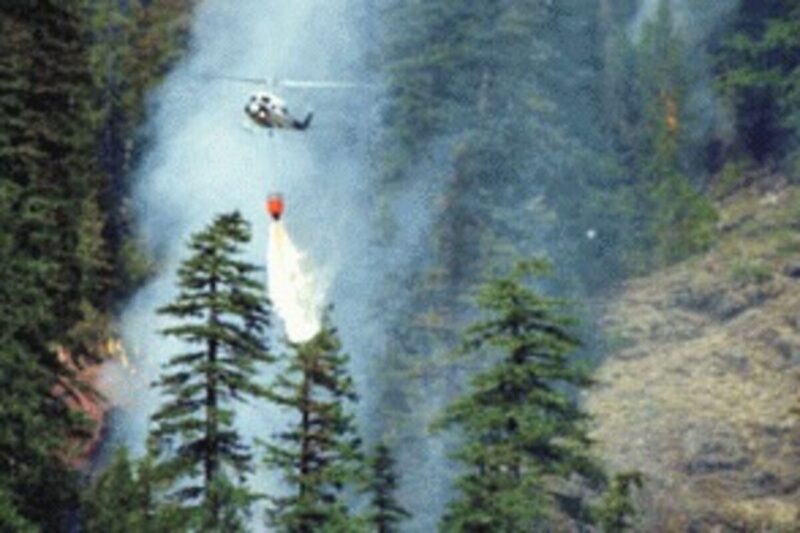
Crews were fighting a 20-acre forest fire started by a lighnting strike on the south slope of Twin Buttes Sunday and Monday.
From a half-mile away on a Cascade Timber Consulting, firefighters looked like ants climbing through late successional reserves as they created fire lines and pulled hose up the slope attempting to get water pressure to the top of the blaze. Helicopters worked in tandem dropping buckets of water on the fire, and air tankers bombarded the fire with retardent.
The slope, sheer cliffs in places, was steep with heavy brush, heavy fuels on the ground and many large snags. Initial estimates reported as many as 50 acres on fire. Trees in the fire were mostly Douglas fir and hemlock.
The fire was reported about 3 p.m. Sunday by Carpenter Mountain Lookout and Rob Ginn, who was patrolling for the U.S. Forest Service on the ground.
The fire was located approximately 11 miles south of House Rock Campground along Forest Road 2044 and near the intersection of Forest Service roads 2044 and 1509, just above 260, roughly four miles directly south of the campground. The fire was close to Cascade Timber Consulting property.
Carl Lemmer, Oregon Department of Forestry Linn District, credited the first crews on the scene Sunday night with containing the fire quickly, keeping it from spreading even farther. Early crews included Ginn, Ken Loree, Detroit Ranger District’s fire engine, Bob Sayer, Keith Murray, Stan Kelley and a crew of 20 from Skookum, a private contractor.
Two smoke jumpers were injured Sunday night when they were hit by falling rock, Joanne West of the Sweet Home Ranger District said. One suffered a broken clavicle, the other a concussion and laceration. Both were transported to Lebanon Community Hospital and later returned to their base in Redmond. Seven other smoke jumpers remained at the fire.
The fire was burning in approximately five acres Sunday afternoon before spreading, Lemmer said. The early fire crews were able to run fire lines up the east side of the burn, keeping the fire from spreading.
Air tankers from Redmond, where the retardent is mixed, dropped 27 loads of retardent Sunday and another dozen as of Monday afternoon. Helicopters were dipping into Gordon Lakes for water to drop on the fire.
The Twin Buttes fire is especially dangerous, West said, because of the terrain and fuel loads.
Firefighters had to cut down snags as they moved up the hill to prevent them from falling and injuring a firefighter or spreading the fire, ODF Lane District Forest Practices Forester and Information Office Tom Berglund said. Other concerns were that the slope was open to a dangerous east wind or shifting winds, which is usually dry and takes moisture out of the air.
Winds were coming from the southeast and southwest Monday gusting up to 10 mph.
In his own district, Berglund said, there were 20 fires as a result of lightning strikes last week.
A five-acre fire burned last week after a lightning strike near House Rock, West said.
Likely, the lightning strike that caused this fire smoldered throughout the week flaring up when conditions were good for it, Berglund said. “The smoke will just wait till conditions are right, just barely burning.”
Ideally, wildland firefighters would prefer to keep a fire under a quarter acre, Berglund said. By the time they reach a half acre, fires are getting “pretty big.”
Probably 90 percent of fires are caught by that point, but the other 10 percent get up and go, “especially when it’s remote, like this,” Berglund said.
Total, four crews of 20 were working on the fire, including one crew from Skookum and two from Oregon Wood, another private contractor, in addition to two tenders, two porta-tanks, two sets of timber fallers, three air tankers with a lead plane and at least two helicopters, another lead plane and a light helicopter.
How long the fire will take to exinguish depends on what the weather does. Relative humidity in the area was reported at 23 percent Monday morning, and there were reports of heavy winds in the South Umpqua area.
“There is a storm coming in,” West said. “Hopefully, it’ll have some moisture in it.”