
Oregon parents disproportionately exempt school-age children from vaccines 

Oregon has the nation’s third-highest opt-out rate, leaving more than 50,000 children vulnerable to serious disease.

By Khushboo Rathore

Oregon Journalism Project

Oregon’s already low kindergarten vaccination rates may worsen after the U.S. Centers for Disease Control and Prevention this month stopped recommending the hepatitis B vaccine at birth.

Public health experts decried the controversial decision, which overturned 30 years of guidance that cut rates of liver disease and cirrhosis.

Oregon is part of a new public health collaborative with Hawaii, California and Washington, the West Coast Health Alliance, that works to support evidence-based vaccination schedules and policy, and recommends the vaccine.

Compared with those states, however, public health officials here may face a tougher task. By law, Oregon parents can claim both “medical” and “personal” exemptions to leave their children unvaccinated.

At 9.7%, Oregon has the third-highest kindergarten vaccine opt-out rate in the country, nearly triple the nation’s 3.4%. Idaho ranks first (15.1%), followed by Utah (10%).

Kindergartners in nearly all Oregon counties have been vaccinated at rates lower than the national average for measles, mumps, rubella, whooping cough and hepatitis B, diseases that can lead to lifelong consequences, even death.

This leaves the state far from what experts call “herd immunity,” which requires a 95% vaccination rate for a community in order to thwart highly contagious diseases such as measles.

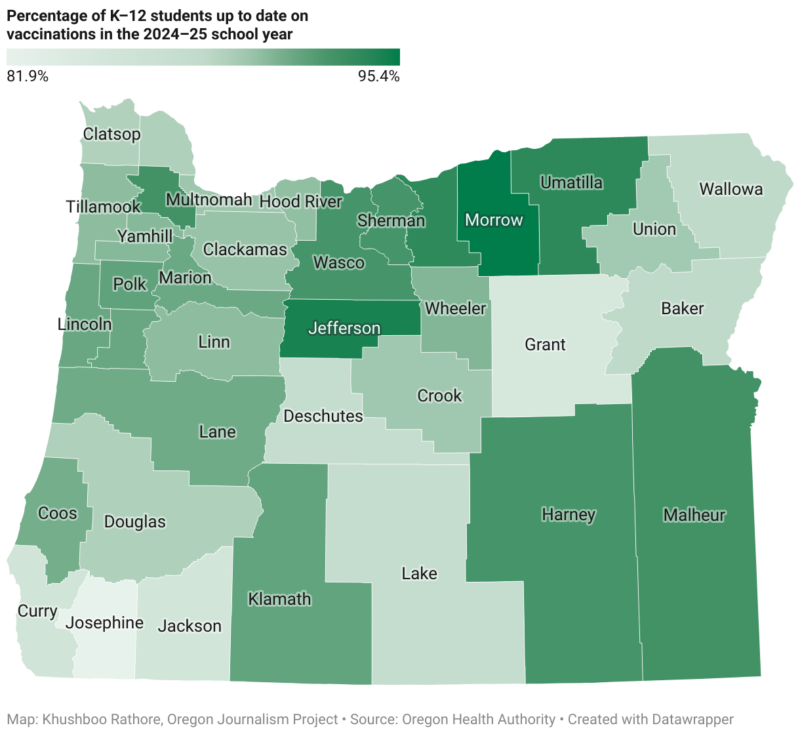
Morrow is the only Oregon county where over 95% of children in grades K–12 were up to date on vaccinations for the past school year.

“We try not to shame them, just provide them with information and education that they can make an informed decision,” Morrow County public health director Robin Canaday says.

Grant County, at the other end, had a vaccination rate for the 2024–25 school year of only 85%.

“I think it’s kind of out of sight, out of mind for some of these major diseases that people don’t even have to interact with anymore,” says the county’s public health administrator, Trey Thompson.

“Post-COVID, there’s still a lot of distrust in just general vaccinations, even ones that have been long standing,” he says.

U.S. Secretary Robert F. Kennedy Jr. of the Department of Health and Human Services has publicly said, without citing evidence, that vaccines cause far more harm than good. Earlier this year, he appointed members to the CDC immunization panel who largely share his views.

Unvaccinated Oregon children have led to record cases this year of whooping cough, also known as pertussis. Through November, 1,453 cases have been reported in the state, a 43% increase over the same time last year, and the highest number since 1950.

“It’s really, really hard to see a child that is so sick from pertussis,” Canaday says, “and to think that vaccines can protect against the severity of those diseases.”


Total
0
Share