
In the metals shop on a recent morning at Sweet Home High School, Bode Nichols and Cohen Gutierrez were bending rebar into L-shaped stakes, using a gas-powered torch.
In the next room, Cadin Matthews and Memphis Gay were welding fish to stakes such as the ones Nichols and Gutierrez were creating.
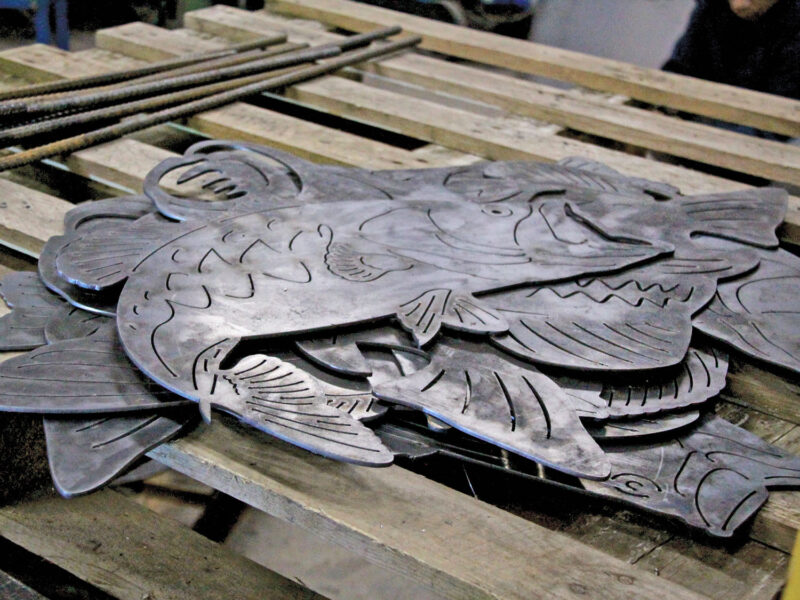
In yet another room stood a plasma table on which students and teacher Austin Hart used a computer-controlled torch to direct a superheated, ionized gas (plasma) at high velocity to cut out the fish from a sheet of eighth-inch metal.
This is all part of the high school manufacturing class that Hart teaches, in which juniors and seniors at the high school have produced a wide range of projects for the school and the community.
It’s also one of the bigger projects the class has attempted, as students have recovered from the COVID lockdown, which severely impacted the metals program, according to Hart.
“We actually do a lot of projects for the school in here, in the welding shop,” said Matthews, a junior. “We’ve built a flagpole for the assistant principal, and we built little stalls for the empty gas canisters, cylinders. It’s really whatever the school needs.
“I know we have a plan to build, like, a mobile welding cart.”
The fish art project, which will include 60 fish representing a variety of different trout, steelhead and salmon, in various poses, will be placed in the flowerbeds along the median on Main Street, Hart said.
The project was originally suggested by Jim and Lisa Gourley, Hart said, but Jim Gourley said a lot of other people have been involved in bringing it to fruition.
He said he and his wife were discussing ideas for public art in town and he said that in a later conversation with County Commissioner Will Tucker they came up with the idea of having salmon swimming down the median strips.
“Those ideas were promoted to our mayor and (school district Supt.) Terry Martin and it moved from there to reality,” he said.
Mayor Susan Coleman said the city was able to provide some funding for the project, which cost just over $1,000 – “minimal, compared to the long-term benefits,” – and was able to get necessary ODOT approvals.
“I’m so glad about this project, students getting involved in their community,” she said. “They’re building pride and community spirit.”
She said she worked with Martin to get Hart’s class involved.
Martin said the project will be able to display to the community some of what is happening in the high school’s career technical education programs, which, he said, with which community members are not always very familiar.
“There is so much good going on, it’s hard to get that out there,” he said. “Hopefully, this will be one little insight,a little peep into the caliber of our kids, their skills.”
Hart said the project has been in the works for a couple of years, and this year he had the students he needed who were interested in pursuing it.
The manufacturing class is the highest-level class taught by Hart, who arrived in Sweet Home in nine years ago to take over a program that was, he said, in decline.
Hart is a product of Philomath High School, where he replaced his own shop teacher for a year after earning his CTE certification at Linn-Benton Community College.

Matthews inspect fish prior to welding them onto supports,
foreground. Photos by Scott Swanson
Before that, he said, he’d “bounced around,” managing an equipment rental yard in Philomath since he was a freshman in the welding program at LBCC.
He described the high school metals program as “pretty run-down and tired” when he arrived in the fall of 2017.
Longtime shop teacher Al Grove had retired and interim teacher had led the program for two years before Hart arrived.
“The building was full of, just, clutter and there was a lot of cleanup I needed to do,” he said. “And then I wanted to take the program from a welding program, where all they did was just weld stuff, to more of a manufacturing (program).”
Things were going “really, really good, amazing,” until the COVID pandemic hit in the spring of 2020.
“That set me back five years,” Hart recalled. “I’m almost to the point now where I was then. We’re finally to the point now to where everybody that I have in the top levels have actually taken all of my classes, and for the most part, they’re all truly into it. So it’s gotten a lot better over the last couple of years.”
Pre-COVID, he said, he had a lot of girls involved in the metals program.
“I was at 25 percent,” he said. “I’ve lost a lot since then.”
The interest level from students has lowered, he said, noting that he sees it as a school-wide issue.
“Kids just are not as interested and dedicated to school as they were.” he added, noting that even dedication among his “die-hards” isn’t what it was pre-COVID.
“I feel like the determination and dedication level has gone down,” he said. “(Pre-COVID,) I had guys that would literally hang upside down in the booth or, like, crawl on the ground. All they wanted to do was be better.”
The current students working on the fish project have stepped up to make it happen, though, he said.
“They are always willing to do whatever I need, and so that’s why I’ve got them in here doing this,” he said. “A couple of them are really pretty good.”
In addition to the projects Matthews cited, Hart said he and students “do all sorts of stuff. There’s some other neat things that we have done.”
They include the metal signs for the staff in the front office at the high school – “they wanted to make the office prettier,” the parking signs on the fence along the back driveway into the high school off 18th Avenue, and the Husky head at the baseball field, which had to be cut out in two halves and welded together due to the size of the plasma table the school had at the time.
“That was kind of wild because it’s an 8-foot circle, and the table was 4 feet, so I had to make the drawing and cut it in half,” Hart said.
The plasma table is part of moving the program past simply welding. The table that existed when he arrived was an older model “that was really dilapidated,” he said.
“You had to, like, try to cheat it and trick it every time you wanted to use it.”
He was able to purchase the modern 5- by 10-foot model for the program in 2021.
Hart himself was introduced to plasma tables by his high school shop teacher, who taught him how to operate it. He uses a computerized template to set up projects to be produced on the table.
For the fish project, Hart arranged the different patterns strategically to get the most fish possible on each 4- by 8-foot sheet of metal.
“I pulled the ones I wanted, edited them, made them the right size we were looking for, and put them all together, packed them on a plate and we cut them on the plasma table.”
It took most of a school day to cut the fish out, said Matthews and classmate Rylie Hollingsworth.
“We started it third period,” Hollingsworth said. “I set up everything on the table and I was transferring (the pattern from the computer) and I actually deleted it, so then I had to redo it.”
It’s really boring when you’re cutting because you have to stand and watch everything cut, especially when you’re cutting 30 fish. It was really fun but it took a really, really long time.
“I love running the table,” Hollingsworth added. “We’re really lucky to have something like this. It’s really nice.”
Matthews said he enjoys working on assignments like making the fish.
“I really like welding,” he said. “I’ve gotten pretty good at it and I enjoy doing projects. It’s cool to start from scratch and build something cool.”
Gourley said he expects the project to have a lasting impact.
“It’s going to be a great project,” he said. “Kids are doing it and they will forever be able to drive down Main Street and see their fish that they made in the middle of that median strip, and they can say ‘I made that,’ and they can take a little pride in their community.
“This helps rebuild community pride.”