

Impasse between agencies, Dad Bod owners results in closure

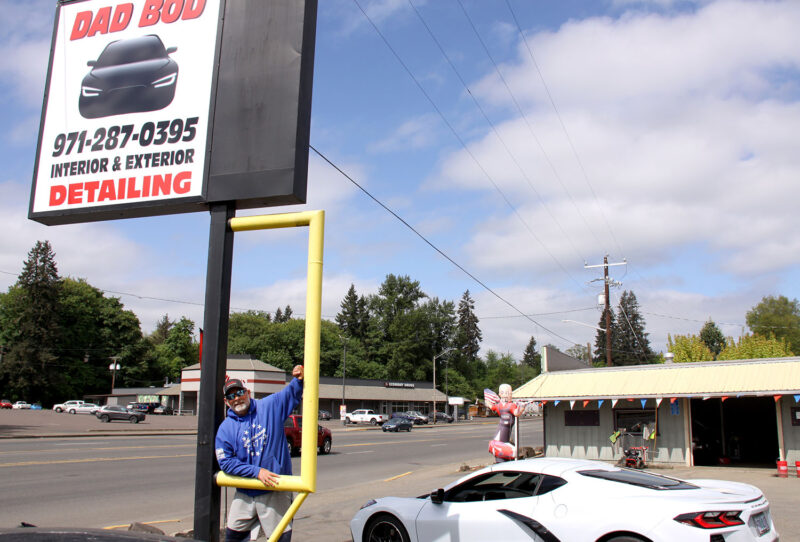
Chris Millard stands beneath his Dad Bod Detailing sign on his lot before he closed in May. – Photos by Scott Swanson

Chris Millard stood in the parking lot of what arguably was one of the most successful start-ups in recent Sweet Home history: Dad Bod Detailing.

He was clearly disgusted, as had been evidenced by his complaints on Facebook about ongoing difficulties he said he was experiencing with government authorities.

He has blamed governmental impasse as the biggest obstacle that forced him to close down his car detailing business at the end of May.

Millard, who had moved to Sweet Home in August of 2023 from Stayton with his wife Jamee and son Austin, said he was “semi-retired” when he decided to do auto detailing in his driveway at 1901 Long St., directly across from the Sweet Home School District offices.

Millard’s former home on Long Street

He opened on Sept. 1, 2024, a small operation under a white pop-up canopy in his driveway.

“It was a hobby,” he said. “Two to three cars a week, that’s what it was supposed to be.”

It didn’t stay that way. The community welcomed his services and before long he had to hire help to keep up with the volume.

“The federal agencies started bringing their vehicles,” Millard said. “We have all four federal agencies in this town.”

A large car dealership contacted him about doing work for them, he said.

In April of 2025, according to city records, in response to a complaint about the business operations in the residential neighborhood, city staff visited the site and informed the Millards that they needed proper permitting, since their residence was zoned residential.

Milllard says the complaint centered on their sign, but he said he couldn’t find a “public record of that.”

Due to “workload and being short-staffed,” the city did not follow up for three months past that deadline, according to city documents provided to The New Era.

“Dad Bod Detailing did not move, nor did they contact staff or submit a Home Occupation Permit,” city staffers wrote in a chronology of the case, which summarized rather voluminous documentation from the case obtained by The New Era.

During that period, Millard said, local Realtor Sherri Gregory offered to allow Dad Bod to rent  the former DanDee Sales building at 610 Main St. He said Gregory offered to install a garage door on the former store building and “they pulled a permit, they had a contractor come out here, and I get a call, ‘Hey Chris, it’s ready to go.’ So I start using it.”

According to the city’s chronology, the renovations were being done without permits and no “change of occupancy” application had been submitted for the change from retail to a car wash business, so a city building official issued a stop-work order at the new location.

The Millards visited City Hall to discuss the situation and city staff said they would lift the stop order if the Millards got a permit for the construction that was taking place. The permit was issued on Aug. 19, 2025,  according to the city.

On Sept. 2, roughly two weeks later, city staff met with Jamee Millard to discuss requirements for operating a car wash at the location, including “building permits, signage, a change of occupancy, plumbing permits, and stormwater/runoff requirements.

Although concerns about signs are not detailed heavily in city documents, Chris Millard said he felt like he got a lot of flak from staff about his signs, including a temporary banner that he installed over the DanDee sign, which remained at the location.

“Apparently, it was ragged,” he said of his banner. “It was brand new but it was ragged.”

He said he saw lots of banners as he drove through town “and I’d just moved in.”

Also, he said, city staff also complained about the inflatable figure he positioned on top of the building as an attention-getter.

“It was a 10-foot-tall inflatable and they were afraid it would fall over.”

On Oct. 14 of last year, city staff sent the Millards a letter, signed by Planning and Building Manager Angela Clegg, stating that the city had not heard from them since the September meeting. The letter also outlined city code requirements: “The carwash runoff must be directed to the city’s sewer system through a baffled tank system, oil/water separator, or similar approved method, or you must obtain the appropriate discharge permit from DEQ.”

The letter also noted that the Millards’ temporary sign “secured with bungee cords” needed to be replaced by a permanent sign and that they needed to submit proper permit applications for the change of occupancy and the sewer requirements.

According to the city chronology, the Millards responded that they were working with the state Department of Environmental Quality on necessary permits.

Chris Millard told The New Era that his wife had had experience working with the DEQ as a former Oregon state employee; he declined to specify what her position was with the state.

He said they tried to work with the DEQ to solve issues posed by runoff of water from the new location.

City Manager Jason Ogden later told The New Era that when the city determined the runoff water from the car wash operations was entering the storm system, the DEQ “became involved as the regulatory authority.”

“City staff have coordinated with DEQ and worked with the business to provide clear options for getting into compliance, including containment and proper disposal of wash water,” he said.

On Dec. 4, 2025, the city says, staff sent another letter “noting that no permits or DEQ documentation had been received,” noting in its chronology that “staff did not issue a stop work order, nor did they involve code enforcement. The business was not interrupted at any time.”

On Dec. 15, the city received an email from the Millards detailing a list of issues they were working with the DEQ on.

On Jan. 26 of this year, the Millards sent an email stating they were planning to have a plumber and DEQ on the site in February.

On March 17, according to the chronology, “city staff asked Dad Bod who their DEQ contact was and relayed the provided information back to DEQ. Staff also informed Dad Bod that DEQ still had no record of prior contact. DEQ notified Dad Bod of a stormwater violation.” That entry in the chronology also indicates that city staff were attempting to connect DEQ officials with the Millards.

Over the next two weeks, DEQ and the city and the Millards communicated back and forth on problems identified by the DEQ that were caused by Dad Bod’s operations and possible solutions.

Problems identified by DEQ included the use of biodegradable soap that “is still harmful to aquatic life,” according to city documents, which also noted that DEQ recommended that the Millards consider a “containment system to capture and dispose of wash water to the sanitary sewer.”

The city noted that if the wash water were “fully contained and does not enter the storm system,” a DEQ permit would not be required.

City staff also noted that ODOT needed to approve “any work affecting the storm drain” on Main Street.

The Millards submitted a proposed plan and diagram, and DEQ sent city staff an example site plan and checklist for proper car wash drainage. The city then, on April 2,  provided the Dad Bod operators with a detailed list of responses to their plan and required actions, which included a wash pad containment mat to “fully contain wastewater – no runoff to street or property at any time,” use of “properly sized” hoses, a storage tank and a grease trap for the line into the storage tank, along with various inspections and other requirements necessary for the operation.

The Millards reported on April 13, in response to an inquiry from the city, that they expected the containment measures to be installed by April 15; then, on April 14, they submitted revised plans.

In early June Chris Millard told The New Era he had purchased a mat – for $3,500 –  to contain the runoff water, plus a $168 fee to use it.

He said he used the mat  for a week, adding that the requirement to capture the runoff in tanks was egregious.

“We run through 881,000 gallons of water a month,” he said, adding that he would have to have the captured water hauled away in 275-gallon tanks.

“To be able to do all the water that we have, we’d need 3,250 of these drained a month,” he said. “That would cost us $441,000 a month. You think I can afford that?”

He also said he worked with NewPIG, a Pennsylvania company that specializes in drain filters for oil, sediment and other contaminants in runoff water to install a filter to catch unwanted elements in the runoff water. He said worked four months with the company, “trying to get the right one, getting them to make us one that works good.”

“The city called DEQ on me. The city has not once come out to check my water, to test it.”

We even offered to put a filter on top of the drain, right under the grate, and we were told, ‘No, you don’t need to do that.

“The city doesn’t care. They only care about the road to here, this way, he said, pointing to the curb. The rest is ODOT.”

On April 16, the Millards applied for a plumbing permit and scheduled an inspection for April 20, also stating, according to the city chronology, that “they planned to move their business over the summer and were seeking a temporary solution.”

According to the chronology, “Mrs. Millard told the building permit tech at the city counter that they were behind on task list items and closing the business due to an illness she was diagnosed with.”

On April 20, two city staffers visited the Dad Bod operations site to verify the temporary containment system which, according to the city chronology, “initially failed, requiring alternative measures and about an hour of staff time.”

“Dad Bod filmed part of the inspection and posted it on Facebook claiming DEQ had approved them and that the city was wasting taxpayer dollars,” a  The system was eventually made functional enough to wash one vehicle at a time, and the permit was approved with the condition that permanent containment must be installed if they do not move as stated.”

At that point, Chris Millard began posting on Facebook, blaming the city for inhibiting his ability to do business.

On April 28, both Millards appeared at the City Council meeting and addressed the council about what Jamee Millard called “administrative targeting and over-regulation” concerning her business.

Millard complained about the city’s concerns about Dad Bod’s signage, in particular that staff complained about the business’s sandwich signs which, she noted, are “everywhere” in the downtown area.. She also claimed that the city was ignoring an “exemption” for which, she said at the meeting, the DEQ had told them their business qualified.

Chris Millard told the council that the city is “actively working against the very businesses that sustain this community.”

He said city staff consistently harass the business and have not even tried talking to them face to face, and despite hosting fundraisers for local youth and nonprofits, Dad Bod would be closing on June 30.

“We are asking the council to intervene where your staff has failed,” Chris Millard told the council. “Lift the restrictive hauling requirements and allow us to operate under our original eco-friendly model.”

He also noted that “administrative red tape” has real-world consequences, resulting in empty buildings and lost business.

“Because of the restrictive hauling plan forced upon us, we have had to turn away over 50 community members in the last week alone,” he said. “These are 50 citizens who wanted to support local business and were told ‘no’ because of city-imposed handicaps.”

City Manager Jason Ogden told the council the city cannot overlook code violations, including DEQ requirements on stormwater drainage.

Later, he told The New Era in written comments dated April 30, “while certain limited activities may qualify for exemptions under DEQ rules, typical day-to-day commercial car wash operations do not.

“While a stop work order is one of the tools available to us when violations occur, we always try to work in good faith with businesses to allow them to remain open while pursuing resolutions, as we have in this case.

“Throughout this process, the city has tried to work with the business to find a path forward while also protecting public infrastructure and local waterways. We apply these requirements consistently to all businesses operating under similar conditions.”

Chris Millard said Mayor Susan Coleman said she wanted to discuss the issue with Ogden and the Millards, but “she could not get us scheduled before she went out of town.”

Instead, he said, they met with Ogden and council President Pro Tem Josh Thorstad, which, he said, was disappointing.

“They had a week to prepare for it and there was supposed to be an agenda ‘to review the concerns you’ve raised, to go through applicable city and state requirements, clear up any misunderstandings and discuss any possible next steps,’” he said, adding he was reading that message off his phone – “which is what we wanted to do.”

He said the city officials appeared, to him, to be unaware “of what the agenda was going to be” and the meeting turned out to be a waste of “45 minutes of my day and my wife’s day.”

“They were just telling us no, we’re wrong. That’s all they did for the whole 45 minutes.”

Ogden, responding to a query regarding Millard’s comments about the meeting, said the purpose was “simply to better understand his concerns and hear his perspective. It was not intended to be a formal review of the city’s documentation or an appeal of the code enforcement process.”

He said they spent most of the meeting listening to Millard’s complaints about the city’s handling of the situation.

“While we asked questions and discussed his concerns, it became clear that we had fundamentally different views regarding the city’s responsibilities and the applicable requirements.”

He said that, although Millard “may have been disappointed” with the results of the meeting, “I believe it accomplished its intended purpose by giving him the opportunity to fully explain his concerns and allowing us to hear them directly.”

Chris Millard said the city wanted him to hook up to the city sewer, but he did not want to pay “$50,000” to do that because he didn’t own the building.

He told The New Era before they shut the operation down that “the DEQ cleared us on our filtration – everything. We’re good to go. The city has not, for what reason we do not know.”

The day after the council meeting, city staff sent an email to DEQ asking for clarifications on statements made by the Millards during the City Council meeting. DEQ returned an email stating they will send a letter to staff.

Ranei Nomura, Water Quality Program manager for the DEQ Western Region based in Salem, responded on April 29.

She said that Dad Bod was “not exempt from DEQ regulation.”

She said that DEQ concerns about the operation included:

Biodegradable soap or detergents that are toxic to aquatic life: “There is no such thing as a soap or detergent that is safe for our waterways. Soaps and detergents that are ‘biodegradable’ mean they do not persist in the environment, but they require oxygen to degrade. The degradation process deprives aquatic life of that oxygen. Also, soapy water is not safe for humans to drink or irrigate over sensitive crops and many Oregonians still get their water from nearby creeks and streams.”

She said that car washes hosted by Dad Bod did not require a permit “because they are generally considered too small to have an impact,” but added that if such activity is determined to “negatively impact waterways,” a “costly” permit would be necessary – about $18,000 for the application fee and $5,000 annually, as well as “additional costs to provide treatment to the wash water to make it safe to discharge.”

Businesses, however, Nomura added, “are not treated the same as charitable activities because they are stationary and can cause long-term impacts.”

“They may be exempt from DEQ permitting, but only if they: 1) wash no more than seven (7) vehicles a week; and 2) do not use chemicals, soap detergents, steam, or heated water.”

Nomura also said that cities routinely require pre-treatment of waste water to remove solids and prevent oily discharges from getting into their sewer systems, which could harm their sewage treatment plants.

In an internal memo dated May 12, Ogden said the city’s “primary issue in this situation involves wash water entering the stormwater system. Unlike sanitary sewer systems, stormwater systems discharge directly into local waterways without treatment.

“Because of that, wash water containing soaps, detergents, oils, or other contaminants is regulated at the state level through the Oregon Department of Environmental Quality, or DEQ, to protect water quality and aquatic habitat.”

Also in the memo, he denied that the city was singling out Dad Bod.

“These requirements are not unique to one business, Ogden wrote. “Similar stormwater, drainage, pretreatment, and permitting standards apply to a variety of operations throughout the community, including commercial car washes, vehicle and equipment washing activities, industrial operations, logging-related businesses, and even certain Public Works activities. The City applies these requirements consistently based on the nature of the activity and the applicable regulatory standards.”

Total
0
Share