





Growing up less than a mile away from the beaches of Southern California, Maddie Tutton has really switched her lifestyle, trading waves for a career in Oregon’s mountain forests.
Tutton was hired in April as the Community Wildfire Defense Grant Coordinator, based at Sweet Home Fire and Ambulance District.
Her presence in Sweet Home is a result of an $8.7 million grant awarded last fall to Sweet Home Fire and other local districts by the U.S. Forest Service. The funding includes staffing for wildfire defense, equipment and Tutton’s position.
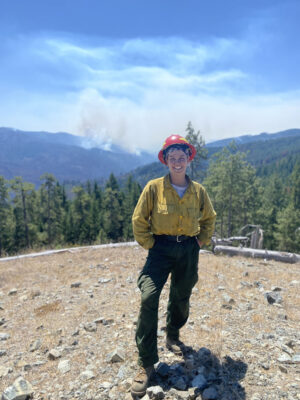
Her role is to oversee the program and manage the USFS grant.
She will help east Linn County residents stay educated about the dangers of wildfires and wildfire mitigation through education, defensible space planning, and specialized fuel reduction projects. This position draws on years of her experience in wildfire suppression, forest restoration, and natural resource management, but her path into this role was anything but ordinary.
After growing up in Newport Beach, Calif., Tutton began her education at the University of Washington with hopes of becoming an engineer. However, after three years in the university’s engineering program, she realized that what she had originally envisioned for herself was not where her passion was leading her.
“I wanted to be outside more,” Tutton said.
Eventually, she changed her major to environmental science and resource management, trading engineering courses for a career combining multiple disciplines, including science, conservation, and hands-on work. And outside the classroom, Tutton often found herself spending just as much time outdoors for fun.
Tutton was a member of the University of Washington’s sailing team, traveled throughout the Pacific Northwest for regattas, and camped outdoors for her own enjoyment.
“We sailed in rain, hail, snow, and pretty much everything,” she said. “I even capsized in the snow once,” she said.
However, after graduating, she still wasn’t sure exactly what career she wanted to pursue. Then a friend suggested she spend the summer on a wildland firefighting hand crew based in Eugene. What began as a temporary summer job quickly became the next step in her career.
“I was hooked after my first fire,” Tutton said.
For two fire seasons, Tutton had the opportunity to work on several hand crews across the West, constructing numerous firelines and helping protect communities threatened by wildfires. That experience gave her a long look into the importance of managing forests before disasters occur.
 “You learn really quickly that everyone depends on each other,” she said. “Every person has a role, and every role matters.”
After two seasons, Tutton shifted her focus from emergency response to recovery as a whole.
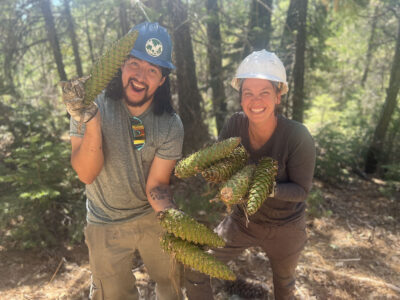
She later accepted a role in a forest restoration project in California, where she had the opportunity to supervise numerous tree-planting crews, restore wildfire burn scars, and take on the super-niche task of scaling pine trees to collect cones that could provide seeds for future forests.
That work in California gave her a different perspective on wildfires and shifted her mindset from just responding to them to helping forests recover. While firefighting focused on the urgency of the moment, restoration required patience.
“It takes years for a forest to recover,” she said. “You’re thinking about what it’s going to look like decades from now.”
These roles and experiences now shape and impact the work she does here in Sweet Home.
As Community Wildfire Defense Grant coordinator, Tutton works with homeowners, contractors, and even partner agencies to reduce wildfire risk before fire season begins.
She also coordinates specialized grant-funded wildfire mitigation projects, helps residents create defensible space around their homes and properties, and even connects landowners with numerous resources to make their properties more resilient to wildfires.
 Rather than responding to emergencies, Tutton spends much of her day talking with people about practical steps they can take to protect what matters most to them, their homes.
“I really enjoy working directly with people and helping them understand what they can do to protect their homes,” she said. “Everybody’s property is different, so it’s about finding solutions that work for them.”
Often, those conversations begin with simple recommendations, including removing vegetation near structures, creating defensible space against wildfires, or minimizing hazardous fuels. But she emphasized that these small changes can have lasting impacts, improve homeowners’ chances of surviving wildfires and protecting their properties, and give firefighters a safer work environment.
Looking back, she sees a clear connection between the decision she made in college and the work she does today. Leaving engineering wasn’t about abandoning one career; it was about finding one that matched who she was.
“I wanted to be somewhere I could make a difference,” Tutton said.