




There was a plan to fireproof Mt. Hood National Forest, but both the left and right stopped it from being implemented.
By Penny Rosenberg
Oregon Journalism Project
It’s nearly extinguished, and it was far from 2026’s biggest Oregon blaze, but the 94,000-acre Grasshopper Fire east of Mount Hood represents the biggest missed opportunity this fire season.
In 2023, a plan four years in the making was adopted to “harden” a portion of the forest: thinning and prescribed burning to mitigate the damage an inevitable fire would wreak.
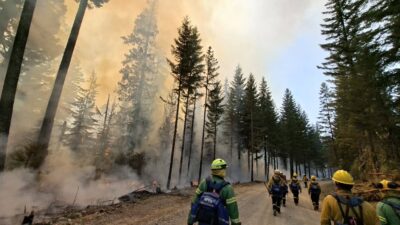
— U.S. Forest Service photo
But before the U.S. Forest Service could sign any logging contracts, Oregon Wild, one of the state’s largest and most aggressive environmental groups, sued and tied up the case for 18 months. A week after the lawsuit settled, President Donald Trump took office, immediately gutting the Forest Service and crippling the agency from moving forward.
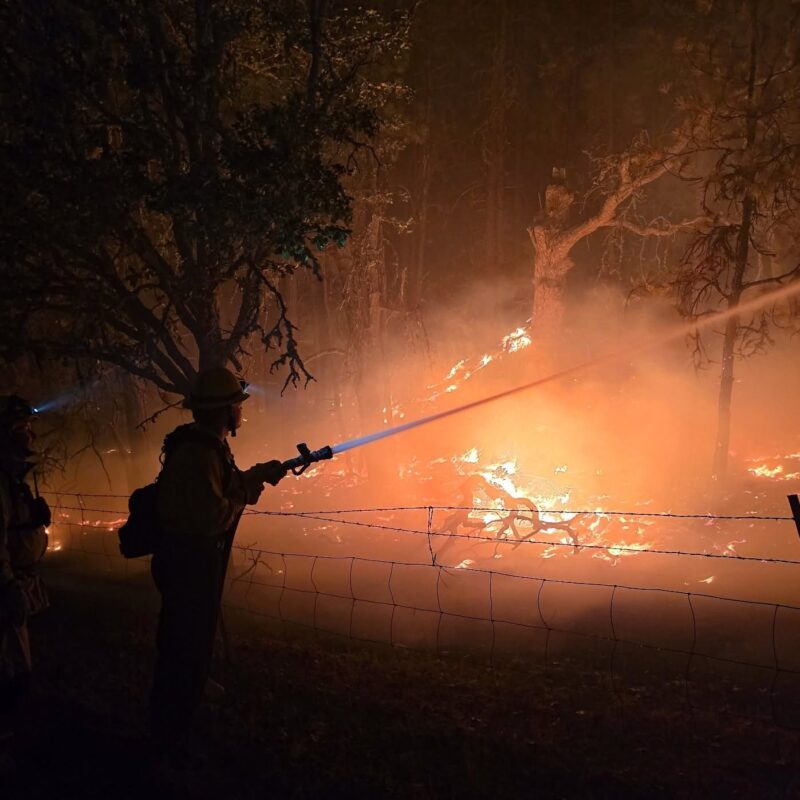
And then on July 23, 2026, lightning struck the east side of Mt. Hood National Forest, 14 miles south of Dufur, igniting a fire that eventually scorched an area twice the size of Washington, D.C.
As Oregon and other Western states grapple with larger and more frequent wildfires, there is still disagreement about how to mitigate the damage. Yet wildfires move at the speed of weather, not at the speed of lawsuits or Washington politics. And the debate has rarely been more focused on one place, a stretch of Mt. Hood National Forest just east of Highway 35.
On Jan. 11, 2023, President Joe Biden’s U.S. Forest Service signed off on the Grasshopper Restoration Plan.
The plan had been developed over the previous four years in concert with the Wasco County Forest Collaborative — an unusual coalition of loggers, conservationists, Native tribes and local officials. The group built consensus and employed science-backed approaches to hardening forests and surrounding communities against wildfire. The plan’s goals: to “reduce the extent and severity of wildland fires” and “create defensible space and areas of safe engagement for fire suppression personnel along Forest Service roads” in a 5,280-acre area.
While some environmental groups signed on, including Bark, a Portland group committed to restricting logging, Oregon Wild did not. For more than five decades, Oregon Wild has built a reputation for political and legal savvy, amassing a degree of influence most like-minded groups can only envy.
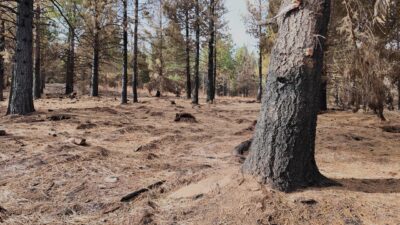
On June 27, 2023, Oregon Wild sued in federal court, claiming that the Grasshopper plan violated the Endangered Species Act by harming the owl habitat. For 18 months, according to Andrew Spaeth, the Wasco County Forest Collaborative’s facilitator, Oregon Wild’s lawsuit delayed thinning and harvesting efforts.
“Litigation is one of the challenges that we face,” Spaeth said, adding that there is “universal frustration” that science-backed solutions that enjoy wide support are so slow to gel.
His comments are echoed by Matt Donegan, a retired timber executive who led Gov. Kate Brown’s 2019 Wildfire Response Council and who currently chairs the Oregon Environmental Quality Commission: “If you spend much time on wildfire prevention, probably the single most frequently mentioned challenge is the litigation of management projects. Actual litigation stalls or stops real projects, while the threat of litigation warps the entire land management process.”
After 18 months of talks, the Forest Service settled and agreed to some of Oregon Wild’s demands, specifically excluding from harvest some older, larger trees and reducing the overall project size. Now the Forest Service was free to move forward on the plan to harden Mt. Hood National Forest.
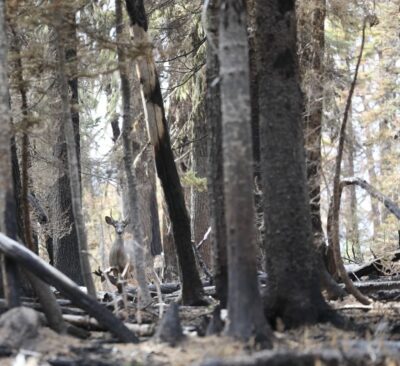
— U.S. Forest Service photo
That was in January 2025, however, when Donald Trump took office for the second time. He proceeded to gut the Forest Service. Sixteen percent of its workforce, nearly 6,000 employees, departed in the first half of 2025. The agency’s Portland regional headquarters closed, and prescribed burning nationally that year fell to roughly half of 2023 and 2024 levels.
As a result, the Forest Service never got going. It never put out any timber contracts for auction.
And when lightning struck on July 23 of this year, winds and the dry fuel swallowed acres of the forest, closing Highway 35 for a week.
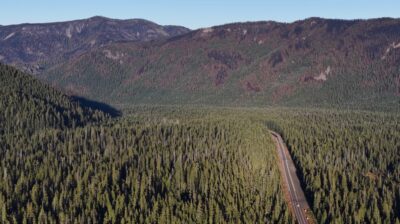
— @GreenOregon YouTube
The cost of fighting the fire, according to the Forest Service: $120 million.
To be sure, neither disagreement over the mitigation plan nor disarray at the Forest Service were responsible for starting the fire. That was Mother Nature. The issue is how much worse the damage became. “That would be speculation,” USFS spokeswoman Heather Ibsen said in an email.
Donegan’s view is that “good laws that have brought tremendous ecological benefit are now used to stop projects in dire need due to climate change.”
Adds Spaeth: “It is a somewhat nuanced and complicated story because it’s not just one thing. It is the culmination of, really, decades of disinvestment in our public lands, disinvestment in the federal agencies, these kinds of whipsawing and constant changes in political priorities and stated priorities of the agencies.”
Oregon Wild Conservation Director Steve Pedery acknowledges his lawsuit slowed things down but accepts no blame for the severity of the Grasshopper Fire. Instead, Pedery said, the Forest Service had plenty of time to mitigate were it not for Trump’s axing of the agency.
“That 18 months was chaos for the Mt. Hood National Forest staff, and I think that’s important,” he added.
For his part, Travis Joseph, president and CEO of the American Forest Resource Council, representing loggers and mills, is frustrated.
“This is a case where we did all the prep work, didn’t get the work done, and now we’re spending all this money cleaning up after the fact.” Joseph said. “That makes no sense.”