






Here are five reasons why Oregon’s higher education institutions struggle to support the state’s job market.
By Khushboo Rathore
Oregon Journalism Project
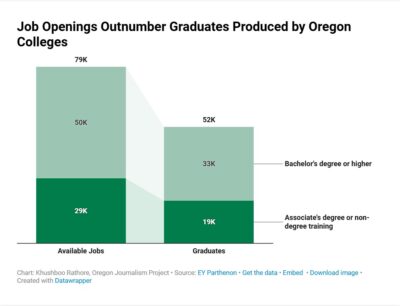 A new report highlighting shortcomings in Oregon’s higher education system contains a little-known fact: The state annually graduates about 26,000 fewer workers with a college education than there are available jobs that require college degrees. That’s roughly the population of Grants Pass, an entire town’s worth of good jobs that go begging each year.
The report was mandated by a controversial law enacted in March that required the Oregon Higher Education Coordination Commission to research and provide recommendations on improving higher learning in the state.
Here are five reasons why Oregon’s higher education institutions are struggling to support the job market:
- The education pipeline is narrowing.
Oregon is dealing with a stagnating population caused by a declining birthrate and fewer people moving into the state, the report says. That means fewer students are entering the elementary and secondary school systems.
Further, only 50% of Oregon high school graduates go to college within a year. This is well below the national average of 58%.
As a result, there are too few graduates to fill available jobs. Overall, Oregon employers generate about 78,000 job openings a year that require a higher education. But the state turns out only 52,000 higher education grads a year.
The deficit isn’t new, according to former state economist Mark McMullen. But historically, Oregon could always pull in graduates from other states. But Oregon public universities are attracting fewer students from out of the state than they were 10 years ago.
“It’s going to be more difficult to lean on other states to make these investments in education and then poach their workers,” McMullen said.
Economic growth depends on putting college graduates to work, and Gov. Tina Kotek’s Prosperity Council said earlier this year that a “misalignment between education, training, and industry needs” in Oregon’s university system limits employers’ ability to hire and scale their workforce.
- Oregon higher ed schools lack support from the state.
Oregon is ranked 46th in the country for public university spending. To make up for limited state support, public universities and colleges charge students significantly higher tuition than Washington’s and California’s state university systems.
Yearly tuition for in-state students in Oregon for the 2026–27 school year ranged from $11,920 at Eastern Oregon University to $17,508 at University of Oregon.
This also means that for some Oregonians, attending college outside the state is more economical, said Mary Moller, executive director of the Coalition of Oregon Public Universities.
“Tuition in this state does create a real barrier for students and families to access our public universities, and families have to make very real, very difficult financial choices,” Moller said.
Oregon community college tuition for in-state students is about $4,100 a year and $6,900 for out-of-state students. Those costs are comparable to Washington’s but much higher than the $1,200 that California charges for in-state tuition, and somewhat higher than California’s $6,300 for out-of-state tuition.
- Many Oregonians never finish their degrees.
More than 825,000 Oregonians attended a higher education institution but never graduated, according to a report by the National Student Clearinghouse. That proportion of the state’s total graduates is the highest in the nation. This group represents a huge pool of potential students who are very important to the state, Moller said.
The loss of these learners meant less income for schools and fewer Oregonians to bolster the state economy by filling higher-paying jobs that require college or associate degrees. Schools like Eastern Oregon University and Oregon State University are helping pave the way for more flexible learning in Oregon, Moller said.
“We really do need to make sure that we’re thinking about all the different populations and how we’re supporting them to make sure that they continue to want to grow and thrive in this state,” she added.
- Graduates of large public universities aren’t staying in Oregon.
University of Oregon and OSU both have student populations that are roughly half in state and half out of state. Yet, 55% of all UO graduates and 48% of OSU graduates leave the state after completing their degrees.
The biggest reason, according to McMullen the economist: Other states have better job opportunities.
“If the opportunities are here, the graduates will stay,” he said.
Community colleges, on the other hand, keep 75% of graduates in state.
- Demand for Oregon health care jobs climbs while Oregon barriers persist.
In addition to the gap between the number of grads and the number of job openings is a mismatch in skills.
The health care field, for example, is growing nationally and is the largest area of job growth in Oregon. The second most in-demand career for workers with bachelor’s degrees in Oregon, according to a report by the Oregon Employment Department, is registered nursing. But Oregon ranks near the bottom in producing credentialed workers in the medical field per capita–including 47th for nursing school grads.
One problem is low pay for qualified nurse-educators needed to meet Oregon’s demand for nurses. This creates a bottleneck that lets in only a fraction of students who want to start nursing training.
Whether it’s nursing or other in-demand professions, “governance changes alone will not and cannot solve the problems our institutions are facing,” Moller said. “There must be changes to funding to move the needle…and to fill the state’s critical workforce needs.”