




A law passed earlier this year lets developers switch from state to local control where approval time is cut by more than half. Only two have taken advantage of it so far.
By Penny Rosenberg
Oregon Journalism Project
In February, the Oregon Legislature passed a bill that in essence said the state process for siting clean energy projects was too slow and allowed certain projects to bypass the state and go to the counties for approval.
As of this date, only two developers have made the switch, and they’ve already sailed through to approval.
But this does not portend well for a state that promised in 2021 utilities would be carbon-free by 2040.
 “We are 47th in the nation for the production of new clean energy, partly because we make it harder to do than any other state,” state Rep. Mark Gamba (D-Milwaukie) wrote to a state agency in September. Gamba said he is looking to tighten the state’s process in the 2027 legislative session.
Shortening the process was the goal when Salem passed House Bill 4031 earlier this year. It gave some applicants a fast track by allowing them to skip state approval and instead apply directly to the counties where the renewable energy projects are proposed. The main drivers behind the bill were the state’s long delays and Congress’ One Big Beautiful Bill Act, which set an expiration date on federal tax credits for clean energy projects.
County officials have proven they can usher an application through in less than half the time it takes the state’s Energy Facility Siting Council.
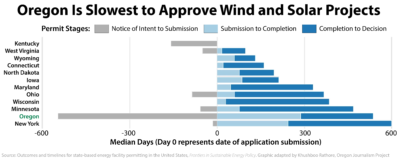
When it comes to green energy, Oregon talks a big game but mostly strikes out. A report released earlier this year by the U.S. Department of Energy’s Berkeley Lab compared states’ approval times for wind and solar projects, with Oregon coming in last place.

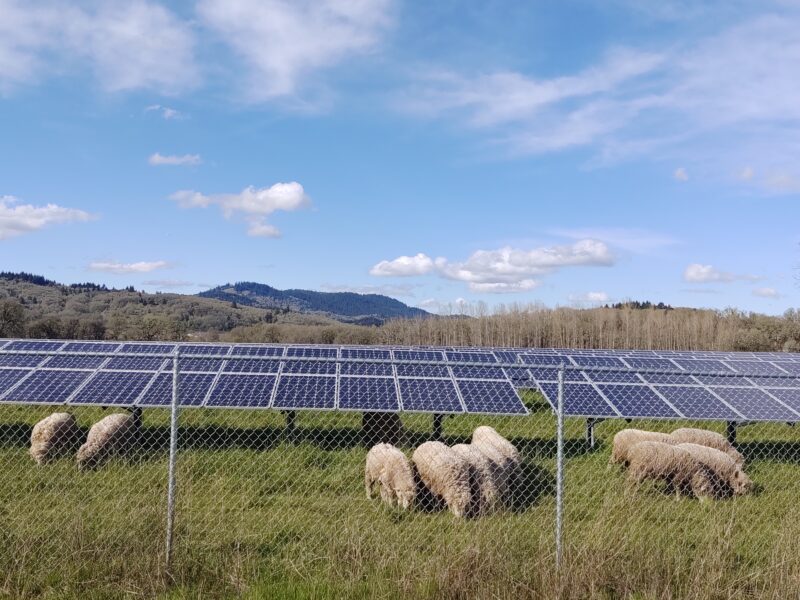
— Courtesy of Brian Walsh
For the 19 states that offer a state approval apparatus, the report says “90% of projects obtained permit approval, most within a year or so of entering the process.” But Oregon projects take, on average, 600 days to arrive at a decision—nearly double the time of other states studied—and can spend nearly as long in a preapplication stage.

— Courtesy of Brian Walsh
After HB 4031 passed, the Oregon Department of Energy identified seven renewable energy projects in the pipeline that were eligible to switch to local jurisdictions. To date, only two have: a solar array in Morrow County and a 69-turbine wind farm in nearby Gilliam County. Both got signoff from their respective counties in September, a timeline counted in months, not years.
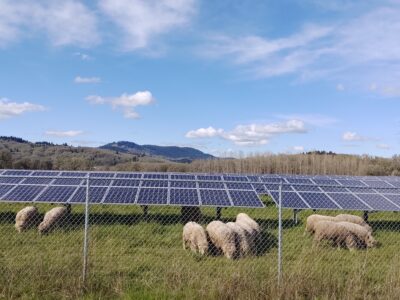
— Oregon State University photo
Brian Walsh, vice president of project development for MN8 Energy’s Well Springs Solar Project, estimates the switch from state to Morrow County jurisdiction shaved more than a year off the siting process. That represents “a tremendous savings for the project,” Walsh said, “and also keeps the price of power lower for those who buy the power and consume the power.”
Thirteen other clean energy projects did not qualify under HB 4031 for county approval and are currently making their way through the slog of the state’s process.
On Sept. 18, for example, the state Energy Facility Siting Council signed off on the Yellow Rosebush Energy Center, a solar farm to be built primarily in Wasco County. It had been originally pitched to the state back in 2023.
A polite word to describe the state of Oregon’s process would be “methodical,” said state Rep. John Lively (D-Springfield). He chaired the House Interim Committee on Climate, Energy, and Environment, which recommended passing HB 4031.
“At the local level, you’ve got local elected officials and staff that are in a position just to act much quicker,” Lively said. “Now, you can argue whether they’re as thorough as they should be or not. The reality is, they follow the code, so they’re doing what the code requires them to do. At the end of the day, not everybody wants these facilities. So, depending on the county and what they’re doing, there’s opposition.”
There was, in fact, little opposition to the two projects that have been pushed through county approval: none for Saddle Butte, and only one person went on the record against Well Springs.
In the end, Oregon counties are much more “streamlined” in their approach, said Ethan Kirkham, a Portland senior research analyst at Greenlight America, which helps proponents of clean energy advocate for projects at a grassroots level. At the state, “it’s a much more exhaustive list of checking all these boxes, and you’ll often see projects going back and forth for one to three to four to five years,’” Kirkham said.
Even if only one or two projects make it to completion in time to reap the tax benefit, Lively said, HB 4031 will have been worth it.
Though, he acknowledged, “it would be nice to see more.”