

Chief: Lebanon Fire District brings value to city despite light staffing

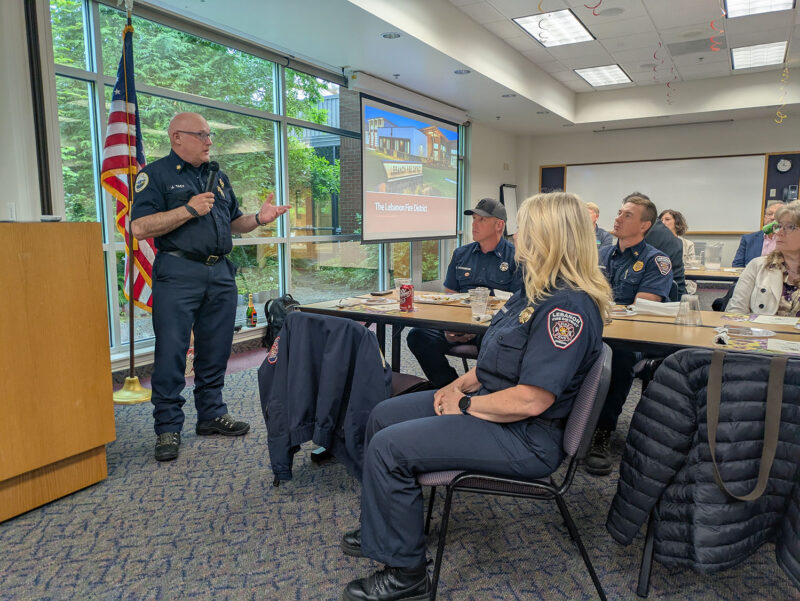
Fire Chief John Tacy, left, addresses attendees at a Chamber of Commerce forum lunch on May 29. Photos by Sarah Brown

Lebanon Fire District brings value to businesses and the community. That’s the message Fire Chief John Tacy wanted listeners to hear during a forum lunch hosted by the Lebanon Chamber of Commerce on May 29.

But first, he went on to make clear, “There’s a lot of people that think we are the city fire department. We are a district. We’re governed by a board. We are our own entity.”

And as their own governmental entity, they don’t have the same funding mechanisms that a city does, such as water, sewer or city service fees.

But it was the importance of staffing that Tacy especially wanted to emphasize on this day.

“One of the big reasons staffing matters is speed, the importance of speed and the availability to respond,” he said.

LFD is responsible for 113 square miles of fire protection and more than 400 square miles in ambulance service, stretching over to I5 on the west, butting up near Eugene/Springfield to the south, halfway to Sweet Home on Hwy. 20 in the southeast, and all the way up toward Crabtree and Scio.

“It’s a huge area to respond to. We do that with two houses and three stations.”

Explaining the difference between a station and a house, Tacy said full-time personnel currently work 24-hour shifts on and 48-hour shifts off, which means they need access to a kitchen, bedroom and other residential-like amenities.

“They spend a third of their working life there, a 56-and-a-half-hour work week, in the fire house,” he said.

LFD Chief John Tacy

And their main workload is, of course, responding to EMS calls – which make up a majority of their calls – and fires, both which provide better success rates the faster they get to the emergency location.

A fire in a structure doubles in size every 30 to 60 seconds, Tacy said, so “the quicker we get there, the quicker we stop the fire.” And the faster a fire is stopped, the less property loss there is, the less down time and disruption there is to services and employees (in a business fire), the less likely a neighboring structure or business catches fire, and, ultimately, the less the community as a whole is affected.

As an example, if ENTEK were affected by fire, millions of dollars and hundreds of jobs would be lost to the community, Tacy said, but also affected are the outside sources – such as truck drivers for ENTEK – who would spend money when passing through Lebanon. And further, the city is affected by a loss of tax dollars brought in by ENTEK.

On a side note, Tacy explained that large employers looking to locate in a city will be looking for a community that provides a good police department, good schools and good fire department services.

One last item to consider is insurance rates. When firefighters can respond to fire calls quickly – i.e., there’s a full-bodied staffing – long term insurance rates can lower. That’s because the Insurance Services Office rates a city’s fire district, and insurance companies often use those ratings to determine a customer’s base cost, he explained.

But with limited funding sources to provide full-bodied staffing, the district would need more homes built in Lebanon.

“If we wanted to add one firefighter to our fire department, it would take 530 brand new homes to equate to that,” Tacy said.

Response speed is also important for ambulance service, he added. In cardiac arrest, there’s risk of brain damage after one to three minutes, and worse after four minutes.

Daily staffing on average at LFD is seven people for two ambulances and one fire engine to cover 400 square miles of ambulance service and 100 miles of fire service. Since voters rejected the levy in 2024, LFD reduced its staffing, equating to about 10.5 positions.

Last year, LFD ran more than 5,000 EMS calls, just 120 less than Albany Fire District and 300 less than Corvallis, Tacy said.

“And they’re doing it with twice to three-times the staffing that we do,” he said. “We’re efficient, we’re effective, but our staffing is at critical mass.”

The number of overlapping calls at one time has risen in the past decade, most of the time being two calls at once. But sometimes it’s four, seven or even eight calls at one time.

As such, LFD “relies heavily” on its volunteer staff, of which currently there are 60.

“We utilize them all the time and we couldn’t do what we do without our volunteer staff,” Tacy said.

But still, volunteer staffing presents unique challenges, such as availability or limited training to a certain level.

LFD also relies on back up coverage from surrounding fire districts, while LFD provides back up coverage for them, as well.

They are also prepared to assist with wildfires, hazardous materials transport, natural disasters, and conflagration with state agencies. But several other types of calls get directed to LFD, as well, including when a roof gets blown off in a windstorm, when a tree or wire goes down, when there’s a water leak, or when, say, an elderly person can’t get up.

Fire Marshal Candace Hedding, at right, explains services provided by the fire district’s Fire and Life Safety Division.

“These are all things we bring that I think a lot of people don’t think about as far as what’s healthy for the growth of your community,” Tacy said.

During the forum, Fire Marshal Candace Hedding and Training Division Chief Russell Duerr provided a little more insight into other areas of value the department brings to the community.

Hedding shared how the district’s Fire and Life Safety Division focuses on prevention services.

Engine and ambulance crews perform company-level inspections for businesses, while Hedding and other higher level staff perform larger scale inspections, which might include inspections at industries such as Low’’s Distribution or ENTEK.

The division also works with the City of Lebanon and Linn County to perform planned reviews, an aspect of prevention that helps reduce property loss, such as required firewalls, works with assisted living and apartment complexes to help them stay updated on fire suppression systems, and works with children and students on education.

As for Duerr, one of his main responsibilities as a training officer is to make sure all career and volunteer personnel are trained to state and national standards, and he oversees training of the volunteers.

The LFD currently finds a larger need for volunteer firefighters in rural areas, to be stationed at the Berlin, Lacomb and Fairview/Waterloo area stations. While a majority of volunteers are stationed at Station 31 inside Lebanon, usually only an average of two to three volunteers are situated rurally.

Total
0
Share