





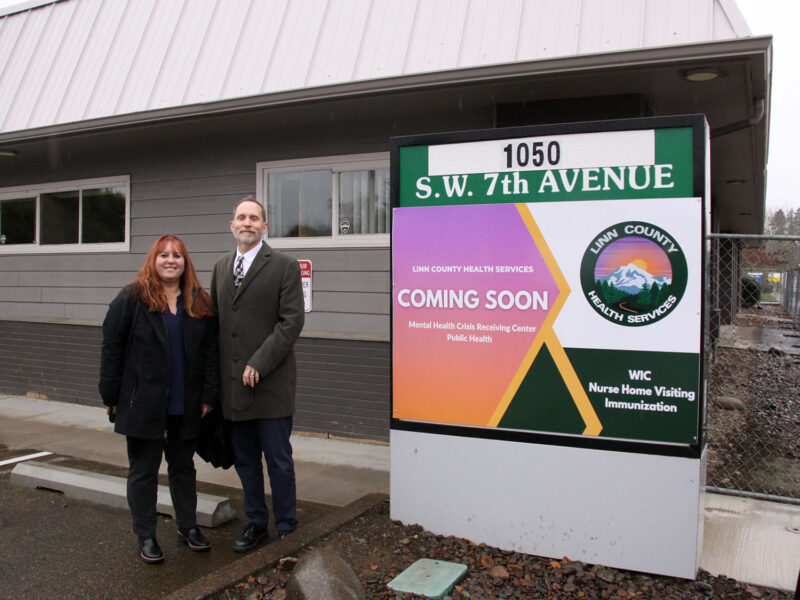
Linn County has begun construction of a new mental health crisis center in Albany that will provide temporary respite for people who need behavioral heath assistance.
Work on the new facility began the week of Nov. 17 in a county-owned building directly across from Samaritan Albany General Hospital on 7th Street in Albany.
“Obviously, we have a mental health behavioral health crisis in the state of Oregon and the rest of the United States,” said Todd Noble, mental health director for Linn County.
According to a COVID-19 Practitioner Impact Survey of Oregon mental health practitioners conducted by the American Psychological Association in 2022, 79% of psychologists reported seeing an increase in patients with anxiety disorders, 66% saw an increase in demand for treatment of depression, and 47% said they had seen an increase in demand for substance abuse treatment.
Oregon began closing mental health hospitals statewide, reducing the number of in-patient beds, about 20 years ago, which has put more demands on counties to provide help for mental illness.
Noble said that, “a couple of years ago,” Gov. Tina Kotek encouraged Oregon’s counties to expand crisis services and build crisis centers.
Linn County already provides mental health crisis services during customary business hours and has a crisis van for providing services in rural areas around the clock, Noble said. The crisis receiving center would provide short-term assistance at a brick-and-mortar facility.
Benton, Marion and Polk counties have all recently opened such centers, some with funding from the Oregon Health Authority (OHA). Lane County has a mental health stabilization center in the works that is scheduled to open in late 2027 and Lincoln County is already working on one. Marion County already had a crisis center, but has expanded it with state money.
They provide services such as suicide prevention, safety planning and referrals to longer term behavioral health care. Individuals can also get support for dealing with substance use disorder including referrals to treatment and overdose prevention education.
Anyone in crisis can enter any one of the centers without an appointment and receive services, regardless of their ability to pay. The centers are strictly voluntary.
Upon arrival, patients are evaluated and can stay for up to 23 hours in a calm, therapeutic environment, which will be the case in Albany. Staff can also refer individuals to other providers for ongoing treatment or to the emergency room if necessary.
The Benton County Crisis Center will include a longer-term residential facility, with six rooms and shared living space where people can stay for up to 29 days. Residential services will not be available at the centers in Linn or Lincoln counties.
Linn County’s facility will not include beds for long-term care. Noble said there would be chairs for clients and staff would assist them, rather than those people going to local hospital emergency rooms for help.
If a person poses a threat, they would be transported to an emergency care center.
The new facility will provide help for troubled individuals that the county currently can’t provide.
“In Linn County, we’ve always had a crisis team for decades,” Noble said. “We’re 24 hours a day, seven days a week, 365 days a year, and mostly going to emergency rooms. And so a few years ago, we started with crisis mobile vans. So right now we have a mobile van.”
But, he said, the new crisis center will provide “sort of a respite area, where people can kind of relax, calm down, de-escalate.
“It’ll be a way to get people into our our mental health program, into diversion.”
He said the department will work with the District Attorney’s Office and law enforcement agencies to get people into alcohol and drug services.
“So it’s going to be like a one-stop shop for people that are struggling, with the goal of keeping them out of the most expensive and challenging emergency rooms that are overburdened.”
Noble said the Linn County center’s location is a big plus.
“The advantage that we have is that we are the only crisis center that will be directly across the street from a hospital in the state of Oregon, and that is a huge advantage,” he said, noting that in other areas people are aware that they can go to emergency rooms, which often have long wait times and are expensive.
“It’s going to be a tremendous benefit for the hospital, and it’ll be an easy way to access services,” Noble said.
In 2023 Noble brought the issue to Linn County commissioners, who approved the use a $75,000 grant from the Intercommunity Health Network for the study. The IHN is a coordinated care organization that blends services offered by Samaritan Health and other private providers with those delivered by local governments, including Linn County.
Noble said Linn County did not get the OHA funding that other communities have benefited from, because of a shortage of those funds, but it has “braided” funding from a variety of sources to pay for the project.
“None” of the funding for the project is coming from the county, he said. “Mental health is not funded by the county General Fund at all. It’s part of our contract that we have with the state. We’ve been doing (mental health services) for years, so it’s not really additional.
“But as far as prioritizing, some of the biggest priorities of the state is crisis. So when we get our dollars, it’s one of our highest priorities.”
Noble said that the county decided to move forward with the center, rather than waiting for additional cash infusions from the state.
“We just went ahead and started the process, because the goal is to have one of these in every region, if not every county in Oregon,” he said.
The county-owned building, at 1050 7th St. SW, also houses public health services such as Linn County Public Health and its WIC program.
Linn County’s center will be based on “the best model, and the first one in the state, which was actually in Deschutes County, which has been running one for a few years,” he said.
“All of us – Marion County, Benton County, Clackamas, Washington, we have all looked at the model coming from Holly Harris (longtime program manager at Deschutes County Crisis Services) and Deschutes County.”
Terri McQueen, I’m the health services contract and procurement manager, said the new facility is scheduled to open June 1 of next year. She said an open house will be held at that time to introduce the public to the facility.
Noble said the new center won’t be operating 24 hours a day immediately, partly because it’s challenging to hire behavioral health staff.
“I think we’ll probably go right to 8:30 to 8, initially, then it’ll creep up to 10 and then midnight.”
But when clients walk in, they will get warmth – both physical and personal, and the chance to settle in a calming environment.
“Frankly, we all know, going into every emergency room across the country, you can be there for hours on end, right? So this is a real efficiency.
“The whole idea is it’s a way to engage people, to get them into services. It really is like an open door. That’s the ultimate plan.”