

Letter rankles neighbors

Staff

09/19/12By Scott Swanson

Property owners along the Albany & Eastern Railroad line between Lebanon and Sweet Home are upset over a letter many received earlier this month from the company, threatening to close the crossings from Highway 20 to their homes unless they pay fees to use the crossings.

The letter, from Jared G. Cornell, director of sales and marketing for Albany & Eastern, informs owners that they need to have a $1 million insurance policy and pay $720, which includes an annual “maintenance fee” of $120, to maintain their railroad crossings.

The letter ends by stating: “If you choose not to provide the requested information, documentation or financial requirements by September 30th, we will close the crossing.”

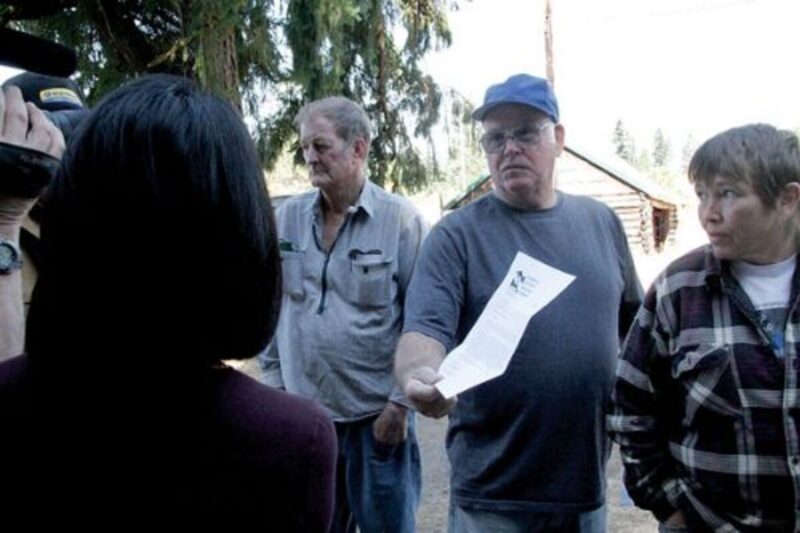
Mike Martel, a resident on Country Lane, which abuts the highway directly across from Harmony Road, west of Sweet Home, was one of eight residents who gathered Wednesday morning, Sept. 12, at the home of Shirley Trahan, 28637 Santiam Highway, to talk with a Eugene TV crew and a newspaper reporter about their concerns. He said he would lead opposition to Albany & Eastern’s plan.

“We’re just questioning the validity of this,” said Martel, one of 10 property owners on Country Lane, which he said is the largest pocket of residents affected by the railroad’s demands. “This is not my fight. This is all of our fight. We don’t think it is right for them to charge us to go to our own homes.

“They can put liens against my property and put barricades up,” he said. “They can knock themselves out. We’ll organize a big rally. I speak for people like Shirley Trahan, who don’t have the ability to fight for themselves.”

The crew, from KVAL TV, had visited Trahan’s home Tuesday, Sept. 11, where it had filmed a report on Trahan’s concerns over the letter. Cameraman Bill Goetz and reporter Lauren Lee were back Wednesday after Albany & Eastern officials took issue with the fact that KVAL personnel were standing on the railroad right-of-way when they filmed the story Tuesday.

“They made it clear that we could be prosecuted for being on railroad property,” Goetz said. Wednesday they stayed well way from the actual crossing, filming angry residents farther down Trahan’s driveway.

Neighbor Leena Neuschwander, who moved onto nearby property owned by her grandmother, Ethel Ellis, right about the time the first of three letters, sent by the company to some of the residents, arrived in March, said the first two letters arrived a week before the company held an informational meeting on March 22 at the Sweet Home Community Center. About 40 people attended that meeting, at which some voiced concerns over the railroad’s plan to charge the fees.

Most of the neighbors at Trahan’s home on Sept. 12 said they had only received one letter – the latest, dated Aug. 30, 2012, and the fee was news to them.

Neuschwander said it appeared the company sent the initial letters to landowners it had been able to identify by that point.

“It’s outrageous,” said Joe Brocard, who operates an apple orchard at 28095 Santiam Highway. “How the hell can they shut your crossing off when I pay taxes to the county? The assessor doesn’t have any trouble finding me.”

Cornell said last week that he had “no comment” on the crossings. He said Albany & Eastern was preparing a written response, but as of Monday, Sept. 17, The New Era had not received that document, despite a phone call inquiry as to its status.

At the March 22 meeting with residents at the Community Center, Albany & Eastern General Manager Mark Russell said some a letter had been mailed to residents outlining the permit requirements. Russell said in March and residents said last week that some people along the railway have agreements with Burlington Northern-Sante Fe Railroad, which owned the rails until the late 1990s. Some of them have even made payments as late as 2011, Russell said.

He said then that questions regarding the $600 fee were still being resolved and that Albany & Eastern had a request in to BNSF and property owners for information on those permits.

Cornell declined to answer a reporter’s questions, which included inquiries into the status of Albany & Eastern’s information-gathering efforts.

Martel said a related issue for the 10 residents of Country Lane is who actually owns their road and the condition of the railroad crossing there, which he described as poor – frequently flooding during rainy seasons, even after it was repaired after the crossing washed out completely in 1997.

He produced a county document stating that the gravel road is county property, but he said that when he contacted County Commissioner Roger Nyquist to ask about the situation, Nyquist sided with the railroad, saying it was the residents’ responsibility to pay for maintaining the crossing because the road is not up to county standards.

At the March 22 meeting, Russell said the 70 miles of rails now owned by Albany & Eastern have been neglected for about 50 years. The company has been involved in a project, at an estimated cost of $4 million, to improve the track and raise the Federal Railroad Administration classification of the rails to level two. Parts of the rails currently fall below the lowest classification and speeds are limited in some places to as low as 3 mph. When complete, the track will allow speeds of up to 25 mph.

The project is largely funded through a Connect Oregon III grant through the Oregon Department of Transportation using Oregon Lottery dollars. The state is paying for approximately $2.6 million out of the $4 million estimated cost, which involves replacing ties and crossings. A&E has already completed work between Albany and Lebanon and Lebanon and Mill City.

Cornell said the company is hoping to attract industry to Sweet Home with the railroad improvements. “There’s a lot of prime real estate in that area that could be developed,” he said. “Our vision is to build the railroad, develop sites, and bring industry and economy to Linn County.”

Martel and others termed the rebuilding project as a “railroad to nowhere.”

“I understand economic development,” Martel said. “I’m all for it. But why would you impose those penalties on us in this infant stage?”

Total
0
Share