


At the end of an all-day workshop on what to do with Sweet Home’s Livability Assessment Wednesday, March 4, tired participants wound up with a list of projects and a realization: They need help.
The 40-some participants who remained at the end of the action planning workshop spent much of the day discussing problems and solutions to local challenges in the areas of the economy and employment, transportation and tourism.
The Livability Assessment is the work of representatives of the Conservation Leadership Network and the Federal Highway Administration who visited Sweet Home for several days in December 2013 to kick off the two-year Livability Initiative effort.
Sweet Home was one of four communities nationally selected to participate in the study, which is seen as a steppingstone to eligibility for grants and other aid from the federal government.
The assessment team produced a 177-page report that assesses Sweet Home’s economic, transportation, housing, health and employment situation and makes numerous recommendations of actions community residents could take to improve things. That report provided the foundation for much of the discussion on Wednesday. It is available for public viewing at the Sweet Home city website, http://www.sweet-home.or.us.
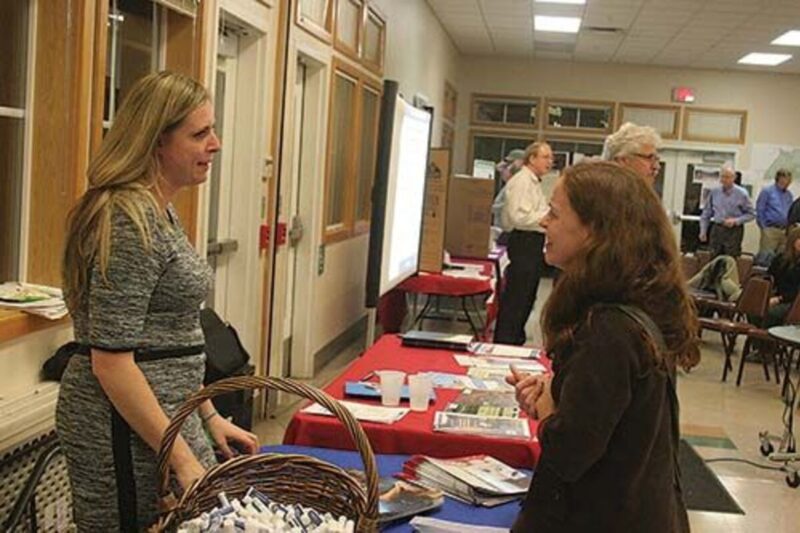
More than 50 people turned out Tuesday evening for a “Share Fair” that included displays by many of the agencies that impact or serve Sweet Home in various ways and which have been involved in collaborative efforts to establish a community forest and other activities in the area. Community participants got a chance to talk one-on-one to community members about current and anticipated projects happening in the Sweet Home region.
They also heard from Sweet Home City Manager Craig Martin and Sweet Home District Ranger Cindy Glick, both of whom have been instrumental in various collaborative efforts that resulted in Sweet Home receiving the Livability study, and George Fekaris of the Federal Highway Administration and Katie Allen of The Conservation Fund, the agencies that have produced the assessment.
Allen reviewed how the study came about and how the goal of the next day’s workshops was to put shoe leather on the recommendations in the report.
She showed multiple examples of what other communities have done to revitalize and preserve their appearance, character and unique traits as development occurred.
“This is your front door,” she said. “This is what people see.”
She said Sweet Home is “primed” to take advantage of the opportunities presented in the report.
“The momentum to do so is extraordinary,” Allen said, adding that she was basing that statement on her experience working in communities across the country.
Fekaris said the Livability program is designed to help Sweet Home, as a “gateway community” to the Willamette National Forest, improve its desirability and functionality as a place to live and visit.
He said that similar projects are or have been conducted throughout the Northwest out of his office in Vancouver, Wash.
About $22 million a year is spent on projects in Oregon, he said.
He said the program is not, technically, a grant program, although projects such as road and parking improvements along Quartzville Road can be done locally, such as by Linn County in the case of the $8 million Quartzville project – $7 million of which is coming from the FHA.
In the workshop on Wednesday, participants split into six groups, each tasked with developing an action plan to solve one or more problems in areas of transportation, tourist attraction and retention, job creation and economic development based on the assessment and its recommendations.
One point that was recognized clearly by participants was Sweet Home’s need to figure out what it is and where it wants to go.
Ideas and plans put forth by the working groups included:
n Using a variety of survey techniques to get input from residents and visitors on what they see in the community and what they like about it.
Group spokesman John Morrison of Brownsville, a member of the Visit Linn Coalition ad hoc group dedicated to increasing tourism in the county, suggested that with the data from such surveys, planners could discover “what people, in general, think” and “could propose what Sweet Home ought to be.”
n Putting together a marketing plan for business recruitment that emphasizes Sweet Home’s strengths – “why it’s so unique, so good,” and the values in the community.
Sweet Home City Manager Craig Martin, reporting for the working group that came up with the plan, laid out a calendar of due dates for research into who does this type of work, getting a list together of available commercial land in Sweet Home – which, he said, has largely been accomplished already, putting together a local team dedicated to meeting with prospects for moving into the community, identifying funding sources for such a plan, and determining who would be the leader in developing the plan – public or private, depending on where the money comes from.
“We want to promote Sweet Home to select businesses – based on what we want and what they want, go after them,” Martin said. “We don’t want to depend on some brochure sitting on a rack.”
n A “sag wagon” bus service to transport hikers, bikers and skiers to the mountains east of Sweet Home – similar to a very popular service on Highway 26 to Mount Hood.
Spokeswoman Gina Riley of the Sweet Home Police Department said the group had already, on Wednesday, identified where they could get a bus and would need to address other challenges in putting their plans into action, such figuring out what the needs of visitors who might use the service are, procuring a trailer to haul equipment and bikes, and volunteers to drive the bus and possibly act as tour guides.
n A jobs training program, focused on public lands, for youths entering the workforce and for military veterans. The group reported that it had set goals of identifying stakeholders – those who could benefit from the program – and obtaining their buy-in, identifying likely participants in the program among the target youths and veterans and figuring out what it would take to make it work and attract the targets’ interest, and identifying funding sources for such a program.
“We don’t want to just create something and shove it down people’s throats,” said group spokesman Keith Brown, who represents the Northwest Youth Corps.
“The goal is to actually put money in their hands.”
n Expanding Sweet Home Junior High’s Safe Routes to School program to other schools within the district. Group spokesman Ed Moore, of the state Department of Land Conservation and Development, noted that the junior high has never formally implemented its plan by taking it to the School Board for approval and said the group determined that the first step should be to do so, then ask the board to extend it district-wide. After that, he said, planners could take it to the city for approval and implementation in the form of improved sidewalks and road crossings where needed, and it could be incorporated into city transportation planning.
Moore, who noted that youngsters do not ride their bikes to school like he did when he was young, suggested that making it safer to get to school in non-motorized ways would help with the “child obesity problem” among youths in the state and the nation.
A “Share Fair” on Tuesday evening drew approximately 70 people to a display by many of the federal, state and local agencies that
n Develop strategies for marketing Sweet Home to increase tourist traffic and encourage visitors to stop in town. County Parks Director Brian Carroll noted that the state’s tourism commission, Travel Oregon, offers free marketing help to Oregon communities through its Rural Tourism Studio, but it is booked up through the year. Still, he said, Sweet Home should apply.
With the collaborative work done by the Oregon Solutions Team, the Sweet Home All Lands Collaborative and then the Livability study, he said, “I think you have a lot of leverage to get one here.”
Group spokeswoman Rachel Kittson-MaQatish said members determined that linkage among websites promoting the Sweet Home area, such as the city’s, the Chamber of Commerce’s and TrailstoLinn, which is a joint effort between The New Era and the Visit Linn Coalition, need to be improved. Also, she said, three kiosks planned for the Quartzville Road area, along with existing kiosks at the chamber, at Sunnyside boat ramp and at the Sweet Home RV park need to be updated with current and pertinent information about what Sweet Home offers.
She acknowledged that obstacles include lack of financial resources and fractured relationships between potential partners such as the chamber, the Sweet Home Active Revitalization Effort (SHARE) and other players.
John Morgan of the Chinook Institute for Civic Leadership, who has served as a facilitator for a number of Sweet Home planning efforts, including the formation of SHARE in 2008, wound things up with some hard questions for the participants.
Morgan began by saying “with all sincerity” that he enjoys working in Sweet Home “because the community spirit is a lot stronger than some other places.”
But he pointed out some difficulties common to the projects developed by the task force teams.
One was what makes Sweet Home special.
“What’s your hook?” Morgan asked. “What creates the unique, marketable in-state profit center here instead of somewhere else?”
Examples of what he was talking about, he said, were: Estacada, which has promoted its extensive frontage on the Clackamas River and has landed substantial testing facilities for water-based sports equipment from Nike; and Portland International Airport – “it’s 30 minutes from Cascades Locks, for Pete’s sake.”
Members of the marketing task force responded that that was exactly why they said they need a marketing firm, to help focus on such a message.
Morgan also said that he sees a lack of coordination and too much duplication of effort in Sweet Home.
“You’ve got a host of disparate groups working independent or parallel of each other. If you’re going to be successful, there has to be some kind of sustained energy that leverages every one of these things, every person and every entity,” he said, referring to the proposals made Wednesday.
Another challenge, he said, is money.
“All six projects cost,” he said. “Which is the priority? Is there a priority?”
Phil Ordway, who is one of the developers of the Santiam River Club project in east Sweet Home, responded that what Sweet Home has to offer is a “quality small-town lifestyle” and said a marketing firm would help formulate that message for prospective new businesses and residents.
“That’s just the skeleton,” he said. “We’ve got to put meat on the bones, but’s that what we sell: lifestyle.”
Michael Heath, who moved to Sweet Home from Las Vegas, Nev. three years ago, agreed, stating that the city offers “one of the best environments I’ve ever discovered in my life.”
Dave Bauer said one challenge is getting people to visit the town.
“We have all these maps and things, but people pass right on through,” he said. “We need to stop them here in Sweet Home.”
Morgan listed three things that he said could stop the projects from coming to fruition: lack of leadership, lack of participants and a lack of “20- to 30-year-olds.”
Audience members agreed. “Instead of trying to stretch already stretched people, bring in the 20- to 30-year-olds,” Ordway said.
“This is the most enthusiastic group I’ve seen since coming to Sweet Home,” said Heath. “Is there any reason why we don’t want more people in the room?”
Allen told the crowd that such questions and concerns are common.
“It’s not unusual to have these issues,” she said. “This is going to sound trite, but you need to take ownership upon what you’ve learned today. You need to stay in touch with one another.”
Morgan and others noted that results will help sell the effort to the public.
Diane Gerson, a retired school principal and former Sweet Home School Board member who participated in the workshop, put it in a nutshell: “If you prove tangible results, you will get people involved.”