



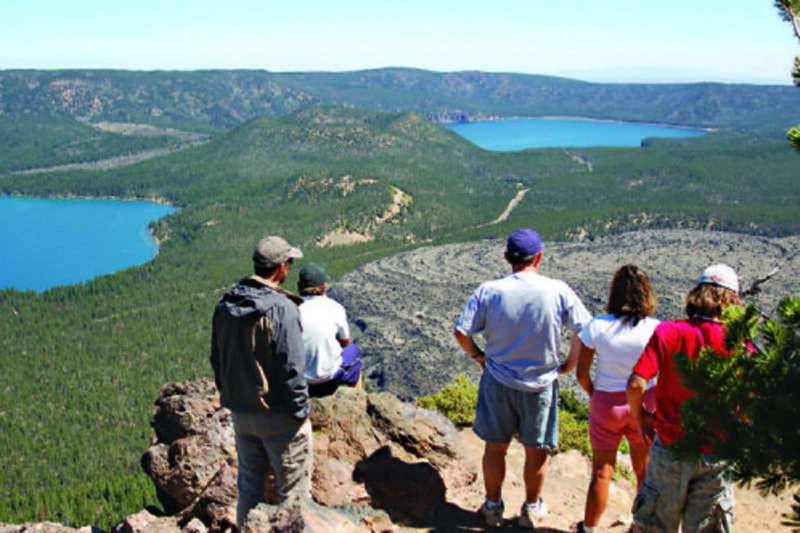
Newberry offers volcanic experience

It began with a sound like distant thunder – but the skies were clear.

Suddenly the ground shook for miles around. A volcanic vent opened on the inside of the caldera’s rim and began sputtering lava and pumice, eventually giving way to the main lava flow. The lava slowly snaked its way downhill, igniting, then burying every tree in its path.

The only people around to witness this fiery spectacle were Native Americans, as it occurred 1,300 years ago. Today, the Big Obsidian Flow in Newberry National Volcanic Monument is the youngest lava flow in Oregon.

Established by Congress Nov. 5, 1990, the monument was created in order to “preserve and protect for present and future generations Newberry’s remarkable geologic landforms.”

Newberry volcano itself is an amazing feature. Though not as distinct from a distance as its neighboring Cascade volcanoes, with a diameter of 20 miles Newberry is one of the largest shield volcanos in the lower 48 states. Over 400 cinder cones dot its flanks.

Although referred to as Newberry Crater, it is actually a caldera, wider than it is deep. The caldera is about five miles across and similar to Crater Lake in its formation.

Massive eruptions from the volcano eventually caused a collapse within and later filled with a lake. In the case of Newberry, continued eruptions caused the large lake to split into two lakes, Paulina and East lakes.

At 250 feet, Paulina Lake is one of the deepest lakes in Oregon (Crater Lake, at over 1,900 feet deep is the deepest lake in the U.S.). East Lake is 180 feet deep. The lakes boast excellent fishing for rainbows, browns, Atlantic salmon and kokanee.

My wife and I spent most of the last week of September at Newberry, splitting our time between stays at East Lake Resort and Paulina Lake Lodge.

“This place is spectacularly beautiful,” said Rob Morrison, co-owner of East Lake Resort. “It’s just a real nice mountain lake and it’s great just to sit and look out at the lake and have a campfire.”

The No. 1 attraction at both East Lake and Paulina Lake is the renowned fishing, especially for brown trout. The biggest brown trout ever caught from East Lake (22½ pounds) is hanging on the resort’s wall. They also have a big rainbow trout mounted on the wall.

“One lady in August caught a 25-inch brown trout but I’m not sure what it weighed,” Morrison said. “Anglers also go after rainbows and kokanee. Lots of anglers catch 12- to 14-inch kokanee. The rainbows range from 15 to 18 inches. Anglers also catch some Atlantic salmon. About half the anglers here are fly fishermen.”

There are several options for hikes within the caldera. One of my favorites is the Newberry Crater Trail, which starts at the Cinder Hill Campground near the resort. The trail climbs steadily to the rim. Once there, turn right and head east just over a mile to the Cinder Hill viewpoint, which provides a great panoramic view of the entire caldera. The round trip is about six miles.

“People can take the short walk to the hot springs along the south shore of the lake,” said Morrison. On a chilly fall morning those hot springs sure felt great.

A short hike that the entire family will enjoy is the trail out onto the Big Obsidian Flow, a loop less than a mile in length. I think the Big Obsidian Flow is the most interesting feature of the monument.

One hundred seventy million cubic yards of lava and pumice erupted from a vent in the volcano. At about a mile long and a mile wide, the area covers about 640 football fields. The flow averages 150 feet thick or about the height of a 17-story building. The lava consists of 90 percent pumice and 10 percent obsidian. During the eruption the lava heated to about 1,600 degrees Fahrenheit.

For a longer hike, take the Forest Service road to the rim, which goes up past the RV park at the resort. Once at the rim, hike the Rim Trail to the west towards Paulina Peak, then take the trail to the pumice plain and the Big Obsidian Flow. From here the Lost Lake Trail heads down along the flow. It’s best to have two vehicles for this hike, or start at the parking lot for the Big Obsidian Flow and hike up and back along the flow to the pumice plain.

After staying at East Lake Resort we headed over to Paulina Lake Lodge and stayed at another rustic cabin. All the cabins at both resorts have full kitchens and bathrooms with showers. Todd and Karen Brown have owned the resort since June 2000.

Of course Paulina Lake is known for its trophy brown trout, the state record coming out of the lake at a whopping 28-pound, 5-ounces. The biggest brown caught at the lake this year was 15 pounds. Todd said that ODFW recently introduced triploid rainbows in the lake, which can grow quite large. The biggest rainbow caught this year was six pounds and the biggest one to come out of the lake weighed around 18 pounds.

From the lodge there are several hiking options. It’s a short walk (0.3 miles) to Paulina Creek Falls, a 60-foot high side-by-side waterfalls. We got to see a pair of dippers in the creek on the way to the falls.

The 7 1/2=mile Paulina Lakeshore Loop Trail circles the lake and provides great views of the lake as well as Paulina Peak and the Big Obsidian Flow. There are even some hot springs along the way.

There is also access to the Crater Rim Trail from the lodge. The 22-mile trail follows the caldera rim and is popular with mountain bikers and horseback riders.

Both resorts closed the end of September. East Lake Resort will reopen Memorial Day and Paulina Lake Lodge reopens Dec. 26 for the winter. Both are already taking reservations for next year. Visit their websites or call (541) 536-2230 for East Lake Resort or (541) 536-2240 for Paulina Lake Lodge to make reservations.

Total
0
Share