



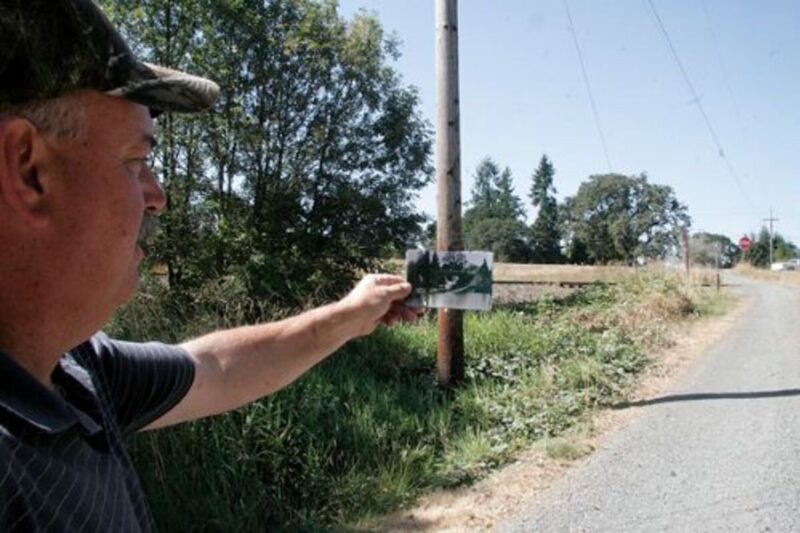
Next stop: Court?

Country Lane residents, faced with legal action, say they want a judge to rule whether they must pay Albany & Eastern

to cross its railroad line

By Scott Swanson

Of The New Era

Owners of eight residential properties along Country Lane are the subjects of a complaint filed Jan. 25 by Albany and Eastern Railroad Co. of Lebanon, accusing them of trespassing after they refused to pay a fee levied by the railroad to cross its tracks west of Sweet Home.

Residents along the railroad line between Lebanon and Sweet Home received letters last fall from Albany and Eastern, informing them that they needed to provide proof of $1 million worth of insurance and pay $720, including an annual “maintenance fee” of $120, to maintain the railroad crossings to their homes or businesses.

Neighbors of the railroad, who have met together on several occasions, have generally agreed to hang tight, they have said. Some, though, have paid the fee or are working with the railroad on getting the required insurance, an attorney for the railroad said.

Both sides acknowledge that the Country Lane matter appears to be headed to court.

In the complaint, the railroad states that the residents of the eight homes on the private road are trespassing because “they have been placed on notice that they have no easement to cross (A&E’s) property but continue to do so” despite the railroad’s offer to reach an agreement, which the residents have refused.

The railroad contends in the complaint that the residents’ “unlawful crossing” of its property poses a risk of accident and damage, which has increased its own insurance premiums.

Albany and Eastern is asking for “nominal damages” and attorney’s fees and court costs associated with its action. It is also requesting from property owners all documentation relating to their ownership of their Country Lane parcels and any rights they claim to have to cross the railroad line. It is also asking for proof of costs for any work the residents have done to maintain or improve Country Lane and any correspondence – written or e-mail – related to the disagreement with Albany and Eastern over the crossing.

The complaint names Michael and Cindy Martell, John and Elaine Harcrow, Jeffrey and Beverly Kaiser, Joanne Fagan, Ray and Michelle McMullen, Jeremy and Karen Orr, Richard and Jill Hutchins and Laura Mithoug, all residents of the Country Lane, a dead-end cul-de-sac-type road that faces onto Highway 20 across from Harmony Road.

Neighbors, said Martel, a leader of the Country Lane group, believe the railroad has targeted them and that it has handled the matter poorly, particularly since they were already having problems with flooding on their crossing before the fee issue ever came up.

The railroad, said attorney John E. “Tre” Kennedy of Lebanon, who is handling the Country Lane complaint, and crossing agreements made with other landowners, simply wants “a legal right in place for them to use the crossing. We want to make sure those who cross the tracks have a right to do so.”

The railroad also wants insurance coverage – at least $1 million worth of homeowner’s, farm owner’s or automobile insurance, that covers each property owner’s crossing to cover any accidents or damage that might occur on its land.

Kennedy suggested in a letter, dated last Oct. 18, to Martell and the other seven Country Lane property owners that they form a homeowners association, of sorts, and pay a total permit fee of $1,000 and an annual maintenance fee of $600. He said Albany and Eastern would also accept a $2 million insurance policy covering all eight properties instead of requiring each property owner to carry their own $1 million policy.

Martell said he thinks the railroad has singled out him and his neighbors “on the premise that we’ll just cave in.”

He questions the legalities of the railroad’s contention that it has the right-of-way at all crossings of its line and it has the right to charge neighboring property owners a fee to help pay the cost of maintaining those crossings.

“Over the last 100 years there were deeds that have come and gone,” he said. “Some of these people were illiterate and just signed with an ‘X.’ When Burlington and Northern owned it, we never heard anything about fees.

“If you take the intent of a rational-thinking farmer back in the 1920s, they worked out an easement so the railroad could come through.”

He said residents also have questions about the fact that Burlington and Northern did not charge some people and how that fits into “squatter’s laws.”

“After seven and a half years, according to Oregon law, you start to forfeit your rights,” he said. “It’s a complex matter.”

Kennedy acknowledged that the Country Lane neighbors were selected for the trespassing complaint because their situation is “unique” in that more people use the crossing than most others along the railway and because of their lack of cooperation.

“The majority of the residents, certainly, have been working with the railroad,” he said. “Basically, none one of them (the Country Lane neighbors) would work with us.”

Martell said he and other residents are upset by a lack of response to complaints he said he has made to the railroad over culverts installed by Burlington and Northern, the previous owner of the line, after a storm washed out a section of the railroad in 1996.

He said he has complained about flooding that occurs just below the rail crossing, on what he said is land claimed by the railroad as its right of way, but the problems have not been fixed.

“If I were to put an excavator down and clean out those culverts, I’d be trespassing,” he said. “We have people who couldn’t get across when it was flooded. I told (railroad representatives) either to fix it or I’d fix it myself.”

Martell said that is one reason why Country Lane residents aren’t eager to pay up.

Kennedy said the railroad is not eager to go to court.

“In no way did we want this to end up in litigation,” Kennedy said. “That is our last resort.”

Martell said he believes the problems largely stem from unreasonableness on the railroad’s part. He said he hopes local legislators will pursue the matter in the session that started Monday, Feb. 4, but he is eager to go to court.

“In a court of law, with rational people as judge and jury, they can listen to it,” he said. “We just want a reasonable solution. I guess that’s what we have to get from a judge and jury.

“We have 30 days to respond and we do not plan to pay.”

Total
0
Share