



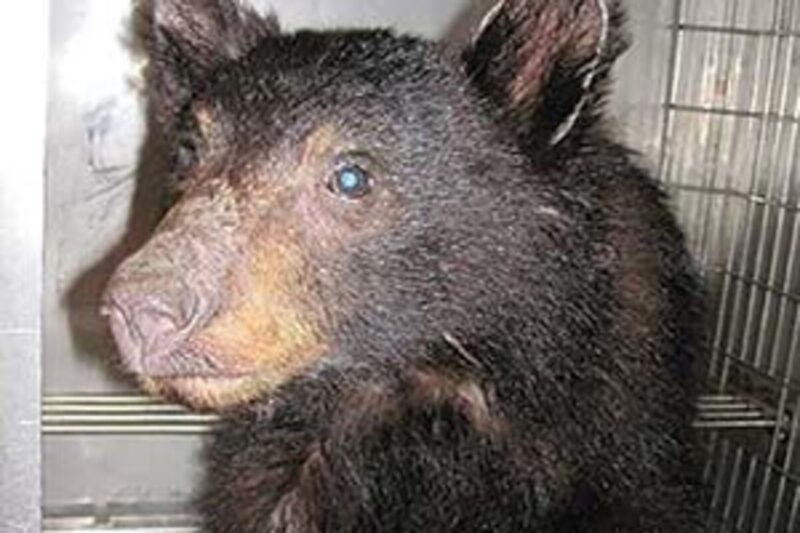
A yearling bear cub that begged for food from campers in the Yellowbottom area during Memorial Day weekend was collected by Oregon State Police and may end up in a zoo, officials said last week.
The bear is seriously underweight and can never go back to the wild, Oregon Department of Fish and Wildlife officials said.
Campers above Green Peter Reservoir reported the animal begging for food and showing no fear of humans.
ODFW state wildlife veterinarian Colin Gillin believes the bear may have been taken from the wild as a cub early last summer and then released before winter, after it had become accustomed to humans.
“Someone may have picked it up, thinking it was orphaned, kept it for a while, and then returned it to the forest,” he said.
The bear is very thin and weighs 25 pounds. Hair loss on its back and rear also indicate malnourishment.
Due to its habituated behavior, it cannot be released back to the wild. If the bear’s physical exam tests show that it is healthy, Gillin will seek out an accredited zoo to take it.
“We receive bear cubs every spring and summer,” he said. “Those that have spent the winter without a mother are in fairly tough shape and very malnourished by spring.”
Similar problems occur with deer fawns, elk calves and other young wildlife picked up by people at this time of year.
ODFW district offices across Oregon are getting calls from people concerned about “orphaned” fawns and calves they find huddled up in the forest.
“The mother deer or elk is usually not far away and will return for her young if they are left undisturbed and people are not around,” says ODFW Baker District Biologist Brian Ratliff, who recently counseled a man to leave an elk calf he found on the Wallowa-Whitman National Forest alone.
“Never assume an animal is orphaned. If you saw the parent killed or the animal is injured, call ODFW, Oregon State Police or a wildlife rehabilitator.”
Unfortunately, people do pick up fawns, calves or other young wildlife and take them home this time of year. While they might be well-intentioned, this can lead to the animal’s early death.
Young animals taken from the wild miss the chance to learn important survival skills from the parent animal like where to feed, what to eat, how to behave as part of a group and how to escape from predators. Research on deer shows that fawns that miss this vital learning rarely survive as long as their wild-reared counterparts, even after care by a licensed wildlife rehabilitator.
If an animal is injured, or truly orphaned, it needs special care. Oregon’s 40 licensed wildlife rehabilitators have the knowledge and facilities to provide this care. They use methods that limit human interaction and mimic the animal’s natural lifestyle as much as possible, so the animal has the best chance of survival when returned to the wild.
Taking animals out of the wild, transporting them, or keeping them at home are all violations of state law. Earlier this month, Oregon State
Police cited an Eagle Point woman for unlawful possession of a prohibited species for keeping a half-blind western pond turtle as a pet for seven months. She picked it up off Highway 62 north of Eagle Point last October and took it home, where she fed it peanut butter, mushrooms and worms. Its eyesight worsened in the second eye due to infection.
She eventually gave the turtle to Wildlife Images Rehabilitation Center in Grants Pass, where antibiotic treatment improved its eye infection and restored sight in one eye. The turtle was released back to the wild in the Agate Lake area last week.
Follow these tips if you encounter young animals in the wild and never take an animal from the wild. If you see an injured or truly orphaned animal, call your local ODFW office, Oregon State Police, or a wildlife rehabilitator:
Deer, elk and other mammals:
Never assume an animal is orphaned. Don’t remove it from the forest, including your backyard. Female deer and elk and other mammals will often leave their young temporarily for safety reasons or to feed elsewhere. They will return when it is safe to do so (when people, dogs, or predators are not present).
Call your local ODFW office, Oregon State Police office, or a local licensed wildlife rehabilitation center when: 1) you see an animal that you know is orphaned because you observed the dead parent animal, or 2) the parent hasn’t returned for several hours or even up to a day, or 3) if the animal is clearly inured or in distress.
Bunnies are rarely orphaned; mother rabbits only visit den sites at dusk and dawn to feed her young.
Keep your dog or cat away from young wildlife, especially in the spring. If you see a seal pup, young sea lion, or other marine mammal that appears stranded or in distress, contact OSP’s hotline at 1-800-452-7888.
Free Fishing Weekend in Oregon is June 6-7, and a number of events are planned around the Willamette Valley to help people make the most of this opportunity.
During Free Fishing Weekend, fishing licenses, tags and endorsements are not required anywhere in Oregon.
To provide a little extra incentive to get out and join the fun, the Oregon Department of Fish and Wildlife and several of its partners are planning organized fishing activities on Saturday, June 6. At most of these events, fishing gear, bait and instruction will be provided.
In Linn County, Roaring River Hatchery will be open from 9:30 a.m. to 2:30 p.m. to youngsters 12 and under. Contact person is Luke Allen at (503) 394-2496.
In addition to these locations, many other lakes, ponds and streams in the region will be stocked with trout. They are listed at http://www.odfw.com under the Fishing tab, along with additional fishing information.
Though fishing licenses are not required all other regulations apply, including those pertaining to catch limits and size restrictions.
Free Fishing Weekend also coincides with State Parks Day, so if you’re going camping or hiking in an Oregon State Park this weekend, be sure and take a fishing rod along.
* * * * *
As of Monday, June 1, the Bureau of Land Management prohibits the use of fireworks and exploding targets on all BLM-managed public lands throughout Oregon and Washington. The ban will be in effect through Oct. 15.
This year’s low snowpack combined with warmer than normal weather patterns over much of Oregon and lower elevations in eastern Washington may boost the potential for possible wildfires. In recent years we’ve had longer fire seasons. Fires are burning hotter and longer fueling the costs of fire suppression.
Those who ignite fireworks or exploding targets on BLM-managed lands can be fined up to $1,000, receive a prison term of up to one year, or both. In addition, individuals responsible for starting wildland fires on federal lands can be billed for the cost of fire suppression.
ODFW has enacted a new fishing regulation on the South Santiam River around Waterloo Falls to thwart illegal fishing practices that, the agency says, harm endangered chinook and steelhead.
Fish can become crowded at the Waterloo Falls as they migrate upstream to their spawning grounds, making them especially susceptible to “snagging” and “flossing” – two fishing techniques that are illegal under Oregon sport fishing regulations.
Oregon State Police have issued numerous citations for snagging at this location in the past and takes multiple snagging complaints from the general public every year, according to Elise Kelley, ODFW district fish biologist.
The new rule on the South Santiam is patterned after similar regulations on other Oregon rivers where illegal snagging has been a problem. It imposes gear restrictions – namely, limiting anglers to the use of fly and bobber fishing gear – that not only makes these illegal and unsportsmanlike fishing techniques more difficult but also easier for law enforcement to detect.
The gear restriction is effective from Waterloo Falls downstream to the Waterloo Road Bridge, a distance of approximately 500 ft. In this area, bobber angling gear must include a bobber and a leader no longer than 36 inches in length.
Any weight (except the bobber) may be no more than 36 inches from the lowermost hook when suspended vertically. The leader below the bobber must remain suspended in the water column and not resting on the river bottom.