






In dozens of school districts, parents have opted their children out of federally mandated tests at rates that undermine accountability.
By James Neff and Khushboo Rathore
Oregon Journalism Project
Oregon’s public school assessments for math, science and English language arts have edged up for the second year in a row.
Test scores released Sept. 24 by the Oregon Department of Education showed statewide proficiency increased by 1.4 percentage points in math, 0.8 percentage points in English language arts, and 0.6 percentage points in science.
Still, the scores are significantly lower than corresponding scores before the pandemic.
“These results give us reason to be encouraged, but also reinforce how much more there is to accomplish,” said ODE director Charlene Williams.
Each year, Oregon students in grades 3 through 8 and 11 take statewide tests in English language arts and math. The goal of the tests is to help show how well Oregon schools and the state education system support students’ academic success. (Students in grades 5, 8 and 11 also take a science test.) The scores are banded into levels 1 through 4, with students in levels 3 and 4 considered proficient.
ODE noted as a positive development that up to 0.3% fewer students opted out of taking the statewide tests, which is required by federal law but is enforced by the state. Oregon does not penalize districts that don’t meet the federal 95% participation rate because Oregon lawmakers passed the nation’s most aggressive opt-out law in 2015.
About 90% of students participated in the tests overall, according to the ODE data release.
But according to an OJP analysis, 14 of 197 districts didn’t report participation rates for at least one subject and 27 other districts reported opt-out rates higher than 20%. Higher than 20% reduces the usefulness of students’ scores as an indicator of success or a marker for areas of needed improvement, experts say.
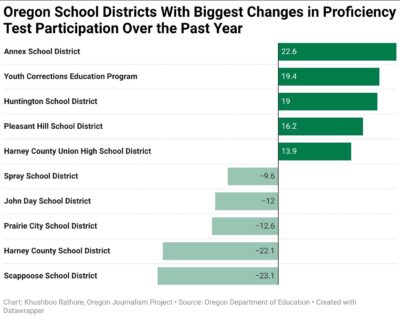
Low statewide participation also limits Oregon’s ability to put state scores on a common scale for comparison with other states.
ODE singled out several districts Sept. 24 for improved scores, including the South Umpqua School District, where Latino students achieved an 11.6 percentage point increase in English language arts proficiency in one year.
Among the myriad results for each school and subgroup of students, one result continued to stand out. Nearly half of eighth graders were graded as Level 1 in math, meaning they “consistently fail to demonstrate grade level knowledge and skills.” This past school year, only 30% of eighth graders were proficient in math.
Educators and researchers consider third grade reading and eighth grade math proficiency as key markers foretelling academic success and gainful employment.
Christine Pitts, head of Open School, a private nonprofit alternative school, formerly led research and evaluation at Portland Public Schools. Despite this year’s small gains, she was alarmed that 48% of Oregon’s 8th graders scored at Level 1 in math and, for those in poverty, 66%.
“We aren’t talking enough about the students in Level 1,” she said. “How far behind are they? Why did they fall so far behind? What are we doing to catch them up, and by when should we see real progress?…We can point to progress and celebrate hard work, but families and our community deserve to know the plan to address this crisis.”
READ MORE: Oregon Schools: What Went Wrong