




Sean C. Morgan
Of The New Era
Sweet Home Police Chief Bob Burford is reminding local drivers that they need to remember particular traffic safety rules now that the school year is under way.
Stopping for school buses
When drivers do not properly stop for buses with flashing red lights, Sweet Home police send a letter to the registered owner of the vehicle violating the law. Bus drivers report the license plate numbers to police.
Burford said of the number of violations so far this year has been “average.”
“There’s always a bit of an upsurge at the beginning of each school year,” he said. “Apparently, drivers fall out of the habit of watching carefully for school buses over the summer, and it takes them a while to catch back up with the law and etiquette each September.”
Drivers are required to stop for buses when their red lights are flashing. This rule applies to all lanes of a road. The only exception is for oncoming traffic when the oncoming lanes are separated by a median.
School zone
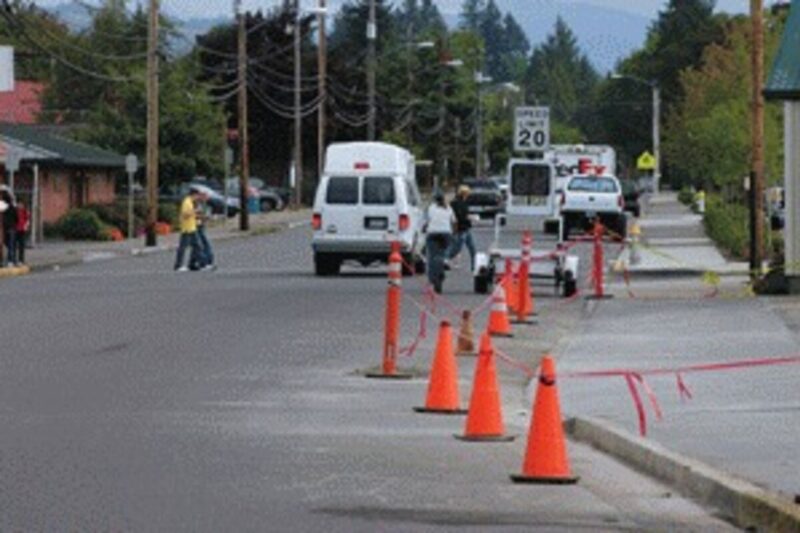
The school zone speed limit that went into effect last school year will remain in effect until July. Under that law, school zones are 20 mph all day when they are within a speed limit zone of 30 mph or less. Speed zones higher than 30 mph are marked by specific times the school zone speed limit is in effect or by flashing lights.
After July, all school zones will be in effect from 7 a.m. to 5 p.m. on school days or when lights are flashing, City Manager Craig Martin said. The delay in implementing the new school zone law allows cities and other jurisdictions time to change signage.
The revised school zone law addresses the many complaints the Oregon Legislature received about the existing school zone law, according to a League of Oregon Cities summary. Citizens complained that the 20 mph school zone speed limit was in effect even in the middle of the night.
Crosswalks
Drivers must yield right of way to pedestrians when they are approaching a lane adjacent to the driver. They must remain stopped until the pedestrian has cleared the next lane adjacent to the driver. Drivers also must stop for vehicles that are stopped at a crosswalk.
Crosswalk violations are common in Sweet Home, Chief Burford said. “I probably see it more because I have an unmarked car, and I’ll make a stop every time on that.”
One of the more problematic areas is 13th and Main, Burford said. Often a vehicle will be stopped signaling a left turn, and other vehicles will continue on past the waiting vehicle.
Even if the vehicle is signaling a turn, other vehicles must stop, Burford said. Once the driver has determined that no pedestrians are using the crosswalk the driver may continue.
Emergency vehicles
When an emergency vehicle’s lights are flashing and visible, drivers must immediately pull as far to the right as possible and stop, Burford said.
Often, people are busy fiddling with their stereos or something else, Burford said. When they finally notice an emergency vehicle behind them, they often pull off to the left, into the turn lane, for example.
Drivers need to pull off to the right, Burford said. If an emergency vehicle is going to pass, it will pass on the left.
A law that went into effect last year requires drivers to slow down and give emergency vehicles and personnel space when they approach a stopped emergency vehicle with lights flashing.
For example, if a police officer has a driver pulled over on the shoulder on a highway with four or more lanes, drivers must pull into the left lane and slow down. On two-lane roads, where there is no additional room, drivers must slow down and give as much space as possible.
“We are right now evaluating the procedures for how police officers conduct traffic stops in order to make them safer for the officer and the person that’s been stopped,” Burford said. “Over the last 10 years, there have been lots of police officers killed or injured on traffic stops.”
Changes could include how officers position their vehicles and whether officers continue to approach from the driver’s side or begin using the passenger’s side of a stopped vehicle, Burford said.
“When it first came out, we stopped a couple of cars for not doing (giving space),” Sgt. Jason Van Eck said.
For many years it was not a requirement, Burford said, but it is a courtesy too. He asks that drivers do it.
“We may very well, in the future, step up on our enforcement efforts in that area,” Burford said.
For drivers who do not get out of the path of emergency vehicles, Burford warns that police officers may not be able to deal with it on police calls, but they will watch for people failing to yield to ambulances and fire engines.