



Sean C. Morgan
Of The New Era
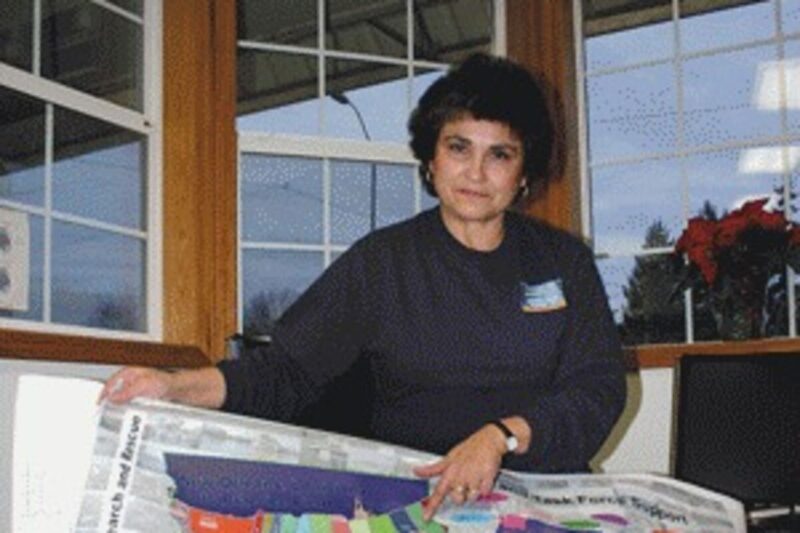
Lupe Wilson thinks the U.S. Federal Emergency Management Agency has gotten a bad rap over Hurricane Katrina.
Wilson of Sweet Home, a U.S. Forest Service employee who assisted in the post-hurricane relief effort in Louisiana, got an up-close look at how FEMA, which took heavy criticism from hurricane victims and from state and local officials in Louisiana and Mississippi, operated.
Sure, FEMA had problems, Wilson said, but those were mainly in the way the agency spent money.
FEMA was moving into Louisiana and Mississippi quickly following the hurricane, using what it had learned from the Sept. 11, 2001 attack on the World Trade Center, Wilson said. FEMA tapped the Forest Service and Bureau of Land Management for incident management, and those crews were moving right away.
Wilson works for the Sweet Home and Detroit ranger districts. She was sent to New Orleans on Sept. 22. She returned on Oct. 10. Abby Dalton, a Sweet Home High School graduate working for McKenzie Ranger District, also was on the team.
The incident management teams from the Forest Service and BLM primarily handle fires, Wilson said, but FEMA used them in New York City for the 9/11 emergency and again for the hurricane response.
Wilson served on an incident management team, comprised of personnel mostly from the Siuslaw and Willamette national forests, working in the New Orleans area, she said.
Wilson has been with the Sweet Home Ranger District since 1988. She has been “Time-Out Leader” on her incident management team for nine years.
“I make sure that people go get paid,” Wilson said. She tracks hours and invoices for the various contracting agencies and businesses.
This was the first time most members of her 33-member team had worked on a non-fire emergency, Wilson said. “This is the first time most of us have ever worked with FEMA.
“What happened is the government found out (it) can use them for other disasters (other than fire),” she said.
Based on her experience with the interagency effort, “I think the government got a bad rap,” Wilson said. “Within a couple days, incident management teams were activated.”
The fault for the problems in New Orleans rests locally, Wilson said, with the city and parrish.
“If Foster (Dam) broke, it would flood Sweet Home,” Wilson said. “The city needs a plan in place. New Orleans needed a plan. They did a poor job with that kind of thing.”
Buses should have been moved and used, Wilson said. Instead, they were left in the flooding city unused while people also remained in the city.
Disasters like this help agencies learn, Wilson said. “Our teams need to better understand how FEMA operates.”
And FEMA needs to learn more about the incident command system, Wilson said. To that end, FEMA employees and Forest Service and BLM employees are teaching each other about their procedures in preparation for future emergencies and disasters.
“We need to learn from this,” she said.
FEMA’s biggest problem in responding to Hurricane Katrina was not having “preseason” agreements in place before the disaster. Instead, the agency made deals following the disaster, pushing up costs for supplies and services.
FEMA should already have had some kind of agreement with the Saints football team to use its practice field, Wilson said. In one case, the agency spent some $1.2 million putting up a tent to house emergency crews and another $450,000 taking it down.
Locally, agencies have such agreements for responding to fires, Wilson said. In FEMA’s case it was “all of the sudden, they need it right away,” creating the possibility of “price gouging.”
Wilson worked in logistics, getting food, supplies, showers and more to the emergency crews working in New Orleans, similar to what she does on a forest fire. When she works on a forest fire, she helps get needed resources to a site.
Her team also created plans for emergency crews to follow as they worked different areas in New Orleans. Her team was stationed at the Saints’ practice field. Members of her team pitched tents in the Saints’ weight room. More than 900 workers slept in cots spread across the Saints’ practice field.
After FEMA search-and-rescue workers left New Orleans on Sept. 30, her team supported a 300-bus transportation system used to get workers, National Guardsmen and others who were authorized in and out of the city.
“What this disaster meant, knowing that this is a national disaster that is the biggest in U.S. history, being able to help and be a part of that, I’m glad I didn’t miss that,” Wilson said. “You’re kind of numb seeing it all.”
The city was deserted except for search and rescue crews, National Guard and police officers, Wilson said. “It was just eerie to see this in a big city.”
Wilson said the experience also made her stop and think, “If you had to leave your house within an hour, would you be have what you need in place?”
Many people didn’t have time and lost important documents, ranging from licenses to Social Security cards they needed to even get help, Wilson said. The people of New Orleans lived in the constant knowledge that levees holding seawater out of their city, which sits below sea level, could break, but many weren’t ready.
A camp crew leader working with Wilson talked about how his grandmother had told him the levees would probably break, but “maybe not in my lifetime or yours.”
After the hurricane, people asked “where’s the government?” Wilson said. “There’s a system in place to activate the incident command system, and incident management teams activated right away. I don’t agree with everything (President) Bush is doing, but there are systems in place.
“It was good training. This is going to happen again. Hurricanes are going to come.”
When they do, FEMA will be able to respond with the help of incident management teams from other agencies, she said. FEMA is able to tap the experience of crews who regularly deal with similar issues while fighting fire.
“It’s made FEMA realize the need to do things preseason,” Wilson said. “It’s government money. I have to watch money in my household. I’m a taxpayer.”
Wilson said that, like everyone else, she works hard for her money and tries to save, and she doesn’t like it when people use a disaster as an excuse to rip off the government.
“It upsets me because I’m a taxpayer too,” Wilson said. “It is not a blank check,”