


Sweet Home Fire and Ambulance District’s Budget Committee approved a $7,370,500 proposed General Fund budget for 2026-27 for the district at their annual meeting on Tuesday, May 19.
The budget will go on to the district Board of Directors on June 16 for final approval. All five directors – Charlene Adams, Larry Johnson, Dawn Mitchell, Jim Yon and Rob Younger, are part of the Budget Committee along with Brent Gaskey, Debbie Paul, Sasha Roebeck, Wally Shreves and Kevin Strong.
All were present for the approval vote, which was unanimous, though Gaskey arrived late.
Chief Nick Tyler summarized the budget, noting that the 11.77%, $776,457 increase from 2025-26 reflects increased personnel costs and inflation, ongoing capital projects, “and continued investment into district reserves and emergency response capabilities.
Specifically, Tyler said, the budget “continues to prioritize operational readiness, firefighter safety, training, and apparatus reliability.”
He said the district has experienced increased costs in personnel, dispatch services, equipment maintenance and operational supplies, which, he said, “continue to impact emergency service delivery throughout the fire service industry.”
Tyler told the committee that the district is fully staffed, after the swearing in of Tanner Funk as a lieutenant, filling the one open position.
Tyler said the district has been “fairly responsible” in how it spends its money.
“We had almost $1 million in expenses last year, but a lot of that was grant dollars,” he said.
He said the district is in good shape, equipment-wise, for the time being, with two new ambulances set to be delivered this year, one expected in the next week.
Plus, SHFAD has two Type 6 brush engines on order, which are also expected “soon,” he said.
“In the next three to five years, I don’t see any major apparatus purchases necessary,” he said.
Fire departments nationwide are struggling with funding issues, he said.
“Apparatus is not in a great state across the nation.”
He said the fact that the district is well-stocked at present gives it time to plan for when it will need new apparatus.
“A new engine in 2026 costs $1 million,” he said, adding that a “more generic” engine might range from $600,000 to $700,000. “But we need to plan for seven figures. Not having to purchase now gives us time to plan.”
He said fire engines have “a certain life span” and the district has one that “we were thinking of surplusing, but we decided to keep it. If something happened to one of our other engines, we’d rather have that than go buy someone else’s headache.”
Tyler and union representatives at the meeting reported that negotiations went well this year and union President Casey Topp said the new contract had been ratified by union members.
Tyler said the union is aware of the increased costs the district is facing, particularly for healthcare, and “now, in partnership with the union, we’re going to try to figure out how to move forward and share some of those costs when they get to the point of breaking the district.”
Strong, serving as committee chair, asked about the risk of budgeting for wildland firefighting activities in other regions of the state that may not happen.
Tyler responded that there is “risk,” but noted that the district’s wildland crew is also doing fuels mitigation work, and that last summer’s fire situation was “light.”
“We have plenty of work here, locally, to keep us busy,” he said.
Strong also asked about SHFAD responses to Blue Pool, one which occurred recently, and other distant locations, noting that “the revenue may not be there.”
Tyler acknowledged that “it’s difficult,” noting that a recent rescue operation at Blue Pool took staff away from the district for 10½ hours.
“On a day like that, what happens to the department?” Strong asked.
“It cuts our staff in half,” Tyler replied.
He said other area agencies are struggling with staffing and finances, and “we’re looking at doing some different things” in regard to Blue Pool responses.
He noted that the Linn County Sheriff’s Office’s Search and Rescue team “has been doing a good job” and may be able to respond in the future to some calls that currently are handled by SHFAD.
Strong also asked about the district’s fuel bills and budgeting.
Tyler said he projected fairly accurately last year on the fuels budget.
“I shook the magic eight-ball just right and we were right on track on fuel,” he joked. He later told the committee that total was $65,000, which he as increased to $90,000 this year.
Johnson suggested that the school district, for which Strong is business manager, and SHFAD might be able to work together to get better rates on fuel by increasing volume.
“You could talk about negotiating a price for six months or a year, and lock it in,” he suggested.
Board Meeting Actions
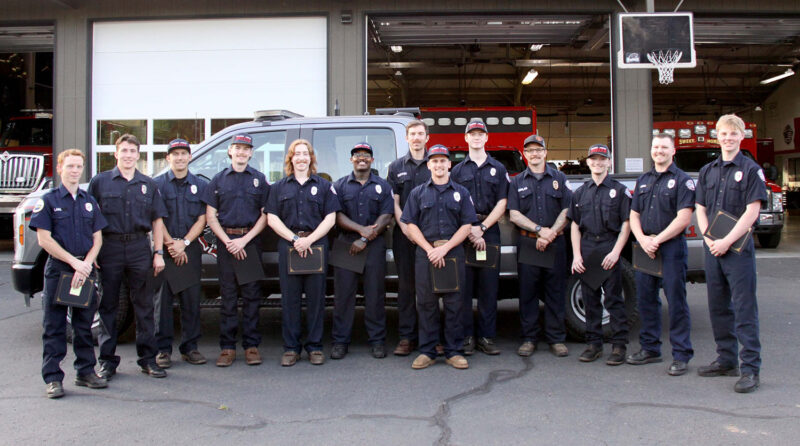
Tyler swore in Tanner Funk as the district’s new lieutenant and 12 members of this year’s Wildland crew: Braxton Bilby, Luke Bloedel, Rusty Brand, Daniel Dodd, Cody Gustafson, Owen Kent, Bryce Koehne, Jack Lang, James O’Neal, Laird Pettner, Will Shippen and Sean Whalan. Three others were not present for the ceremony.
Board members also agreed to do a walk-through visit at the newly upgraded Station 23 in Crawfordsville at 4 p.m. on June 9.
SHFAD Grant Applications
Battalion Chief Shannon Pettner reported on her efforts to gain seismic grant funding for upgrades to Station 24 in Cascadia, and an adjacent residence that will eventually house firefighters, similar to work that was done at the other three stations.
She said it would cost the district $12,000 to write the grant and submit it, but that if SHFAD doesn’t get it, they could keep submitting the same grant application.
Board members voted unanimously to go forward with the grant.
Pettner also reported that she’s hoping the state will reinstate community wildfire risk reduction grants for seasonal wildfire protection staffing.
She also said SHFAD is working on grants that would backfill reimbursement shortfalls from Medicare, Medicaid and other programs.
Plus, Pettner said, she’s working on a grant that would provide an “EMT Basic” program to give up to 24 high-school students an opportunity to earn their EMT certification before graduation.
“There’s a shortage of EMTs in Oregon,” she said, adding that she hopes students who get certified “will want to go on.”
She said she’s also working on a grant that through ODOT for up to $5 million in funding over three years to reduce accident fatalities by providing improved post-crash care capabilities. The program would provide “blood products,” she said, to prevent victims dying of blood loss before they reach the hospital.
Tyler said the department is also working on a Community Paramedic program that would provide post-hospital check-ups in the community.
He gave the example of a patient with a fever and pneumonia, whom medics transport to the hospital.
“We take them to the hospital to get antibiotics, because that’s what you need for that,” he said. “But then they don’t get it filled or don’t take it. We would provide followup.”
Pettner noted that the program would also include crisis intervention and mental health.
She and Tyler cited the example of a patient who has had 10 visits from an ambulance over the past month for a diabetic issue.
“We’re going out on these calls, but we’re taking an ambulance,” Tyler said, adding that such trips deplete the department’s staffing. Plus, he added, there are “long lines” in urgent care, it may take “six or eight months” to see a doctor, and even for medics there are long waits at the hospital – “wall time,” Tyler called it, because things are busy in the emergency room.
“A lot of times, the discharge instructions are rushed,” he said, which contributes to confusion and lack of action on the part of patients.
Pettner also said SHFAD is looking to get an inflatable mattress that can lift patients on the floor, and a power steer chair, which “can take someone up stairs at the push of a button,” rather than requiring a full ambulance crew, who risk back injuries trying to lift patients.
“A lot of times we get called for things that are never going to be a transport,” she said. “:Those are things we don’t need an ambulance for if we have adequate equipment.”
“Under-served is a big buzz word,” Tyler concluded.