






In Oregon, ranked 11th for oldest population, many counties face disproportionate financial risks if Congress fails to prevent a projected 22% benefit cut by 2032.
By Khushboo Rathore
Oregon Journalism Project
Oregonians receiving Social Security benefits will see an increase of 3.6% in their checks starting January, the federal government announced Wednesday. That’s good news for the state’s economy, which has the nation’s 11th-oldest population.
But a state like Oregon, with a disproportionate number of elderly, is particularly vulnerable if Social Security’s trust fund reserves are depleted by 2032. At that point, incoming payroll taxes would cover only about 78% of scheduled retirement benefits, leading to an automatic cut of roughly 22%.
“There’s going to be downstream effects on housing, other kinds of assistance, Medicaid, Medicare” if nothing’s done, said Sarah Emmans, a public finance consultant. “It’s got a fiscal ripple effect.”
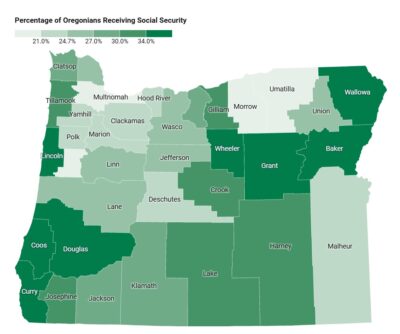
Social Security Administration data from December 2025 shows that 22% of Oregon’s population receives Old-Age, Survivors, and Disability Insurance, commonly known as “Social Security.” Twenty years ago, it was 17%.
Some counties in Oregon such as Curry County, where 44% of residents receive benefits, would suffer more. In Multnomah and Washington counties, only 16% receive benefits.
What makes Social Security different from other retirement funds is the consistency and stability it provides, Emmans said.
“This is like the bread and butter,” she said. “This is the one you can rely on. It’s not going to go up and down with your investment, your 401(k) disbursements.”
The benefits provide tremendous buying power and support jobs across Oregon, Emmans said.
People who receive disability insurance funds aren’t at risk if Congress fails to act. Reserves are in a separate federal disability insurance fund that isn’t projected to run out in the next 75 years.
Emmans doesn’t think a Social Security reduction will likely happen in 2032, but as more people become eligible for benefits and fewer are being born to pay in, a reckoning is inevitable.
“I just don’t know how many more times they can keep kicking the can down the road,” she said.