

Watershed projects improve fish passage, drainage in local streams

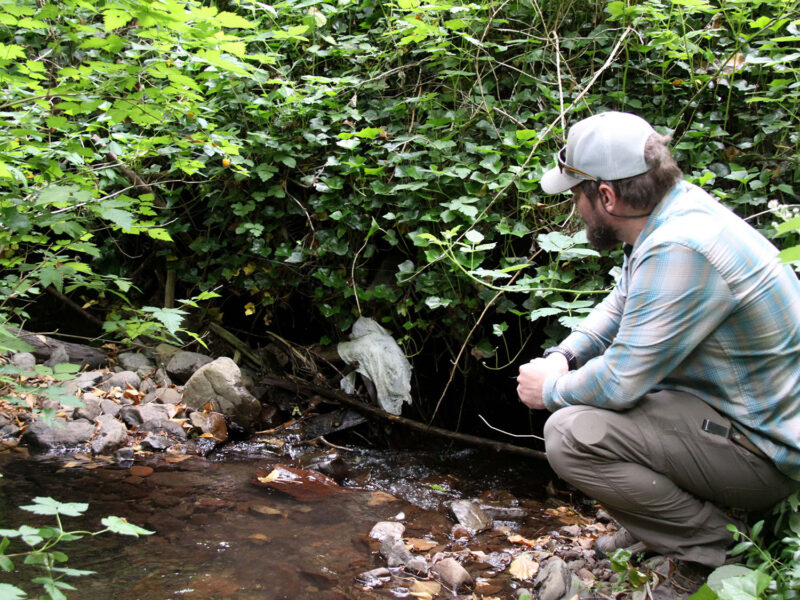
Tyrell Styhl inspects a culvert on Mouse Creek that is overgrown, undersized, and subject to clogging by trash and debris. A planned replacement is in the works. – Photos by Scott Swanson

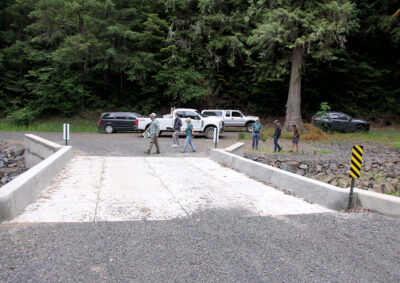
Upper Ames Creek was running a little low for late spring, roughly a foot deep in the main channel, earlier this month as members of the South Santiam Watershed Council pulled up to a brand new bridge at the AC 400 Line.

They were there to check out one of two projects recently completed with federal funding to improve stream flow and fish passage by replacing undersized culverts along local creeks..  Watershed Council Executive Director Tyrell Styhl and Alex Shoulders, watershed education coordinator, led the group of board members Marcia Morse, Scott Bruslind and Brian Rose, along with a reporter.

Tyrell Styhl, executive director of the South Santiam Watershed Council, center, leads a tour focusing on improvement projects, such as this new bridge on the Ames Creek 400 Line.

“There were two culverts here that were no longer functioning,” Styhl explained as the group spread out across the two-laned concrete bridge spanning the creek.

This is Hill Timber land managed by Cascade Timber Consulting, and CTC engineer Daniel Virtue was at the site, where he worked with local contractors to get the bridge built last summer.

The old culverts, which were replaced by the bridge, kept the water flowing but didn’t allow for fish to pass, Styhl said.

This new bridge is designed to withstand a 100-year flood. The gentle stream trickling over the rocks now can turn into a raging torrent after heavy rains, and the old culverts were prone to backups from debris in such conditions.

Scott Bruslind, SSWC president, gauges the height of a newly installed culvert on the South Santiam 500 Line.

Styhl said Chinook, at least presently, do not travel this far up Ames Creek, but that steelhead might. He noted that at the construction site watershed personnel used electrofishing to remove the aquatic life in the steam channel where the work was to take place and found 30 cutthroat trout, along with brook trout, sculpion, a brook lamprey, salamandars.

The project is a result of the Private Forest Accord (PFA), a 2021 agreement between conservation and fisheries groups, 11 timber companies and the Oregon Small Woodlands Association, to modify portions of Oregon’s forest practice laws and regulations to expand protections for fish and amphibians while also providing regulatory certainty for timber harvest and forest management.

The agreement requires CTC and other landowners to  replace bridges and culverts that don’t meet standards imposed by various government agencies.

Former SSWC staffer Shannon Richardson holds a brook lamprey that occupied the area now crossed by the bridge on the Ames Creek 400 Line. The aquatic creatures in the area were removed to allow the construction. – SSWC photo

The PFA legislation established a multi-million-dollar grant program administered by the Oregon Department of Fish and Wildlife to improve fish passages and restore aquatic habitats for species overseen by NOAA.

South Santiam Watershed received a little over over $800,000, according to Styhl, out of a total of $8.7 million awarded to Mary’s River Watershed Council, a group of five watershed councils including North Santiam, South Santiam, Calapooia, Luckiamute and Marys River.

This funding will restore fish passage to 18 different sites in the Mid-Willamette, opening up access to 43 miles of high quality spawning and rearing habitat for a variety of native fish, including Upper Willamette River spring Chinook salmon and winter steelhead trout, which are both listed under the Endangered Species Act. The funding will also help to develop permit-ready designs for another 6.7 miles of habitat, according to information published by the Mary’s River council.

The goal is to support Upper Willamette River Chinook and steelhead by addressing 18 barriers across multiple watersheds in the Mid-Willamette region, according to Mary’s River.
“Efforts include removing a dam and replacing several culverts to reopen access to more than 40 miles of habitat. This work will also support local communities by reducing the risk of flooding and helping improve response to wildfires.”

Former SSWC staffer Shannon Richardson removes a trout from Ames Creek in preparation for the bridge construction. – SSWC photo

A second project where an unnamed creek crosses the South Santiam 500 line, east of Foster Lake, involved installation of a 12-foot-wide culvert to replace three smaller ones, and also shifted the road some 75 feet.

The new culvert made of aluminized steel is expected to hold up better to the elements than the older galvanized steel culverts have. Styhl said that the design is also intended to accommodate the water and debris flow of a 100-year flood.

Rising construction costs and dotting all the bureaucratic i’s and t’s contributed to higher costs for the projects, which consumed the $800,000 grant, so CTC stepped in with financing and manpower to finish them, Styhl said.

A third, smaller, project is planned at Mouse Creek, just north of Highway 20 in Cascadia east of Short Bridge, but is on hold, pending funding.

CTC Engineer Daniel Virtue, left, chats with Scott Bruslind, SSWC president, about the bridge project.

“We pushed it off to implement in 2026 and then the construction costs of these three projects were just a lot more than anticipated, because they were at 2023 prices, so we had to take all the rest of the money from that Mouse Creek project and shift it over to cover these things,” Styhl said.

The Moose Creek site looks like the other two, he said, when the group visited it later in the morning. Heavy undergrowth all but clogs three barely-visible 36-inch culverts.

Styhl said required archeological surveys have been completed and design work is “80-percent” complete for the project.

Total
0
Share