




Sean C. Morgan
Of The New Era
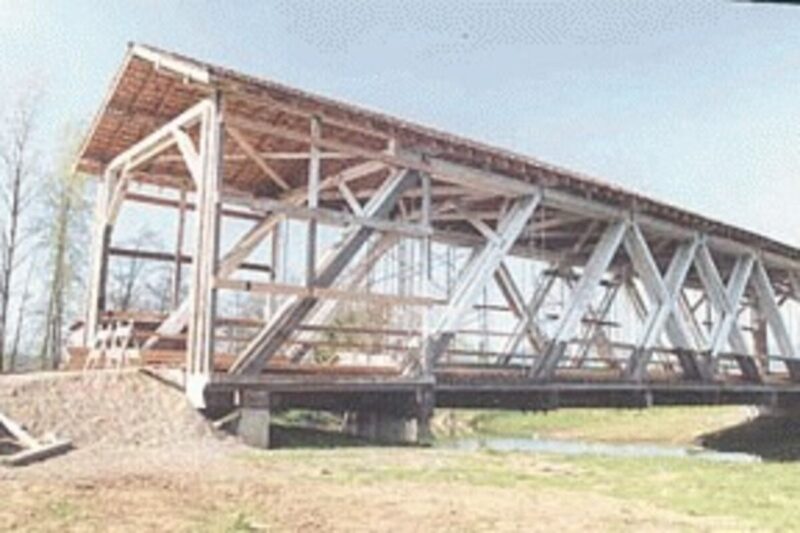
Weddle Bridge will get a partial new roof within a matter of weeks.
Part of the new roof will be temporary until decaying structural beams and rafters are replaced.
“We’re still working out the details with High Mountain Construction today,” Community Development Director Carol Lewis said last Wednesday. The Lebanon company will place three layers of cedar shakes on the south side and the east end of the north side of the bridge.
“Everything that has to come off for construction (later) is going to be done in titanium synthetic underlayment,” Lewis said. The bridge requires the replacement of structural timbers and “tuning.” Once the construction is complete, the roof will be completed.
The shakes for the final phase of roof construction will be stored until they are needed, Lewis said. The natural cedar should last even longer with a third layer — some 20 to 25 years.
The source of the wood has not been determined yet, although the Save Weddle Bridge committee has been talking to the U.S. Forest Service about getting some cedar.
Roof construction will begin in four to five weeks, around Christmas time, Lewis said. The roof work will protect the bridge structure from further water damage this winter.
“We don’t want any more of the upper cords, trusses and rafters rotting out,” Lewis said.
The roof would cost approximately $27,000 if done all at once, Lewis said, but that total will be lower for the partial roofing after labor and unused parts are backed out of the total estimate. Those costs will be incurred later when the roof is completed.
Weddle Bridge was closed to the public in September after an engineer identified structural problems.
The city has been waiting since then for an engineering report explaining what will need to be done and what it will cost.
The first report is in, Lewis said, but the consultant, Oregon Bridge Engineering Consultants, is fine-tuning the report to make it more realistic for Sweet Home, prioritizing work and taking into account volunteer efforts and material donations, like structural timbers, that logger Jim Cota is trying to secure, Lewis said. City staff can deal with wetlands and environmental work connected to the project, and the historical survey used in the Ames Creek project can be used for the bridge project, which will eliminate those items from the list of expenses to repair the bridge.
“We need to prioritize the work and things we can do ourselves,” Lewis said.
First priority will be opening the bridge to pedestrian traffic; the second, opening it to emergency vehicles; and third, completing preservation work.
Lewis said the city does not have a good estimate yet, but it will cost more than $120,000.
The city had been estimating $50,000 to $120,000.
“We’re trying to get a reasonable number,” Lewis said of the engineering report. ì”We could go in and spend $500,000.”
The project will need to be phased, Lewis said.
“There’s no way to fix that bridge in one fell swoop. This effort is going to go on for a few years, and then we just need to take better care of that bridge.”
The Save Weddle Bridge Committee will have a table at the East Linn Museum Christmas Bazaar at the high school on Dec. 3 selling DVDs, CDs and screen savers about the bridge. The committee also will have an educational display about the bridge and its status.
Weddle Bridge, built in 1937, was originally located over Thomas Creek on Kelly Road near Scio and Stayton. It was the twin to the nearby Gilkey Bridge.
The road was curved, and during icy conditions, cars would frequently slide into the bridge.
The bridge was dismantled and stored at the Linn County Road Department maintenance yard on Richardson Gap Road near Stayton and Scio. During its final days, before it was replaced by a concrete structure, the bridge was in a bad state of repair.
About 20 people got together in the 1980s and formed the Cascade Forest Resource Center. The group’s goal was to build a logging museum, and the bridge was supposed to be centerpiece to that and a focus for the community.
The group purchased the bridge for $1, and Phil Stafford moved the bridge pieces by truck.
Sweet Home High School wood shop teacher Ben Dahlenburg and his students rebuilt the bridge in 1990 at its present location in Sankey Park with the help of numerous volunteers.