
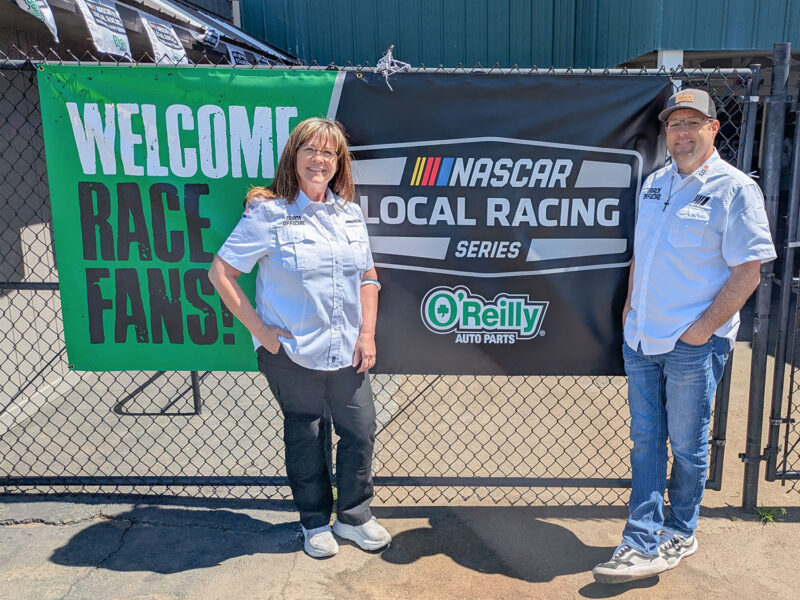
Willamette Speedway kicked off its 60th season on April 18 – and a new era for the one-third mile clay oval on the outskirts of Lebanon with its first-ever NASCAR-sanctioned event.
“It’s bigger and better than ever,” Cory Penfold, who has owned and operated the track with his wife Sandy since 2022.
Cory Penfold said this is his 50th year at the track.
“I started going there when I was 2,” he said, noting that his dad, Dan Penfold, raced at Willamette.
When he was 12, he determined that he wanted one day to own the speedway.
“Thirty-five years later, I finally made it happen,” Penfold said. .
After years of ownership by Clair and Evelyn Arnold, then by Jimmy and Jerry Schram, who owned the racetrack, at 36606 Airport Drive, from 2010 to 2022, he saw that dream become a reality.
Penfold said they’ve made changes, but some big ones have happened this year as they’ve switched sanctioning bodies, from the International Motor Contest Association (IMCA) to NASCAR.
Penfold said he’s been interested in switching to NASCAR, recognized as the premier motorsports organization, for some time, but he was battling advanced Stage IV cancer last year and “had to put that move on hold.”
“If I wasn’t going to be there, I didn’t want to do it,” he said. “When I got over cancer, we pulled the trigger.”
The only other NASCAR-sanctioned track is Coos Bay, he said.
The move means changes at Willamette, one being the return, after a decade, of a guaranteed points fund for the track championship, Penfold said.
This season’s Division I (Late Model) champion is set to collect a $7,000 championship check, $3,500 from NASCAR and the other half from the Penfolds. Also, the Penfolds are matching the NASCAR payout through the top five positions and paying out through the top 10, something no other track in the region is doing.
Also, the number of divisions has been reduced to six: Late Models, Street Stocks, Limited Late Models, Hornets, Modifieds and a division Willamette is calling WPCK (Western Predator Cage Karts) Cage Klones Leveling the Field and Raising the Stakes.
The move to combine what previously were Modified and B Modified classes into a single division is intended to increase competition and interest, he said, noting that Willamette already did that successfully with the Sportsman and Super Sports classes.
“They told me we couldn’t do it,” he said of that move last year. “We had 17 different winners in 22 different starts. The car count was low before and now we get a full field.”
For the new Modified division, he said, “we took a little bit from the Modifieds and gave a whole bunch to the B Modifieds to level the playing field.
“They get to race for more money.”

outside Lebanon. — Photos by Sarah Brown
Penfold said the change may be a work in progress, and tweaks may be made as they go along.
“It may not be perfect at first, but it was really close,” he said of the opener. “Everybody’s competing in a small group of drivers. We’re going to form our own rule package, combine the two and increase the car count.”
The WPCK competition, open to drivers 16 and up, will include three races on the big track and 12 on the small infield track, those on Sundays.
Penfold said some of the Karts qualified with faster times than street stocks.
“It’s a great way for anybody to get into racing,” he said. “It’s not as costly.”
Another advantage of the switch to NASCAR, he said, is that local drivers are no longer limited to racing for just track championships.
“Now they’re racing for track, state, regional and national titles,” Penfold said.
“The Division 1 champion, if he wins nationals, gets to get his award at the national banquet,” he noted. “We just like the structure of NASCAR. There are many benefits.
“”It will definitely enhance the show for the fans,” Penfold said. “Providing a payout like this increases car counts and gives teams more opportunities for sponsorship and national recognition. My team and I studied this program top to bottom. Every promoter I spoke with in the Weekly Racing Series reported nothing but success — increased revenue, better marketing support, and facility improvements that benefit everyone from the drivers to the fans.”
He noted that the $1,770 payout for Late Models winner Joey Tanner, who won last year’s championship, was higher than any last year.
Other off-season changes include new flooring in the men’s restroom, which “desperately needed to be replaced and new paint under the grandstands, he said.
“We are constantly upgrading the facilities,” adding that their goal is to make Willamette a “premier” track on the West Coast.
A new gate has been installed in Turn 3 to prevent major wrecks, he said, noting that improvement was engineered by Shawn Anderson of Sweet Home-based Anderson Enterprises. “It’s a wonderful addition for safety.”
He said their goal is to “get local businesses and community members back to the track,” noting that they estimate that Willamette brings some $4 million into the Lebanon community each summer, to gas stations, hotels, stores and restaurants. Plus, the track splits 50/50 winnings with local schools and the Veterans Home, he said.
The opening night lineup drew a near-capacity crowd, Penfold said.
The main grandstands, which seat 3,323, were nearly full and there were “a few hundred” more in the area behind Turn 1, as well as pits filled to capacity to watch Tanner and the other winners: Clay Debban in Limited Late Models; Bricen James in Modifieds; Shane Phillips in Street Stocks; and Matt Bangle in Hornets.
“If Saturday night was any indication of how the season is going to go, we are going to be successful,” Penfold said. “It was a large crowd.”
Races are held through September, typically on Saturday nights but with a few Sunday events. For more information, visit https://www.willamettespeedway.com.