


Street: Working in Arctic like working off planet

Sean C. Morgan

Len Street may have been a race horse jockey and he may own a bakery now, but arguably more interesting might be the time he spent drilling for oil in the Arctic.

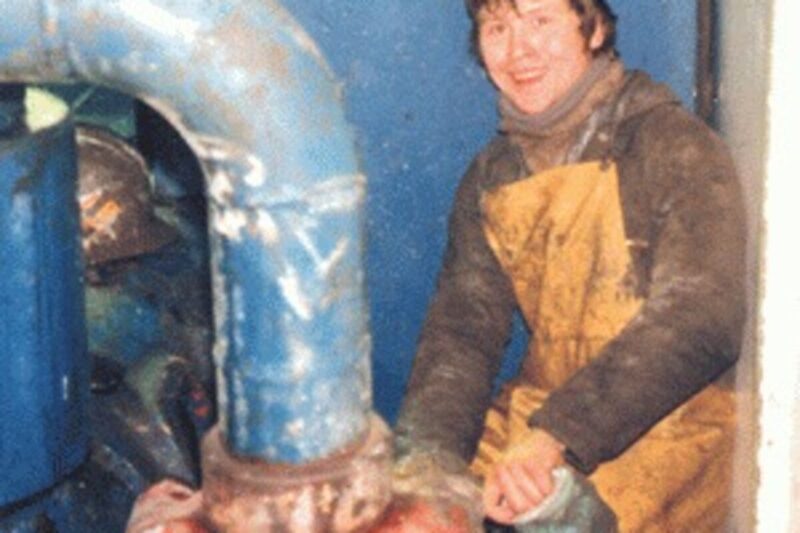
Street spent three years in the early 1980s working Arctic oil rigs on the Beaufort Sea in between racing horses, a time he spent in terrain that might as well have been on Mars as alien as the Arctic environment can be.

“We could be on land or sea,” Street said. “You really don’t know the difference.”

That far north, as winter closes in, the desolate, icy landscape looks the same as far as the eye can see in places. The ice may conceal the ground, or it may conceal an ocean beneath 20 feet or more of ice. Freighters, barges and ships that spend the winter in the Arctic are frozen in place as they await the spring.

Bright, beautiful days are cold, reaching as low as -40 or -50 degrees, as the sun sinks below the horizon over weeks. Eventually, the entire region is engulfed in winter darkness, a night that lasts until the spring. The temperature dips down to -70 degrees not counting any wind chill.

Street worked off the most northern tip of Canada at a tiny settlement called Tukoyucktuk. In this area, like many parts of northern Canada, roads are made of ice. A truck scoops up ice melts it then sprays it out on the ground behind it. The water freezes again, forming a smooth surface for vehicles to drive.

Drilling crews stayed in base camps at least a mile from their rigs, just in case something goes wrong and the rig has a blowout. The bedrooms are tiny and shared, but workers rarely see their roommates because they work the opposite shift. Quarters are provided with portable trailers.

At Tukoyaktuk, a seasonal bar called the Fox Den is built by piling snow around a wooden frame.

Crews work 12 hours on and 12 hours off for two weeks in the Arctic, then they are required to completely leave the Arctic for two weeks.

To reach Street’s work site, he would travel from Edmonton to Norman Wells on a small commercial liner. From there, he would ride a bush plane to Inuvik or Aklavik. Flying in the region, herds of caribou were clear on the ground, and passengers could make out the wolf packs stalking them.

Wearing the proper clothing in the Arctic is a matter of life or death. Workers wear many layers of clothing covered in neoprene, a plastic that doesn’t freeze, Arctic suits. At the extreme temperatures, exposed skin can freeze within five seconds.

Ice builds up on the eyes, which are the only part of the face exposed by a down-filled mask. The nostrils also have a small opening.

Surprisingly, it was hard to get on with Arctic oil rigs, Street said. Prospective workers were drawn by high wages.

Street was working on a small Atco rig in Alberta when “I heard about all the drilling going on in the Arctic. I heard the pay was really, really good. I was, like, ‘Holy smokes, the Arctic. I’d never been there. First of all it’s monster pay, and I’m going to do exactly what I’m doing now, only it’s 80 degrees colder.'”

Street ended up getting the number of a “tool push” with Bawden Drilling on the back of a Falcon Farms business card. A tool push serves as a kind of liaison between oil rigs and company offices. The tool push is also kind of the manager of a rig.

“I was calling this number every day,” Street said. It was an opportunity to see something he had never seen and would likely never see again.

He figured he would end up going up for one hitch then quitting after he’d seen the Arctic, he ended up staying on three seasons once he found out the work was “cake” and it paid three times the money he made on the Atco rig.

In more hospitable climates, the work is faster-paced. In the Arctic, safety is stressed “to the nth degree” forcing a slower pace.

“It was a lot more mental than it was physical,” Street said.

Street was so enamored of going to the Arctic, he figured it must have been 15 years he kept calling the tool push. In reality, it was probably more like three weeks or a month of calling daily trying to catch him.

One day, Street’s relief on the Atco rig was late, so he didn’t have to go in until late on his next shift. Street got up at his normal time, 4 a.m., and called, again to no avail. He tried again several times and then one last time before leaving for work. That’s when he caught the tool push. He had been calling too early all this time.

“I tell the guy, ‘I want to go to work for you in the Arctic,'” Street said. “His reaction, ‘Who doesn’t? I’ve got a list of all kinds of people that want to go.’

“I said, ‘I’ll make you a deal,’ and said, ‘I’ll outwork every single man you’ve got on that rig pound for pound.’ He says, ‘How soon can you be on the rig? I’ll go ahead and give you a shot.'”

Street was off. He reported to the Atco rig, where his coworkers cheered him on.

He purchased Arctic gear for about $500 Canadian, but the supply store didn’t have boots in his size. Street is size six. The smallest Arctic boots available were size eight, which is what he ended up wearing.

His first assignment was “lease hand.” The main job of the lease hand is to dig out a two-foot trench 100 feet from the rig to help contain anything, from oil to “sour gas” that might escape the rig. Substances contained in the trench can be pumped back to the rig or tanks.

While working the rigs, workers must be prepared to get out quickly when they get a 24-hour notice. the 24-hour notice comes on unexpected thaws. Crews get as much as they can onto something that will float then wait it out. They don’t even begin working the Arctic in the first place until temperatures reach -20 degrees.

In extreme cases, companies may lose equipment. In the case of Bawden One, which Street worked, it was left to sink into the tundra at some point after he worked for the company. Sometimes, the company can decide losing the rig is cheaper than trying to pull it out. Street only recalls one 24-hour notice, but the weather cooled down and he went back to work.

Street only worked lease hand for about a week. Usually, digging the trench takes two or three weeks. He noticed steam hoses sinking into the ice and decided to use them to help soften the ice and finished inside a week.

The tool push that hired him came out to the rig after that, and he was called to the doghouse, an enclosed space at the rig with a variety of equipment to see the tool push. He figured he did something wrong and was going to be sent home.

“He looks at me, ‘Are you Len Street,'” Street said. “‘He goes, ‘Pound for pound ? What do you weigh?’ I said, ‘Ninety-eight pounds.'”

Most of the workers were 200 pounds or bigger.

He asked Street to try his hand at roughneck. He worked that position, helping disconnect pipes coming out of the hole or connect pipes going into the hole.

“I loved roughneck,” Street said. “You got mud and sludge all over you.”

He also worked mud man, which pumps a mud solution into the hole to force other substances, like oil and grindings out of the earth.

His goal was to work the derrick. The derrick worker climbs to the top of the derrick and catches the upcoming pipes and pulls them away from the hole for storage or puts pipes into position to be connected on the way down.

The pipes could be taken up or down at any time to change drill bits for different types of rock or to try new holes. A rig could drill for a month without hitting oil, and at times, the drill might go three or feet in 10 hours. Holes averaged between 3,200 and 3,800 meters, approximately 2.3 miles, in depth.

To work derrick, he also had to put time in on the motors. The four motors provide power and heat for the rig. Working around the hole, where the roughnecks and driller are located, is open to the air but hot thanks to heat for the motors. Working the motors requires constant maintenance, including changing the oil every couple of days. All of it is performed with the machines running.

He turned down several motor positions because he liked rough necking so much, but then he learned he had to put time in on the motors before moving to the derrick.

Street’s third season, he worked the derrick.

He spent summers taking extra courses, on sour gas, Arctic survival and basic first aid. He eventually taught Arctic survival.

“When we’d leave a site, there’s but a 10-foot square that is not left the way it was when we got there,” Street said.

“I loved it,” Street said of the experience. “It’s really hard for words to describe it. It’s really hard to explain. It’s a different world. You’d leave home for two weeks and go to a place that only exists in your mind, a place you’d only see in National Geographic. It’s like visiting another planet. It’s like a dream.”

Street purchased Mollie’s Bakery in September.

As an aside, customer Howard Bergerson came up with an odd little fact last week. He promptly shared this find with Street and Mollie. When Mollie bought the bakery in 1962, she bought it from the LaRue family. In French, “la” means “the,” and “rue” means “street.”

Total
0
Share