


Sean C. Morgan
“Kids, don’t try this at home,” Dan Brewer said, affecting an Australian accent, right before he was bitten by the rattlesnake he was handling.
What might have been a perfectly forgettable average vacation turned memorable on July 14 with years of laughs still to come for Brewer, his family and probably everyone else who knows him.
Brewer, a Linn County deputy from Sweet Home, was on vacation with his wife, Patty, and son, Ben, to see another son, Nathan, and his wife in Utah. They had been out to visit Nathan twice before but never taken the time to stop and see things along the way.
This time, the Brewers decided to make it a two-day trip to Utah and stopped to play in some Eastern Oregon rocks they had seen on earlier trips. With a video camera making a record of the trip, wisdom and experience trumped youth and brawn when Brewer found the quicker, easier route to the top where he watched his son finish the climb.
With old, jagged rocks, sage brush and tumbleweeds, “it’s perfect rattlesnake country,” Brewer said.
Brewer had just gotten off work at six that morning, he said. He was just getting to sleep in the car when they stopped at the rock formation.
“I was real groggy, not thinking real clear,” Brewer said, but he got out to climb the rocks with Ben. Ben was worried about snakes in the area, and Brewer “told him what to look for.”
To get an idea how unlikely it is to be bitten, Brewer said, no one at the Burns hospital had ever had to treat a rattlesnake bite. A doctor in Boise, Idaho, had taken a class out specifically to look for a rattlesnake in its natural environment then failed to find one in a week.
After reaching the top of the rock formation, “we were headed down when Ben finds this big old boulder with a snake underneath the boulder in the shade,” Brewer said. “I say, let’s get a look at it.”
It was too big to rake out from under the boulder with a stick, so he rolled the boulder off the snake. He pinned it with a stick then picked it up behind the head in his left hand.
Brewer grew up in Arizona around diamondback rattlers that get much bigger, up to about six feet.
“You’ll find skins stretched out on the walls down there up to 12 feet long,” Brewer said. That’s not to say the snake was 12 feet long. The skins stretch when they’re not attached to a snake.
Brewer had always caught and played with snakes, sometimes even rattlers though he didn’t find those often.
“When I do find one, I like to look it over,” Brewer said.
The local timber rattlers don’t get near as long, Brewer said. This one was only about two and a half feet, maybe three feet long and about three inches in diameter.
“My first problem was being sleepy and not thinking clearly,” Brewer said. After rolling the giant boulder, he was sweating. He reached up with his left hand, holding the snake’s head, to wipe his brow.
“I was doing silly things like that,” Brewer said.
Patty was running the video camera from the road, so he sent Ben to bring the camera back for closeups. Patty wanted them to get away from the snake.
“It’s a beautiful animal,” Brewer said of the rattler. “This snake didn’t have a blemish anywhere, a perfect specimen of a snake.”
When Ben returned with the camera, Brewer started imitating (the guy on TV). With his best Australian, Brewer looks at the camera and urged people not to try this at home then went on to explain, “this is the most poisonous snake in the region.”
The snake started rattling, drawing Brewer’s attention. The rattle was good-sized but worn down from rubbing against rocks. He was going to start counting the buttons to figure out how old the snake might be when he must have relaxed his grip on the head just enough.
The snake slipped its head out just far enough to turn its head, opened its mouth and stuck one fang in the tip of the middle finger of Brewer’s left hand.
Brewer threw the snake.
“You could hear Patty on the video in the background saying, ‘I told you, you idiot,'” Brewer said.
Brewer said he’s all right, but Ben argued with him, “No, you’re not. Get in the car.”
The snake slithered into the bushes where it continued rattling.
“Blood is just gushing out because venom is an anti-coagulant,” Brewer said. He let the blood pump out. “When it stopped pumping, I started squeezing.”
The bite was like a bee sting that intensified after about 15 minutes, Brewer said.
Ben used the cord from his CD player as a tourniquet. Popsicles and ice from the cooler were used to ice the wound. They used up all of the ice and popsicles in the 50 miles to Burns.
Brewer made jokes about it, he said, but Ben and Patty kept telling him it’s not funny.
Patty called 911, and the Burns hospital started preparing antivenin, which takes a half hour. The dry antivenin is carefully mixed in a solution and cannot have any bubbles.
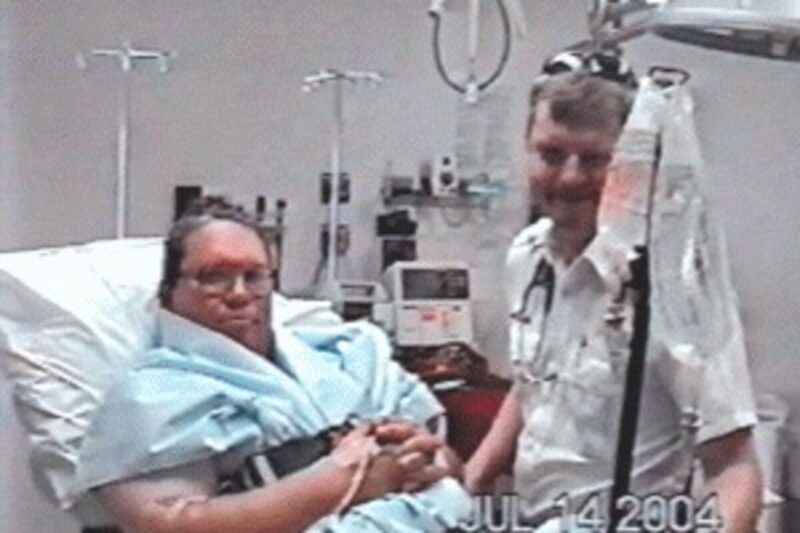
“They had every person in the hospital mixing antivenin,” Brewer said. By the time he reached the hospital, the venom had traveled up his arm, and his other arm, legs and left side were burning and swelling.
He was begging for pain reliever, but the doctor told him that would have to wait until the antivenin series started. After the first series started, “they must have given me a nice dose of morphine because I was quite intoxicated.”
He ordered McDonald’s but no one brought him anything.
The treatment was under the direction of the Poison Control Center in Denver, Colo., which sent him on his way by Lifeflight to Boise, Idaho. Usually that means a helicopter. When he was put into an airplane, Brewer asked about it.
He was told that a helicopter wasn’t fast enough, he said. “Then I began to get a little concerned. I thought they’d give me a shot, I’d be on my way on my vacation.”
He woke up again in the hospital in Boise. A doctor kept checking his heart and lungs for the Poison Control Center every 10 minutes.
“I just wanted to sleep,” Brewer said.
Following the first series, which included eight vials of antivenin, Brewer was still swollen. His blood pressure reached 198/105, high enough that doctors were worried about a stroke or hemorrhaging. If he hemorrhaged, he would bleed to death because of the anti-coagulant in the venom.
Doctors were also concerned he would lose part of his finger, hand and even arm. The finger turned black.
He continued through three more series of antivenin treatment, 18 hours and six vials each with two vials in follow-up. During the treatment, doctors would track the movement of the venom based on where Brewer said there was pain. If it kept moving, it meant the venom was still active.
The pharmacy in the Boise hospital was running low on antivenin by the time treatments were finished on July 16. When Brewer was released, he said he felt good.
Once he got a plastic protector on the tip of his finger, “I was in pretty good shape,” Brewer said. He kept it elevated for about a week after leaving the hospital, spent another week or so on vacation and returned to work.
“After it was all over, I began to have some anxiety about it,” Brewer said. When sleeping at night, he began thinking about what might have happened, what it might have been like 12 miles out into the desert and other alternatives.
“The seriousness of it began to set in several days later,” Brewer said. If he had not had treatment, it probably would have killed him because of the amount of venom injected.
People most often ask him if he learned anything, why and would he do it again.
“I don’t know,” Brewer said. He learned quite a bit about snakebites and the dozen ways it can kill a person. He learned that most snakebites are dry, affected only by residual venom on the tooth or fang.
“I learned rattlesnakes are not like the ones around Sweet Home,” Brewer said. Those snakes calm down “as you play with them. A rattlesnake seems to get madder the longer you play with it. They’re very docile snakes. They like to move slow, stay cool in the heat of the day and go hunting in the dark.”
Rattlers will run from an enemy if they can, Brewer said. “I’ll probably be more careful in the future.”
Insurance will cover most of the $57,000 or more the treatment cost, but he’ll still end up paying a deductible of at least $1,000. Each vial of antivenin cost $1,000.
That didn’t ruin his vacation though.
“I wouldn’t say that I screwed it up,” Brewer said. “It was a memorable vacation. We’ll remember it forever. We’ll joke about it and laugh about it (for years). I’m not afraid (of snakes). I probably would be more cautious. I hope I wouldn’t be as sleepy next time I come across one.”