


Sean C. Morgan
Eggs. It’s not what’s for dinner.
Or breakfast.
Rather, it’s what’s for the knick-knack shelf.
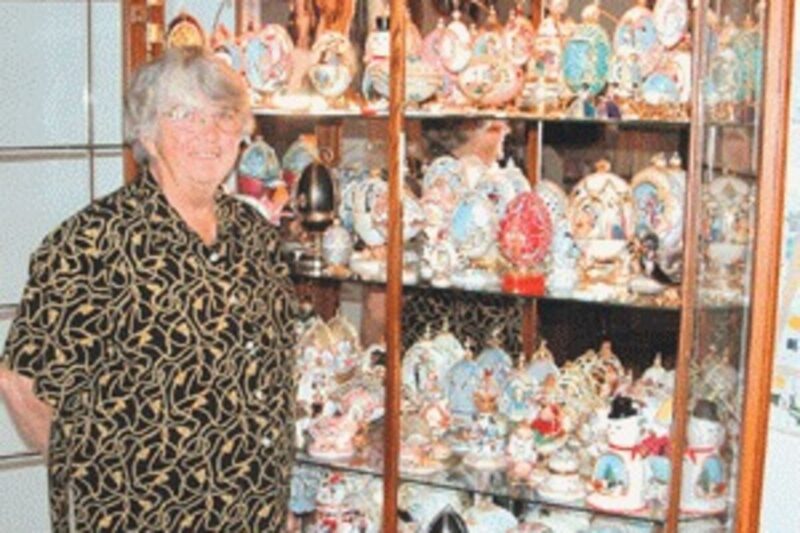
Dorothea Oar has hundreds of eggs filling the shelves of her home. The eggs are decorated and painted in bright colors of all kinds with Austrian crystal, beads, pearls and lights.
She sells the eggs at an annual show in Portland and at the Sweet Home Genealogical Society’s Christmas bazaar each year. Other than that, she just works on her eggs for fun.
She started decorating her own eggs about five years ago after seeing an egg table at a craft show in Lebanon. She had a table of her own selling other types of crafts. Nearby, Leona Wollums of Lebanon was selling eggs.
Oar and her sister, Shirey May, “expressed the desire to learn how to do it,” Oar said, but Wollums was busy with a beauty shop and didn’t have time to teach them.
Oar, May and two friends, Patt Hoss and Shirley Van Epps, ended up taking lessons from Kennedy Deschazer for about a year, then they joined the Egg Artists of Oregon. They now go to Portland once a month. At the monthly meeting, someone teaches new egg crafts.
“They’re beautiful, and you don’t find too many people doing them,” Oar said. “The reason I really wanted to start was because I wanted to give my children something different for Christmas.”
Every year, Oar makes 21 eggs for her children and grandchildren.
“They’re a keepsake,” Oar said. “They’re something you should have all your life.”
Oar works with all kinds of eggs, from delicate chicken and goose eggs to the sturdier ostrich and emu eggs.
“I just simply like to sit down and do an egg and see what happens,” Oar said. She works from patterns or makes patterns of her own for the eggs, but “you never do two alike. You can do the same patterns twice, but it will never come out the same.”
The hardest part of doing the eggs is drawing the pattern and cutting the eggs, Oar said. The smaller eggs are more delicate, and with the size of her hands, cutting them can be difficult.
The larger eggs are easier, Oar said. The ostrich eggs are thick enough she must score them before cutting them.
To start an egg, she puts a small hole in one end then blows the egg material inside out of the shell through the hole. Then she cuts the egg with a dentist’s drill, making the same sound as a dentist drilling a tooth. A tray full of drill bits sits above her workstation.
From the drill, the eggs go over to a desk where she paints and decorates them.
She keeps boxes of empty egg shells, typically purchasing empty ostrich and emu eggs and blowing out her own chicken, quail and goose eggs. Nearby, she stores small figurines made from plastics, ceramics and other materials.
After painting and decorating the eggs, she puts miniatures inside them or puts hinges on to make jewelry boxes. On some, she may sculpture flowers on the surface of the egg. Others get lights and finials, a decoration capping the egg or used to hang the egg.
Her eggs include all kinds of decorations inside. Some are kaleidoscopes. She makes eggs with woodland scenes and wildlife for men. Some get snowmen. Others get fairies. One egg depicts the “Princess and the Pea.”
The length of time it takes to make an egg varies. One egg took her a month as she covered the entire egg in tiny no-hole pearls one at a time. Normally, she can do an egg in a couple of days, and usually she works on two at a time so she can keep at it while paint and glue are drying.
The eggs are expensive in materials alone. At the crafts table, she can sell them from $20 for the smallest simplest ones to hundreds. A couple of ladies at the egg fair sell eggs for more than $1,000.
“They get to be a habit,” Oar said. She works on her eggs all the time. “It occupies your time.”
Her late husband, Earnest, was sick the last few years of his life. He passed away in August.
Working on her eggs helped take her mind off the problems. While he would sleep, she could work on the eggs. He enjoyed her eggs too.
“He told me, ‘You’re stupid for doing this,'” Oar said. “But he bragged to everybody coming in.”
Oar has three children, including Judy Taylor, Floyd Oar and Robert Oar. She has eight grandchildren and seven great grandchildren.
Persons interested in Oar’s eggs can contact her at 367-3543, and if someone is really interested in learning how to do it, she is willing to give a few lessons.