


Sean C. Morgan
Samaritan Lebanon Community Hospital unveiled the first full-size Japanese-style hospital healing garden in the state last week.
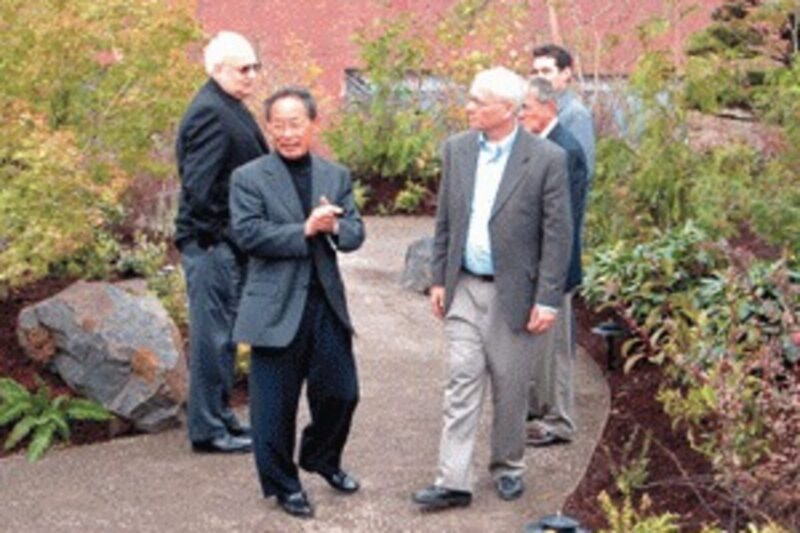
Samaritan officials and designer Hoichi Kurisu presented the garden to media on Oct. 19.
Since the mid-1980s, scientific research has confirmed what healers have long asserted, SLCH CEO Becky Pape said. A natural setting can promote healing, and this garden will be a healing force in the treatment of patients.
“Healing involves all aspects of the patient, which includes not only physical well-being but the emotional implications as well,” Pape said. “This garden will help relieve stress of not only patients but hospital staff as well.”
SLCH is a 49-bed acute care facility serving the east Linn County communities of Lebanon, Sweet Home, Brownsville and smaller neighboring towns.
Kurisu is an internationally acclaimed landscape architect. He designed and directed the construction of the new garden. Kurisa, whose company is called Kurisu International, has offices in Portland and Lake Worth, Fla. He has been recognized by President Ronald Reagan and former President George Bush during his more than 30 years of design work.
“He studied under a master in Japan,” Kurisa’s son Koichi said. The project used crews from Eugene and Portland, with about four to five working on it with a project manager.
The garden includes three large waterfalls, fully mature trees, pathways, lighting features, a covered patio and a gazebo in Japanese architecture. The garden can be viewed from four different wings of the hospital.
The garden is virtually complete, SLCH Foundation President Bill Rauch said. The garden still awaits six benches, the covered patio structure and the gazebo.
“They built the garden with mature plants,” Rauch said. “A lot of gardens, it takes six years to grow into the garden. This is how he (Kurisu) wants the garden to look.”
Every season, the garden will have a different feel, Rauch said. Plants throughout the garden bloom at different times of the year.
“There’s actually flowers blooming right now,” Rauch said, gesturing toward the purple blossoms.
Kurisu designed melded four different gardens into the overall design, providing each view a different look. In the center, the garden is raised, providing a kind of backbone to the overall effect.
Different kinds of flowers are planted in each area. The infusion therapy area will have no aromatic flowers, while the view from the birthing area will have many flowers.
Each view has its own purpose, Kurisu said. In the infusion treatment area, patients are worried and concerned, “but there’s nature, all the pine trees and all the plants kind of embrace you – You are not alone. The birthing wing is more often the green grasses, the flowers.”
The birthing area will have view of a sculpture of a mother and child.
The training center provides a view for students who get tired, Kurisu said. They can look out at an inclining hill and see a refreshing view of the native plants used throughout the project.
“This is probably only one of two full-size Japanese gardens in the United States,” Rauch said. The other one is in one of the big cancer research centers, M.D. Anderson in Illinois. Healing gardens are drawing attention and interest constantly now. “For example, in England, they require every new hospital have a garden.”
Kurisu has been designing gardens for 45 years and for 30 years out of Portland, he said. He has designed nearly 2,000 gardens but not for hospitals. He has long proclaimed the benefits of healing gardens, and it is now starting to catch on.
“The biggest benefit of this is not for the patients,” Rauch said. “It’s for the staff.”
The garden can improve treatment just by providing stress relief to staff members.
If a surgeon stops in the garden and sits for just 30 seconds, Rauch said, it can improve the surgeon’s performance.
“The results of a hospital are based upon happy people,” Rauch said.
Samaritan wants to study the effects the garden has on oncology treatment and is seeking grants to pay for it, Rauch said. “The trees lean. Through thousands of years, they’ve found if you lean the trees toward the people who use it, it literally draws you into the garden.”
Throughout the garden, Kurisa has included geometric shapes in the design, Rauch said. These shapes sooth the subconscious.
It provides a “don’t-worry-about-it, we-are-one kind of feeling,” Kurisu said. It brings comfort and peace.
A yet-to-be completed infusion therapy wing enclosed with a glass wall will face the koi pond and a large waterfall. Many infusion therapy patients spent up to six hours receiving treatment, such as cancer patients receiving chemotherapy. Sounds from the waterfall will be transmitted into the rooms to sooth patients during treatments.
Also facing the garden are the birthing wing, classrooms in the new Health Career and Training Center and the cafeteria where staff, patients and visitors can enjoy the garden.
It wasn’t designed with this in mind, but Rauch pointed out the circle of life represented by the garden’s viewers. Moving around the garden, life begins, the young are trained, people work and typically older persons are treated in the infusion therapy area.
“It’s amazing this garden can serve all those people,” Rauch said.
The garden is being constructed solely through donations, Rauch said. Total, the garden will cost about $400,000. There has been much community involvement. One Lebanon woman is providing as much koi as the hospital needs. Materials for the garden include rocks and boulders provided by Cascade Timber Consulting in Sweet Home.
Construction of new training center rooms continues, and the hospital will build the extension to its infusion therapy area later.