

Sean C. Morgan
Ames Creek is traveling through a metal pipe past Sankey Park where crews are moving the stream channel.
The pumps and pipes were set up and tested on Thursday. Ames Creek was drained Friday and shifted into the pipe at about two cubic feet per second.
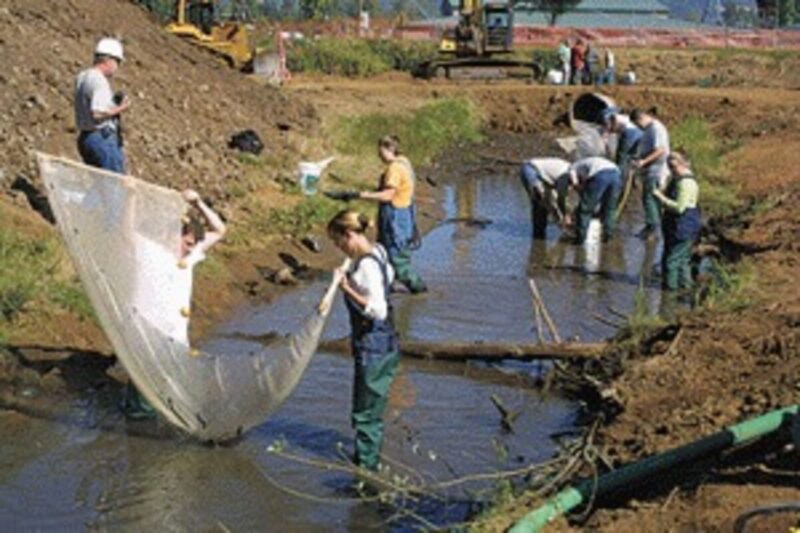
A crew of youths from Community Services Consortium joined Forest Service fish biologist Wayne Somes and others involved in the project in gathering stranded fish and moving them above and below the project. A screen keeps fish from entering the pump.
Once the fish were removed, Program Manager Daren Utley of the Sweet Home Ranger District said, contractor Rod Wolfer went to work digging the new channel to its historic location as part of Phase III of the Ames Creek Restoration Project.
The project is operating on a Division of State Lands permit valid through Sept. 30, Utley said. The work in the stream bed must be completed before that date.
“We’re thinking we’re ahead of schedule, and most of the challenging work will be done by the end of this week.”
With all of the stories, “we didn’t know what to expect when they started digging into this,” Utley said. So far they haven’t found any ’48 Buicks or anything weird like that, just a few “sinkers,” old logs that sank to the bottom of the mill pond.
Along with moving the channel, crews must complete erosion control measures, including soil-wrapped walls along the banks and planting. Crews are also building five rock weirs in the channel to create pools where fish can rest on their way upstream and spawning beds. They will also build several structures in the stream around old-growth logs.
After channel work is complete, work will continue around Ames Creek for up to another six weeks, Utley said. That includes more erosion control and planting native wetland species.
The $335,000 project is receiving $170,000 from the Bonneville Power Administration, $15,000 from the U.S. Forest Service, $45,000 from the payments to counties program and $105,000 from the Oregon Watershed Board, administered by the South Santiam Watershed Council.
“It’s about fish passage,” Utley said. “That was the idea for going around Dahlenburg Bridge.”
The channel will be moved into its historic location, prior to being dammed and used as a mill pond. A scenic pond was drained following the February 1996 flood. Since then, the city used a grant to construct an overflow culvert for the pond.
Later plans changed to leave the pond empty and restore the stream in conjunction with efforts up and downstream from the park. Fish have been unable to easily pass Dahlenburg Bridge, and project workers started looking at this project to provide passage around it. The bridge will become a lookout point.
The concern is for winter steelhead, spring Chinook and Pacific lamprey, South Santiam Watershed Council Executive Director Greg Pendle said. He was among those who moved fish on Friday.
“There were just so many fish in there,” Pendle said. “We proved the existence of steelhead smolts.”
They also found cutthroat trout and hundreds of juvenile lampreys, which have problems passing the dam.
“It’ll be better access to spawning and rearing habitat,” Pendle said. “There will be a lot of improvements, which will improve spawning habitat.”
The salmon do not spawn in Ames Creek, Pendle said, but they do hide up that creek during high flows.
“This project is such a benefit not just to the fish and species in Ames Creek but to the community itself,” Pendle said. It has been some six years in the making since a collaborative effort started between the city, watershed council, Forest Service, District 55 students and other organizations.
“One of the things at the get go that we hoped we could do with this was community involvement,” Utley said. “And we wanted a local contractor.”
Wolfer got the contract, and a number of other local contractors and companies are helping out too, including Tack Logging, Liberty Rock, Wes Staley and Cascade Timber Consulting among them.
“We do a lot of in-stream work for Cascade Timber Consulting,” Wolfer said. “And we do some for the Forest Service. This is probably a little more intense. I think the challenging part is we’re trying to pump all the water around.”
“These guys are going to be living here long after the job’s done,” Utley said. “The community should really be proud of them. They’ve just been working their hearts out to get it done and get it done right.…”
“We were concerned. We wanted this thing to look good. It’s got to be stout enough to withstand high-flow pressure and look good enough with low flow that it doesn’t look like low tide at Waldport.”
It will take a couple of years for the new plants to establish themselves, Pendle said, but it will become more attractive as they take hold.
There will be several access points from the park where lawn will lead straight up to the stream bank. The area will also feature a number of low-lying shrubs and diverse greenery. The channel will be visible from the park at a number of points, especially near Weddle Bridge.
The channel project should be completed by the end of this week, Wolfer said.
Persons are welcome to watch the work, but they are asked to stay outside the fenced work area, including the parking area in front of Weddle Bridge. The playground is open with access from the parking lot on 14th Avenue. Persons may also watch from Weddle Bridge, which may be accessed from the Boys and Girls Club and high school side of the stream.