

Sean C. Morgan
When City Manager Craig Martin came to work in 1997, he didn’t know about City Hall’s furnace.
He walked in one morning, and City Hall was cold. He needed to push the reset button on the furnace, something that happened four or five times a year.
“The first time, I did it was a little shocking,” Martin said. The furnace belched out a puff of black soot at him. He learned to get out of the way.
The Police Department had moved out of the basement by the time Martin became city manager, but the department still held prisoners in the jail cells in the basement.
“I could hear the detainees singing in one of the jail cells,” Martin said. He doesn’t remember what the prisoner was singing, but it reminded him they always needed to be aware that police could have someone in the holding areas. Coming from parks administration, “that was kind of a unique experience for me.”
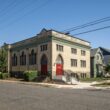
City Hall turned 50 years old last week, and Martin shared those two experiences. City Hall has been upgraded and improved since then. The furnace was replaced with a high-efficiency gas heater and controlled electric air conditioning, and the police have a new building and new cells. The cells in the basement are now used for storage, each used by a different city department.
City Hall started going through its most recent changes after the February 1996 flood when the Police Department was forced out of the basement to a modular building behind City Hall. An elevator and lobby area was added by 1997.
The elevator had gained a reputation for trapping people temporarily, but it “hasn’t happened for awhile,” Martin said.
In 2002, City Hall went through a number of changes. The city remodeled the basement for use by the engineering and building staffs. Court and the council chamber moved out to the modular building used by the Police Department. Public Works administration moved to City Hall from its Ninth Avenue location.
Last spring, the city put a new vinyl roof on City Hall. So far, it has appeared to eliminate leak problems in the roof.
Spacewise, “we’re probably at capacity,” Martin said. “If we were considering adding an additional department up here, we couldn’t do it.? Having Public Works up here has really helped as far as working with utility billing.”
With planning, building and engineering all together at City Hall now, people are able to almost everything with the city with just one stop, Martin said. They no longer must travel between City Hall and the Public Works office on Ninth Avenue.
After 50 years and the recent remodeling, depending on how the city grows, “I think we should be good for at least 10 to 15 years,” Martin said. “Of course, we’re going to need to stay up on our maintenance.”
Structurally, the building is probably nearing the end of its usable lifespan. That was one of the roadblocks in plans to attach an expansion for the Police Department. The cost of bringing the structure up to current codes was prohibitively expensive.
It could be expanded, Martin said, but it would be costly.
Gov. Paul L. Patterson dedicated the new City Hall on Oct. 16, 1954, telling those gathered that it was a symbol of the growth and progress that has taken place in this valley in a few short years.
At the time, many areas of the city that had been largely undeveloped were now dotted with dwellings or thriving businesses.
The governor praised Sweet Home residents for what he termed their faith and confidence in the future of this city.
Holiday time in Sweet Home, and in recognition, the city declared free parking at meters from noon on.
The New Era ran a photo of the new City Hall with a crowd gathered in 12th Avenue for the ceremony. Below that was a photo of Gov. Patterson and Mayor Eugene Ellis by the bronze cornerstone tablet by the entrance. City manager at the time was Roy Eames.