


Sean C. Morgan
The Department of Environmental Quality is using soybean oil to clean up the plume of chlorinated solvents that contaminates the Midway area ground water.
Contractor Hart Crowser, Inc., and subcontractor Cascade Drilling, Inc., spent last week at the former site of Ridgeway Logging on the corner of 46th and Highway 20 on the cleanup.
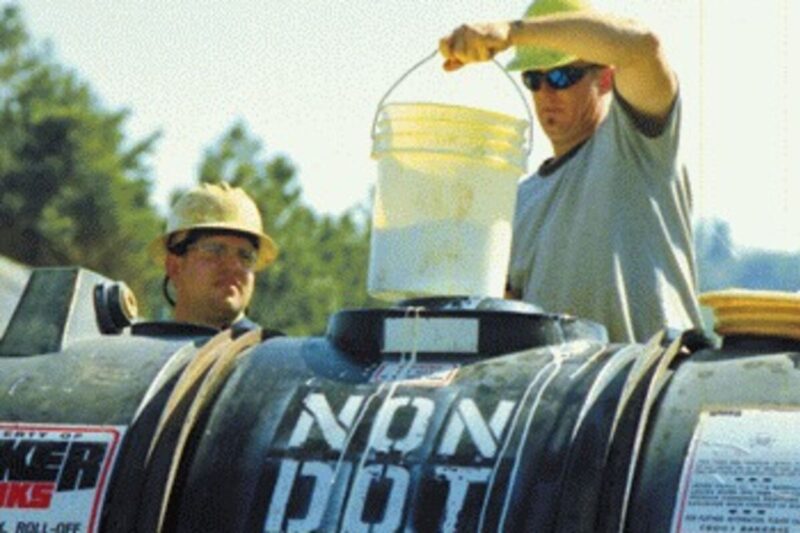
The soybean oil provides a food source for a naturally occurring bacteria already in the ground, Dave Anderson, DEQ project manager, said. The bacteria helps break down the solvents in the ground.
The soybean oil is emulsified with a substance that keeps oil and water from separating. The oil is then injected into the aquifers at 20 to 40 feet below the site.
Anderson believes this is the first time such a cleanup process has been used in Oregon, he said. It is less expensive than other alternatives though it takes longer.
Activities at the site have included log truck maintenance and repair, offices and scissors manufacturing since the 1960s. The site is now vacant. Tetrachlorethene (PCE) was used in the scissors manufacturing process.
In 1992, the Oregon Health Division notified the DEQ that chlorinated solvents had been detected in drinking water wells in the Sweet Home area.
In December 1994 and January 1995, DEQ conducted further sampling and revealed significantly higher concentrations at a well on the Ridgeway property.
By March 1995, DEQ had sampled 33 wells for “volatile organic compounds.” Seventeen of the wells contained chlorinated solvents. The highest concentration was detected in the Ridgeway well.
DEQ began providing bottled water to residents whose wells were contaminated at levels exceeding safe drinking water standards or advised them to hook up to city water.
Based on sampling and ground water monitoring, the DEQ determined the contamination likely originated with three individual sites, including Ridgeway, the U.S. Forest Service Sweet Home Work Center and High Tech Muffler.
The Forest Service site contamination was below the cleanup threshold, Anderson said. The High-Tech site needs a little work, with chlorinated solvents and petroleum contamination on site, but the Ridgeway site presented about 75 percent of the overall problem.
The Ridgeway site was designated at orphan site in March 2001 after DEQ determined that the property owner and former operator, Slip ‘n’ Snip, were unable to afford an investigation and cleanup.
In June 1996, the U.S. Environmental Agency removed soil for analysis and later disposed of about 1,172 tons of the most heavily contaminated soil.
Although much of the contaminated soil was removed, “there’s still a risk there based on the indoor air,” Anderson said. The plume is under residents’ homes, and vapors can come up through the ground into the houses. There also is a more minor concern about contaminated wells still used for irrigation.
In February 1998, 15 of 35 wells tested were contaminated at levels higher than safe drinking standards. Additional impacted wells were subsequently discovered, and DEQ hooked up 17 households to city water and installed carbon filtration systems on four wells outside the city water supply area. The City of Sweet Home extended water service to those four wells in 2000.
Data from indoor air sampling and other testing indicated by February 2003 there was a significant risk to human health from the remaining ground water contamination. Following a feasibility study then, DEQ determined that treating the site with an injection of vegetable oil was both cost effective and feasible to reduce long-term risk at the site and off-site locations.
Contamination by chlorinated solvents is most common in the west part of the state, Anderson said. Keizer, Salem, Milwaukee and Portland all have issues with it. It is especially a problem for cities that rely on ground water for drinking water, such as Keizer where one of its municipal wells is contaminated.