


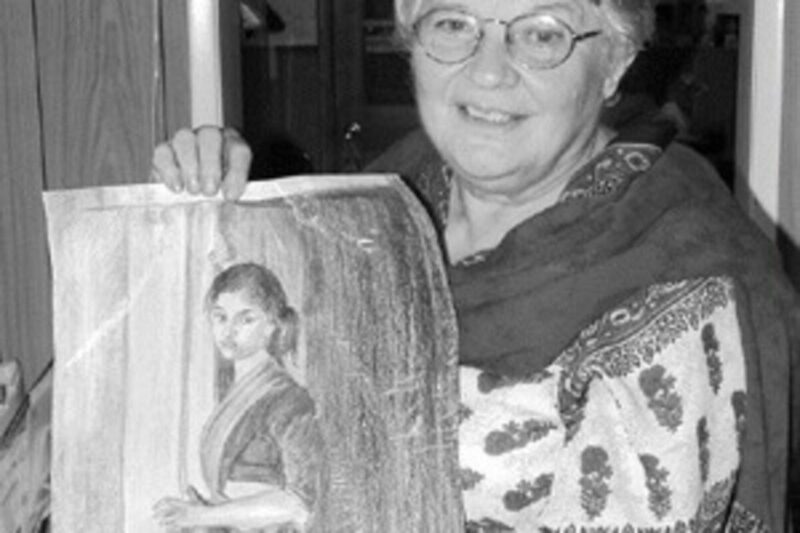
Local library volunteer helps dedicate bookmobile in India

Sean C. Morgan

Mary Rife is a key part of Sweet Home’s library, happily telling tales to young children and trying to stamp out illiteracy.

But her passion reaches much further than Sweet Home out into the world.

Rife recently returned from a 23-day trip beginning on Oct. 24 to India where she helped a former classmate “inaugurate” a new bookmobile service in a rural area.

Rife found that children around the world are the same. They have no language barriers. In fact, she had an easier time telling her stories to young children than she did talking to a class of journalism students.

Rife joined Dr. Jaswant Singh. She flew out of New Jersey with his daughter Amardeep Hoonjan of Edison, N.J., on the 17-hour Air India flight, which has “the most wonderful Indian food. The only problem is they feed you every two hours.”

They made a brief stop in Paris before flying into Bombay in the southern part of India then to Delhi. Her final destination was Ahmedgarb in the state of Punjab, close to the Pakistan border.

Dr. Jaswant and Rife attended library school at the same time. Since then, he has worked and taught in the United States and Canada for 30 to 40 years. He also served in the Indian Army.

Dr. Jaswant, one of 11 children, all educated in the United States, used inheritance money with his family’s support to fund the bookmobile to help fight illiteracy in the rural area of the state, including Jurahan, his native village. Dr. Jaswant’s parents wanted to use their money to do something for the children of Punjab.

“The bookmobile goes to three different locales in the 30-mile area,” Rife said. The area probably has about 30,000 people spread out.

Most of the people in the area are Hindu, Sikh or Muslim, she said. They all wear the turban and don’t cut their hair.

“People are extremely friendly and compassionate,” Rife said. “I was welcomed wherever I went.”

Boys and girls are educated separately, and when the bookmobile showed up for the first time, they tried to separate themselves to go in. Rife invited them on in and told them they were welcome to just sit and read.

The same thing happened at the inauguration, Rife said. “You couldn’t get the men and the women to sit together.”

In many places, including government buildings and the bookmobile, persons must remove their shoes at the entrance. The Indians drink tea constantly. It was the first thing Rife had for breakfast while there.

“The roads out there are so bad that 15 miles could seem like 60,” Rife said. Many of the roads are unpaved. If paved, they are often broken.

“The first day there, I tripped and fell and probably cracked a rib, so I had great fun driving around,” Rife said. “I knew all the bumps.”

The bookmobile was inaugurated, which means the same thing as “dedicated,” on Nov. 7 and began its weekly work of visiting rural communities.

Dr. Jaswant wants to show the good library service can do, Rife said. “He wanted them to have books in Punjab. There are libraries in India. They are not very good.”

The Delhi library is old and looks like a warehouse of out-of-date books. Rife doesn’t think it should even be called a library.

“The dust is horrible, but you have to realize, India is dusty,” Rife said. “It was dismal. The children’s area was about as welcome as a dead cat.”

Only one state actively promotes libraries and literacy, Rife said. That’s West Bengal. It also has the highest rate of literacy in the country.

Dr. Jaswant wants to show people that libraries don’t have to be like Delhi’s library, and he stays busy trying to promote the passage of a library act in Punjab.

“Dr. Jaswant said it was unfortunate that the successive governments had ignored the concept of libraries and emphasized more the need of casinos,” the Ludhiana Tribune, and Indian newspaper, reported.

About 80 percent of the books, written in Punjabi, on the bookmobile are aimed at adults. Children’s books are not as commonly written in the language of the state. The bookmobile has about 1,800 books. By comparison, the Linn Library League’s bookmobile has about 3,000.

Each state has a different language, Rife said. In school, the children learn English, Hindi and their state language.

Rife prepared seven stories to tell ? In Rife’s case, it’s more like perform ? for the children who would visit the new bookmobile. Among her repertoire for the trip were “The Brementon Musicians,” “Billy Goats Gruff,” “Too Much Noise” and the Indian tale “Once a Mouse.” The stories come from all around the world.

She prepared felt board pictures to help her tell the story, but after visiting everywhere she could in Delhi, she couldn’t find a felt board. She ended up finding material that Velcro would adhere to and used that.

“The children don’t have a language barrier,” Rife said. Smiling and using the figures helped get the stories across. She would tell her story in English and show the figures. Animal and vehicle sounds are the same in every language, making it even easier to share her stories.

The people and children enjoyed the new bookmobile, Rife said. “I think Jaswant is on the right track. He wants books to be provided for children.”

India’s a huge country, but Rife believes he’ll have an impact.

Along the way, Rife did plenty of sightseeing. She visited the planned city of Shandagar, the Taj Majal, the Pink City, the Golden Temple and many other temples.

“The Taj Majal is just as beautiful as you hear about it,” Rife said.

The land is crowded seemingly everywhere, with a population of nearly 1 billion, “in the city or a major highway going into a city, you’re apt to get into a traffic jam,” Rife said. That traffic jam will include everything from bicycles and rikshaws to three-wheeled, six-passenger buses, cars and trucks. Carts may be pulled by tractors, camels, elephants or cows. In most case it’s cheaper to hire a driver than own a car.

Rife loved Indian food, especially the chapatis and dal, a lentil dish.

“We also had great fresh vegetables, the best radishes I’ve ever had anywhere,” Rife said, but travelers need to be careful with vegetables, especially greens, depending on how they are raised or cooked. Persons also need to drink bottled water or boil the local water unless they grew up there.

McDonald’s has a presence in India too, but French fries and coffee are about all it has in common with its American counterparts. Rife enjoyed a tiki burger, made from a potato patty, there. Also available was McCurry.

Rife said Dr. Jaswant had been inviting her to India for some time.

“I said, well, I’ll go, but I have to do something,” Rife said. She settled on telling folk tales to the children.

“I wanted to support Jaswant and see what kind of reaction I would get from the children inasmuch I don’t speak their native tongue,” Rife said. “I wanted to prove to myself that children need this. He wanted them to know that people from across the world are interested in them as well. It really worked out well. The kids were fascinated. I realized children are the same the world round. I knew it, but this proved it.”

The best part of those children is the same as at home, their big eyes and wonderful smiles, Rife said.

Total
0
Share