


Crawfordsville tour features changes to ‘Pigeon Shoot’ property

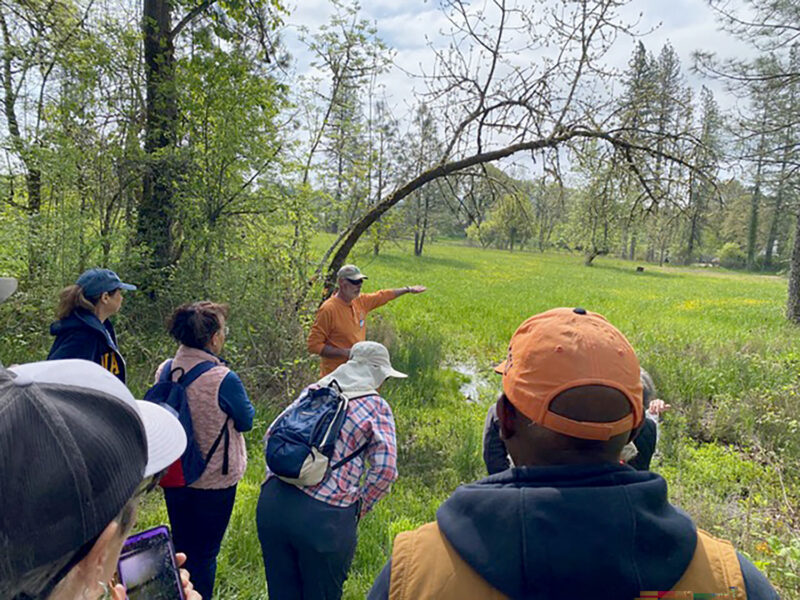
Phil Callaway has a mix of mature pine and incense cedar along with six acres of wet prairie. – LCSWA photos

By Larry Mauter
LCSWA

Linn County old-timers might know Phil Callaway’s 38-acre forest property along Crawfordsville Drive as the “Pigeon Shoot.”

Not so today.

Callaway’s parcel just north of the Calapooia River still has flocks of band-tailed pigeons that visit a sodium-rich mineral springs there between April and late September.

Hunting was stopped in 2016 when Callaway and his wife Karyn purchased the property and built a home.

He has now rebranded the property as “Camas Springs.”

The Oregon Department of Fish and Wildlife has told Callaway his spring hosts the largest pigeon population in the south Willamette Valley. Future land improvements call for planting elderberry and cascara — among the favorite foods for the Oregon native game birds.

Tour-goers Greg and Karen Harty examine an ash tree that is likely the result of several trees that grew together.

“It was just bare land. We built a home and moved in in 2018,” said Callaway, a retired software engineer.  “It was a dream come true to get this place.”

A Linn County Small Woodlands Association (LCSWA) tour of the property on a sunny May 1 showcased the beauty the Callaways found.

Mature stands of Willamette Valley Ponderosa pine – likely about 80 years old – and tall incense cedar grace the upland slopes. Fields of camas and buttercups flourish in a six-acre “wet prairie” area that is mowed annually.

The changed landscape was shaped with help from federal Natural Resources Conservation Service cost-sharing money and professional assistance, Callaway explained to the 45 people on tour.

Advanced Land Management of Sweet Home used a masticator to chew up the brush and invasive blackberries that dominated forest areas.

Llew Whipps, with the non-profit Institute for Applied Ecology, based in Corvallis, assisted Callaway with the land transformation. She was on hand May 1 to help explain the reclamation process.

Callaway moved to Oregon after earning a degree in wood science and technology from Colorado State University.

His philosophy about the property is that he is “temporary caretaker” of the land.

“I want leave it a little better than when I found it,” he said.

He is striving for both “horizontal and vertical diversity” among the trees.

Challenges and uncertainties remain. The ice storm of January 2024 took a heavy toll on deciduous trees.

“Messy is good. So I guess I’m good,” Callaway said.

Also, a developer on a neighboring property is building a subdivision. Callaway is concerned the construction may alter water flows on his land.

He harvests firewood and burns about six cords a year, but has no plans for logging. While the Willamette Valley has seen an upsurge in Valley pine plantings since the 1990s, the closest mills for pine are south in Roseberg, he noted.

The day was part of a year-long list of activities hosted by the LCSWA. For information on future events, visit www.linncountyswa.com.

Total
0
Share