


Amira Therese had already been in dozens of different placements as a foster child when she found herself, at age 15, in Henderson, Nev., in, she realized, a trafficking house.
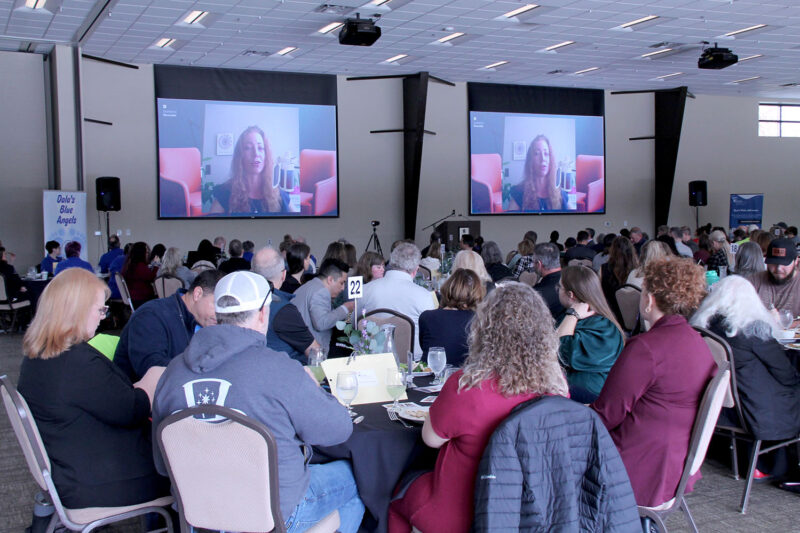
Therese, now an author and activist based in Arizona, is also the host of the podcast “Interview with a Foster Kid,” which exposes realities of the foster care system that “most people never see,” according to the show’s explainer. She was the keynote speaker at CASA (Court Appointed Special Advocates) of Linn County’s annual luncheon Wednesday, March 4, at Boulder Falls Inn.
Therese, who participated remotely, told the story of how she had been moved nearly constantly through most of her childhood, and on this particular trip she was told by a new caseworker that she was going to be transported to her new “forever home.”
She related how she started wondering what was going on when the caseworker told her they were taking a “road trip” and would be picking up “other girls,” which turned out to be one other teen. Then they crossed the state line, from Arizona.

When they arrived, Therese said, they were told that they had two choices to make money.
“Now mind you, I’m thinking I’m going to my forever home,” she said. “I’m ready to meet a new family and hope it works out.”
Instead, she said, it was “chaotic and scary,” with adults and “girls my age” circulating through.
She and the other girl who had arrived with her, “Melissa,” determined to get out.
“We had very little idea of the extent of what was going on,” she said. “We were upset, just thinking they wanted us as child labor.”
They made it back to Arizona after a “tumultuous” four-week journey, where she was told by her caseworker, “who was not happy to see me,” to “stop telling your lies.”
Therese said she ended up in juvenile detention because, her caseworker told her, the story she was telling made her unplaceable.
She was there for two weeks when she heard a familiar voice. An “eccentric” woman wearing a leather coat “stormed” into the facility, and announced, “I’m taking her.”
“She looked at me, and she said, ‘I found you.’ She always found me,” Therese said of “Judy,” the CASA volunteer who had been assigned to her when she was 11.
“”This time I wasn’t moved into a foster home and nobody was looking for me, but she found me,” Therese said. “I felt so safe in that moment. I felt found.”
She added that her CASA volunteer “wasn’t extraordinary – she was ordinary.”
“She had a family, she had another job, she had problems, she had a whole life outside of what she was doing within CASA, but she had a few extra hours a month, and believed that I mattered.”
She said CASA needs three things from the public: volunteers who are willing to give 10 to 15 hours a month “and you don’t need to be perfect; you just need to show up;” funding; and “your voice.”
“CASA needs your voice; tell people about this. Make CASA as well-known a cause as every other cause you care about.”
Shyla Malloy, executive director of Linn County’s CASA,noted to the crowd of well over 150 attendees that Therese has been searching for “Judy,” with whom she lost touch after exiting the foster care system.
“She does these keynote presentations and hopes that someday somebody will see her story and recognize that and that they will be reunited again,” Malloy said. “So that just tells you how powerful that relationship is.”
CASA volunteers, Crystal Tyndall, a local banker who sits on CASA’s Board of Directors, told the luncheon crowd after Therese’s presentation, are trained, court-appointed community members who advocate for abused and neglected children in the foster care system.
“We show up, we stay, we make sure a child is never invisible in a system that can feel overwhelming,” Tyndall said.
CASA volunteers visit children monthly, gather information from teachers, doctors, and caregivers, and report to judges to ensure children’s needs are met and they are safe.
Tyndall told the audience that they could help by volunteering themselves, or by donating to support the training.
“Somewhere in our community today, a child is wondering, ‘Does anyone see me?’” Tyndall said. “Let’s make sure the answer is ‘yes.’ Let’s make sure they are found.”
CASA of Linn County can be reached at (541) 926-2651 or at www.linncasa.org.