



Lebanon Fire District held a workshop for its Board of Directors on March 5, providing a five-hour deep dive overview of the district’s responsibilities and challenges.
Financial snapshot
Chief Administrative Officer Desiree Barker presented the board with a financial overview of the LFD.
When measures 5 and 50 were introduced in the 1990s, challenges for all governmental districts began to grow.
In 1992, ambulance costs went from “reasonable rate” to a fee structured rate, which also affected the district’s revenue, she said.
“It cut it back pretty significantly from what we were seeing before,” Barker said.
It was in 2016 when the district began seeing the trajectory of expenses outpacing revenue, “and we are definitely seeing that today.” Though the district continues to seek ways to mitigate it, the problem persists.
While property tax revenue goes directly to fire services, decreasing ambulance revenue demands some of that tax revenue cover ambulance service expenses.
It’s a problem that causes the budget to look like the district is bringing in or spending more money than it actually is, based on how transfer line items function, Barker said. When residents see the budget, they misunderstand what’s really happening.
“I’ve been looking for effective ways to communicate it so that people understand how that inflates our budget so that there’s that immediate understanding, but it’s very difficult,” she said.
Barker said when she tries to talk to people about the problem, they seem to have “no real true interest in numbers” yet there’s “a lot of interest in the accusations.”
Currently the district is looking at a $643,000 deficit, despite trying to cut even the smallest costs, from postage all the way up to staffing. Barker said the district had 43 full time staff in 2020; today there are 37.
“Removing staff means removing ambulance services, and that is very, very significant, and I think the community needs to understand that,” she said.
Fire Chief John Tacy explained the district receives limited property tax from properties within urban renewal development areas, of which Lebanon has five, adding up to approximately $364,000 loss per year (2022). Additionally, enterprise zones in Lebanon are exempt from property taxation during a period of time. When new homes are built in those areas, LFD doesn’t receive tax for three to five years.
Other challenges include the rising cost of PERS, insurance costs, aging infrastructure and apparatus, and a growing population’s needs.
As the district continues to seek various forms of funding, including federal and state grant programs, it’s a levy that would ultimately help LFD simply “bring us back into alignment,” Barker said.
“Public awareness is important,” she said. “We’ve got to get the public on our side to understand how desperate we are to keep things in the right place so that we do not lose the ambulance services, because that’s what’s at risk.”
LFD will be seeking guidance into the possibility of returning to the community for another chance at gaining a levy from voters.
“I believe we can get the message to the community by letting them know just how serious it is, but the mission here hasn’t changed; we’re here to help,” Barker said. “That’s what we need them to help us to do.”
Recruitment challenges
Firefighter Michael Perkins addressed the board on behalf of the Lebanon Professional Firefighters Union regarding recruitment.
“Based on the trends we are seeing, we believe this is becoming an organizational risk that could impact staffing stability and service delivery if not addressed,” he said about recruitment.
Eight years ago, he said, was the last time the district increased its line personnel. Since then, several positions have been eliminated, “resulting in fewer personnel assigned on shift, even as overall call volume has continued to increase.”
Eight years ago, the district was running over 6,000 calls a year. Last year, they responded to more than 7,000 calls.
He reported that in the past eight years, 28 line personnel voluntarily left the district, representing a 100% turnover rate when comparing the number of union members currently working the line.
They cited the following reasons for leaving: compensation, call volume, burnout and schedule.
According to Perkins, line personnel receive about 10-15% below the average rate of comparable departments, while experiencing double the call volume per badge in addition to other duties they have little or no time to perform.
“At present, the district is facing increasing difficulty attracting paramedic applicants,” he said. “We have developed a reputation among some local paramedic programs as a place that quickly burns through our paramedics.”
Board member Robert Taylor asked Perkins how to, based on the budget crisis, fix the problem.
“This is not just to say you need to pay us more money,” Perkins responded. “This is saying that we see a significant challenge here in both retaining and recruiting employees.”
Essentially, he asked, what alternatives can we come up with together?
Operations overview
Tacy told the board he believes the district’s Standard of Cover (SOC) is “really, really out of date,” about 12 years old or so.
An SOC is a data-driven plan defining how emergency resources – such as personnel, engines and ambulances – are distributed to manage risks, and includes performance benchmarks, such as turnout and response times for fire, medical and specialized services.
“Standard of Cover really kind of tells us where we’re at right now with what expectations are,” Tacy said.
In order to update the district’s Strategic Master Plan, Tacy would first like to update the SOC.
“It’s pretty hard to project where we wanna be or where we’re going without knowing where we’re at,” he said.
Deputy Fire Marshal Jason Adamson presented an overview of the Fire and Life Safety Division, which provides a variety of services such as fire code inspections, fire investigations, development plan reviews and training.
The division also performs a variety of public services, such as meeting children, giving station and tours, staff training, recommending medical options to families, defensible space assessment, fire extinguisher training, social events, smoke alarm installs, residential key box installs, lifejacket kiosk, youth firesetting intervention, emergency pre-planning and address marking.
Other services and programs provided under the division include hazmat, rescue, fire academies, CPR/First Aid education, lift assists, fatal accident investigation and clean up, and, of course, fire and wildland suppression, and EMS transportation.
As Adamson presented his division’s duties, Board Member Dale White took the opportunity to chime in with a simpler, broader view of how LFD is perceived.
“The fire department is a problem solver,” White said. “If anybody has a problem, they call the fire department, whether it’s a lost kid, a cat in a tree, anything like that.”
Division Chief Mark Fitzwater said the district tries to follow the National Fire Protection Association recommended guidelines as best it can given its resources.
In urban areas, the NFPA recommends 15 firefighters on a scene within nine minutes. However, LFD can only staff two ambulances and one engine a day, Fitzwater said. The ambulance service, which helps fund firefighting staffing, covers 419 square miles from Brownsville to Scio, as well as some mutual aid in Sweet Home.
He said the district is seeing a rise in the number of ambulance service calls.
Ten years ago, the majority of calls they received had no overlap. There were 2,174 “no overlap” calls, and 1,762 “two concurrent calls,” plus some three or more concurrent calls.
In 2025, the majority of calls were concurrent calls. There were 2,004 “no overlap” calls, and 2,413 “two concurrent calls,” plus an increase in three or more concurrent calls.
Fitzwater told The New Era the LFD only staffs two ambulances, so when they are out during the concurrent call times, there are no more ambulances to respond to any other calls, forcing LFD to call in off-duty crews.
“We, on average, request callbacks 48 times a month,” he told TNE. “That means that on average, we have 48 times a month where we have no ambulance coverage in the district and either have to rely on mutual aid from Sweet Home, Albany or off-duty personnel to respond to the station and take an ambulance.”
The number of concurrent calls is increasing, leading LFD to see they are in need of more ambulances, Fitzwater told the board.
According to him, LFD is currently receiving an average of 550 to 600 calls a month, about 75% of which are ambulance calls.
He explained that the district tries to hit NFPA guidelines. With the resources they have, LFD would like to get 10 firefighters on scene within 10 minutes, but by doing that, it would take longer for them to respond to a second call that may come in at the time.
Division Chief Russell Duerr leads the Training Division, which provides training for volunteers on different levels, including any mandated training and recertification processes.
Training includes firefighter and support volunteers, including partnerships with College of Osteopathic Medicine of the Pacific-Northwest and Chemeketa Community College, which provides students who bring a variety of support to LFD.
Duerr organizes firefighter academies in partnership with other area agencies. Training covers a variety of focuses, such as standard firefighting, hazmat, rescue, wildfire, engine operations and more.
He noted that volunteer enrollment is dwindling.
“Speaking of needs,” he said, “on the recruitment side, we’re always looking for the rural firefighters. In addition to that is the tender operator program in our support volunteers.”
Currently, LFD only has two or three emotional and practical support volunteers, which Duerr would like to fill out more. A challenge Duerr faces is convincing volunteers to spend at least one night a week training, and to do additional training and respond to calls.
“The easy part for me is I can get people through the door,” he said. “But then to have them engaged and continue their training and continue with the culture of the fire department and then so much learning plus the academy, that’s the where the struggle is and where the drop off is to keep people engaged and interested.”
Other topics reviewed during the workshop included apparatus, maintenance and protective gear reports, communications and general operations.
To watch the full workshop, visit LFD’s YouTube page at https://www.youtube.com/live/L08uOlik2dY?si=If6rWCl48nuykoo7.
Board meeting
The following week, on March 10, LFD held its monthly Board of Directors meeting.

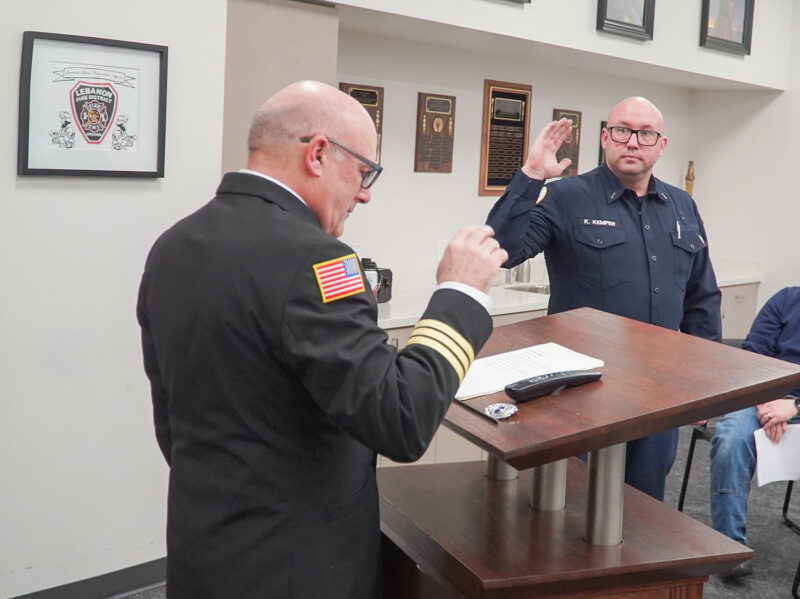
During a mass badge-pinning ceremony on Feb. 10, firefighter Kyle Kemper was out responding to a call and was unable to be officially pinned by his family. The board took the opportunity during their March 10 meeting to recognize Kemper, who was promoted to lieutenant.
In other business, the board:
- Approved annexations of 40850 McDowell Creek Drive and 43349 Snow Peak Drive.
- Approved the purchase of a Ford pickup from a pre-approved $86,000 CWDG grant. The truck will be mainly used for Home Inspection Zone inspections and address marking, Tacy said.
- Tacy met with a public affairs consultant who recommended a levy vote in the May 2027 elections.