




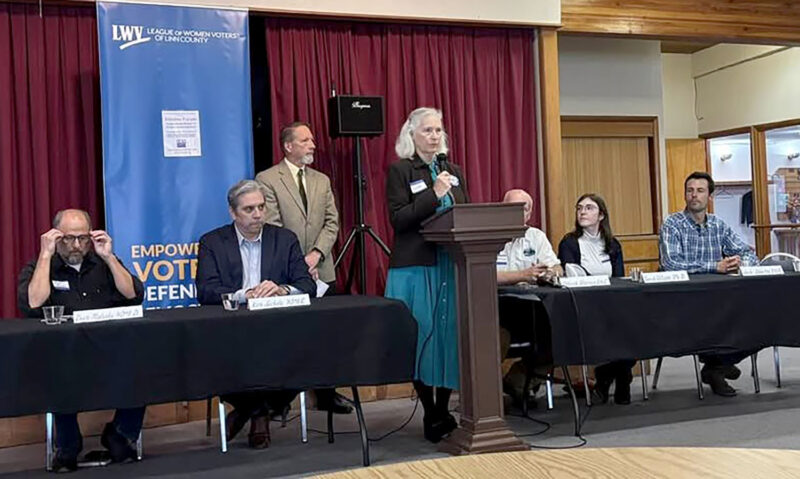
*A video of the forum from the League of Women Voters can be seen at Facebook.com/LeagueOfWomenVotersOfLinnCountyOregon.
*A video of a forum hosted by the Lebanon Chamber of Commerce on Tuesday, April 28, can be seen at Facebook.com/LebanonChamberOfCommerce.
This year’s primary election, which ends May 19, includes local competitive races among Republicans for the Oregon State House of Representatives District 11 seat and the Oregon State Senate District 6 seat. Ballots are being mailed to voters beginning April 29.
Those candidates are included in specific question-and-answer reports in The New Era’s election section. They are, listed in alphabetical order, Jami Cate, Nicole De Graff and Jack Tibbetts for the Senate seat, and Ken Jackola and Angelita Sanchez for the House seat, which is being vacated by Cate in her quest for the Senate seat.
Also on some local ballots are Democrat Ivan Maluski of Scio, running unopposed for the House seat, and Democrat Sierrah (Owen) Williams of Sweet Home, running unopposed for the Senate seat. Independent Patrick Starnes of Brownsville, running for the Senate as well, is not appearing on the primary ballot because he is a third-party candidate. He will be on the November ballot, along with the winners of the Republican and Democratic primaries.
Republican incumbent Will Tucker is running unopposed for Position 1 on the Linn County Board of Commissioners. Democrat Theodore (TJ) Hiner Jr., of Sweet Home, a wildland firefighter, is running as a Democrat.
Thirteen Republicans are running for governor, including Christine Drazan, who lost by four percentage points to now-Gov. Tina Kotek in the 2022 election, with third-party candidate Betsy Johnson in that race; Stayton state Rep. Ed Diehl, who led the Gas Tax referendum drive which resulted in Measure 120; and Chris Dudley, the former Portland Trailblazer who ran for governor in 2010, narrowly losing to John Kitzhaber. Kotek, a Democrat, has nine challengers for the nomination.
See Oregon Journalism Project coverage of the governor’s race at www.sweethomenews.com/category/ojp. There is no paywall to read OJP stories.
Two Democrats and two Republicans are on the ballot for the 5th District seat in the U.S. House of Representatives, which represents most of Linn County: incumbent Jannelle Bynum and challenger Zeva Rosenbaum, a Salem-based communications manager, on the Democratic ballot and Deschutes County Commissioner Patti Adair and Jonathan Lockwood of Lebanon, a public relations candidate and law student.
The only statewide measure on this ballot is Measure 120, which asks voters whether they support a 6-cent-per-gallon increase in fuel taxes, the nearly doubling of vehicle registration fees, and an increase of passenger vehicle title fees from $77 to $216. Half the revenue from the tax would be distributed to ODOT, with the remainder going to counties (30%) and cities (20%) for road construction and maintenance.
In addition, this primary ballot will include two measures to be decided by Sweet Home voters: changes to the Sweet Home city charter, which dictates how the city government operates, and a proposed $40 million bond measure for the Sweet Home School District which, if passed by voters, would qualify the district for a guaranteed $12.252 million in state funding.
Sweet Home School Bond Measure 22-214
The $40 million bond measure would essentially extend the current bond, which voters approved in 2017, with no increase to what property owners are already paying on that bond.
Revenue from the bond, together with the nearly $12.3 million from an Oregon School Capital Improvement Matching Program (OSCIM), would pay for safety upgrades at all the district’s schools, including updated emergency communication and lockdown systems, according to plans being formulated by district officials.
District Business Manager Kevin Strong told School Board members earlier this year that the bond would be “structured to maintain the existing tax rate, very similar to what we did in 2017, when the community passed the bond for the Junior High School and, in fact, since then, due to growth in assessed values, the actual tax rate has declined.
The bond would maintain the current tax rate, which is $1.45 per $1,000 of assessed property value, approved by the 2017 voters; prioritize classroom and learning facility upgrades at the high school; create schools that are “durable” and “long-lasting;” and leverage grant money to reduce local costs.
City Charter Changes Measure 22-215
The Sweet Home City Council earlier this year referred city charter amendments, crafted by a Charter Review Committee over the past year, to voters for final approval.
The charter is a foundational legal document that acts as a municipal constitution for Sweet Home, outlining how the city operates, its structure, powers, and procedures.
The charter defines the roles of local officials, the form of government, and must be adopted or amended through voter-approved referendums such as this one.
The Charter Review Committee held several meetings last year to review and propose changes to the city’s charter, which is essentially the city’s constitution defining its structure and procedures for the municipal government.
Many changes to the charter include basic housekeeping in the form of how things are worded, but more notable changes include council vacancies, unexcused absences, council ethics, length of position for a manager pro tem.
More specifically, the revamped charter awaiting voter approval:
- Changes formatting to improve readability and modernize language.
- Updates procedures for vacancies that may result from a mid-term councilor being elected mayor (new Section 2.1).
- Removes a requirement that city officers other than the city manager be bonded, which was contingent on separate ordinances (current Section 7).
- Clarifies that eligibility for the office of City Council member or mayor requires residency in the city for one year prior to election or appointment (new section 3.1).
- Changes the beginning of the term of office for mayor and councilor to the first day of January following the election, rather than the first Monday in January (new Section 3.3).
- Changes how vacancies are handled (new Section 4.1), including:
- If the incumbent is elected to another city office (i.e. mayor).
- If the incumbent ceases to reside within city limits.
- If an incumbent has unexcused absences from council meetings for more than 30 days.
- Requires vacancies in elected offices in the first half of the term to be first offered to the two next highest vote-getters in the previous election before appointing anyone else (new Section 4.2).
- Allows a smaller council quorum in the event of three or more concurrent vacancies (new Section 5.2).
- Changes the title for president pro tem to council president (new Section 5.4).
- Requires at least four affirmative votes for hiring or firing council-appointed positions, filling council vacancies, land use decisions, utility rate changes, modifications to city code, approval of ordinances containing emergency clauses, or any disciplinary action toward a councilor or mayor (new Section 5.5).
- Requires a public comment period at all regular council meetings (new Section 5.6).
- Adds a section on council ethics and conflicts of interest, including requirements for enforcement (new Sections 5.7 and 5.8).
- Changes the bond requirement for the city manager from $10,000 to an amount set and approved by the City Council and changes the section on interference in administration to comply with state law (new Section 6.2).
- Removes a requirement to post ordinances in three or more places within the city for 10 days after passage (new Section 7.3).