



Opinion: Residents battle escalating costs in last affordable housing

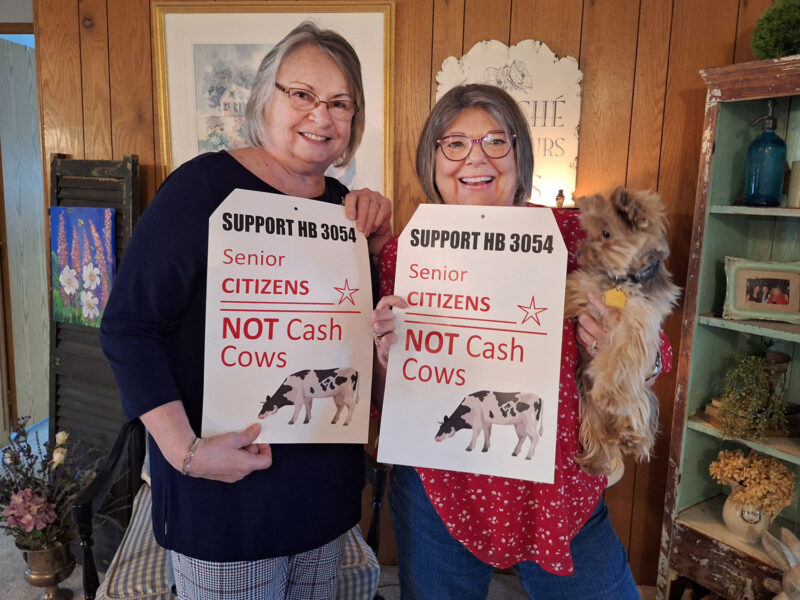
Lynn Cole and Judy Annin show their support for HB 3054, which they played a role in making happen in Oregon. – Barb Schafer photo

By Barb Schafer


Judy Annin and Lynn Cole were friends and co-workers for decades. After their husbands passed away, both had decided to move to Twin Cedars Mobile Home Park in Lebanon, a senior living park for residents 55 and older.

To date, Annin has been there for 11 years, while Cole moved in three years ago.

Both had retired from careers in which they had worked professionally in support services for senior citizens, and they were planning ahead for affordable living for themselves. Traditionally, such mobile home or manufactured home parks have offered a reliable way to live in a decent home affordably.

Until several years ago, most mobile home parks were owned by “mom and pop” organizations, where you could reach the owners with any concerns, and there was plenty of communication and respectful, often friendly relationships were built.

Nancy Nelson White, third-generation owner of Woods Trailer Park, stated about their family park in Lebanon, “Some residents at this park have lived here for many decades. They bought their home and rented the lot from the owners. They were neighbors. They looked out for each other. If they had concerns, they could talk in person (to the owner). Everybody has the owner’s phone number. We’re not hidden.”

Some residents at Twin Cedars have lived there for many decades. They bought their home and rented the lot from the owners, who lived in Lebanon and managed the park. In those days, the owners might have raised the lot rent $15-25 when it was necessary to maintain the park, and for many years, the rent didn’t increase much.

Then came the corporations.

In recent years, large corporations have been buying manufactured home parks across the states, able to far outbid most would-be local purchasers. The parks are seen by some as “cash cows.” These same corporations also started buying up lots in Oregon, even in Lebanon.

After two years of corporate ownership at Twin Cedars, the move-in cost increased by 100%. Meanwhile, monthly rates grew significantly, too. The lot that rented for $825 in 2023 had risen to $1,300 in 2025 and will increase again next year.

While manufactured home owners can move their home off the lot, the cost to do so far outweighs the benefit.

“Mobile homes are not mobile,” Annis emphasized. “Our homes could not be moved. If moveable, the cost would be similar to moving an older home of any kind.”

But as rates increase, the owner must remain in good standing for the rental of the lot. If they fall behind, they can be evicted.

Some have had to simply move away, leaving behind their home and the equity they thought they were building. Thus, their home becomes the asset of the corporation, which can, once the owner has abandoned the property after eviction, remodel and resell it.

Shortly after Cole moved to Twin Cedars, she and Annin met other residents who, they said, complained about the rapidly increasing costs. As prices rose substantially and they were unable to contact the corporate owners, the ladies began meeting more regularly with their neighbors.

“At our first meeting, we had 20-25 attendees,” Annin said.

She was researching housing, noting that the rent had gone up more than 14% the prior year. People were complaining about the landlord and what he was charging, but Annin reminded them, after looking it up, that he wasn’t breaking the law.

Then the letter writing began.

“We had an idea,” she said. “We were all going to write a letter and all sign it.”

There were letters to state representatives, and there were more meetings.

The corporation that owned Twin Cedars appeared unreachable. Annin and Cole said they just wanted a chance to sit down with someone to talk about the issues. Still, despite letters, emails and phone call attempts, there continued to be no response from the owner corporation.

According to the residents, the locally hired manager was “clearly” uninterested in questions about issues residents had, simply telling them that they needed to follow his rules “because I told you so,” Annin said.

So the residents hired an attorney who contacted the park manager about park rules that were not legal, one of which included denying access to the clubhouse.

After that, the clubhouse was reopened. But rent raises were still a concern for the residents.

The regular meetings among residents became educational. The group discovered it was legal to offer to buy the park themselves, but when they tried to look into that option, they learned the park had already been sold to another corporation.

“We realized we needed as much help as possible,” Cole said.

They reached out to HUD, the Housing Authority and CASA of Oregon (Community and Shelter Assistance Corporation) for help.

Cole and Annin were learning together as they worked together.

“Because our park had already been purchased by a real estate investment firm, it was too late for CASA to help, but CASA has helped other park tenants throughout Oregon to purchase their parks,” Cole said. “We also learned that the HUD Price grant (Preservation and Reinvestment for Community Enhancement) helped CASA finance the tenant-owned parks. That gives tenants some control of their parks as well as keeping rental costs reasonable.”

Meanwhile, Cole, a retired registered nurse, said she was becoming more concerned about the park residents who were battling health issues, stressing over cost increases and, in several cases, unable to keep paying the higher costs of staying in their own home.

Both Annin and Cole have been senior advocates for most of their lives. They have been working together on and off since 1997, primarily supporting seniors. They couldn’t just let this happen to their neighbors.

“It’s amazing how we grew in our contacts and started getting invitations to learn more,” they said. “A network began to grow around our little group. We organized people to write to their representatives.”

They also started a Facebook page, Manufactured Homeowners of Oregon.

Other states responded and neighbors discovered the issues weren’t local or even just statewide, but that it is a nationwide concern.

As they continued to meet and educate themselves on housing laws, more neighbors were forced to leave their manufactured home behind because they could no longer pay the lot fees. The pair also said they both heard about some people who, to get out from under an overwhelming lot-rent debt, sold their homes to the corporation for $1.

Estimates suggest that by 2030, 40% to 60% of manufactured home parks will be owned by large corporations. In Lebanon, 80% to nearly 100% of these parks are investor- or corporate-owned. Another way to look at it is that Lebanon’s manufactured home parks are owned by out-of-state corporations, mostly sold by “mom and pop” investors.

But meeting the residents became empowering for Annin and Cole and their neighbors.

Through their efforts and those they recruited, after thousands of hours of effort, Oregon State House Bill 3054 passed both chambers and was signed into law in June 2025.

The act limits space rent increases in manufactured home parks to 6% per year. It also prohibits certain sale conditions and mandates a study on park utility systems. It is slowly beginning to help some residents.

Both political parties are interested in issues of homelessness and affordable housing. Senators Jeff Merkley and Ron Wyden, as well as U.S. Senator Elizabeth Warren, are among those who are working on housing issues.

Cole and Annin said this has been a learning curve and an exhausting experience, but they’re proud of the results so far. They agree that their 37-year friendship and professional history together made them more able to step in to work so hard for people, most of whom they would never meet.

“People don’t listen to you when you’re angry,” Annin said. “We needed to learn how to share our story so folks would listen.”

When Gov. Tina Kotek signed HB 3054, residents of Twin Cedars Manufactured Home Park were invited to attend.

“We were sitting in the Senate Chambers peanut gallery and they called each senator’s name for a vote.”

The vote passed. The two friends and their neighbors had begun to make a difference in their park and around Oregon, perhaps beyond.

~ Barb Schafer is a Lebanon resident

Total
0
Share