


The party’s first primary debate takes place Thursday, April 16, leading into a heavy advertising season.
By Khushboo Rathore
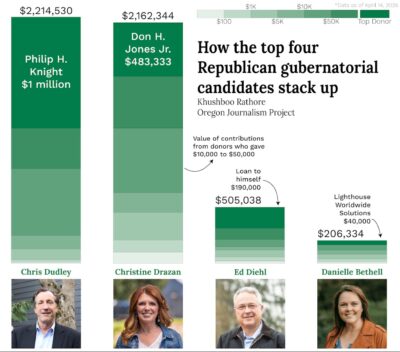
The top four Republican candidates for Oregon governor are headed to their first debate on Thursday, April 16, in Hillsboro. At this stage, the two front-runners have raised the most money, thanks to huge contributions from wealthy patrons. Here’s a breakdown of the campaign finances for the four, as of April 14.
Chris Dudley
Dudley, best known for his time as a Portland Trail Blazer and his 2010 bid for Oregon governor, has raised the most: $2,214,530 from 269 contributions. But nearly half of his haul—$1 million—came from Nike co-founder Phil Knight. (In the last governor’s race, Knight gave $3.75 million to unaffiliated candidate Betsy Johnson and $1.5 million to the Republican nominee, Christine Drazan.)
Dudley has also pulled in three $100,000 contributions—from Steve Harder of Newport Beach, Calif.; Oregon and Idaho philanthropist Erika Miller; and the Dudley Family Foundation. Oregon businessman Terry Emmert contributed $64,073.
Most of Emmert’s contribution, 92%, was listed as “in-kind” for fundraising and advertising expenses. Emmert believes Dudley’s background as a businessman makes him the best fit for Oregon.
“[Dudley]’s not what you call the normal run-of-the-mill politician,” Emmert says. “He wants to run the state of Oregon like a business, have people accountable, and bring back education to the level that it should be.”
Christine Drazan
Drazan, a state senator from Canby, has raised $2,162,344 from 1,309 contributions since entering the race last October. Her biggest contributor is Don H. Jones Jr., who gave $483,333. Jones founded The Spartan Group, a network of car dealerships and real estate holdings.
Drazan also received $100,000 from the Union Contractor Group of Associated General Contractors and $50,000 from Murphy Plywood in Sutherlin.
State Rep. Shelly Boshart Davis (R-Albany) donated $58,465 in cash and in-kind contributions.
Drazan has also been endorsed by organizations such as the Oregon Farm Bureau.
“Christine Drazan has demonstrated that she listens to Oregonians, values working lands, and supports commonsense solutions that strengthen our economy and protect our way of life,” the bureau said in a February news release.
In 2022, Drazan lost to Democrat Tina Kotek by about 66,000 votes. Her current campaign focuses heavily on the economy and affordability. She has begun big advertising buys but still has $1,010,474 on hand.
Ed Diehl
State Rep. Diehl (R-Scio) raised $505,038 from 233 contributions. His largest source of support: a $190,000 loan to himself. His next-largest contribution was $100,000 from Salem restaurant owner Glen Stonebrick. The Oregon Firearms Federation PAC publicly supports Diehl and gave his campaign $20,000.
“With a field crowded with candidates who have no chance of winning, and a solid supporter of gun rights in the race, we believe the choice is clear,” the advocacy group says on its website. “The best hope for Oregon gun owners is Ed Diehl.”
Two fellow lawmakers, Sen. Todd Nash (R-Enterprise) and Rep. Mark Owens (R-Crane), each donated about $5,000 through their campaigns. Diehl had $310,632 on hand as of April 14.
Diehl is running on a “no tax” platform, promising to cut taxes and state spending by 10% if elected. He led an effort to bring a 6-cent-a-gallon gas tax increase approved by lawmakers in September to the ballot in November. Democrats in this year’s short session, fearing an embarrassing defeat during the midterms, moved up that referendum to the May ballot.
Danielle Bethell
Bethell, a Marion County commissioner, raised the least of the top four candidates—$206,334 from 301 contributions. Her biggest backer is Lighthouse Worldwide Solutions, a contamination monitoring company based in White City. It contributed $40,000 in October 2025.
The second-highest contribution was $25,000 from Robert Freres Jr., president of a lumber company in Lyons. Several Oregon politicians have contributed to Bethell’s campaign, including former Klamath County Commissioner Dave Henslee and fellow Marion County Commissioner Colm Willis. As of April 13, she had $12,242 on hand.
Ballots for the May 19 primary will be mailed to voters beginning April 29.