
Rod Sell has always enjoyed the outdoors – cycling, hiking, that sort of thing. But as he retired as manager of Lebanon’s city Maintenance Division, he’d realized that he needed to plan for the future, including his.
That’s roughly how Sell, 72, got involved in Build Lebanon Trails, which helped start and for which he’s become a prominent leader and spokesman since the nonprofit group was founded in 2005.
Sell didn’t grow up in Lebanon, but he’s always been a local off and on since childhood. He spent his early school year in Albany but attended junior high and high school in Sweet Home, graduating from Sweet Home High School.
After that he lived all over Oregon, he says.
“I went where the work was, construction primarily.”
In the 1980s, construction work was becoming hard to find and Sell landed a job with the city of Corvallis. Four years later, he applied for a job with the City of Lebanon, which was taking over the local water system from Consumers Power.
That launched a 22-year career with the city, as Sell rose from entry-level to management.
As maintenance supervisor, he was responsible for upkeep of the streets, sewers, water systems and library – and parks.
“Back in the day there were some parks in Lebanon, but they needed a lot,” he recalled, noting that they lacked irrigation and restrooms, for starters. He got permission from up the ladder to go to work on those problems and started finding success in applying for grants.
“We were very successful,” he said of that quest. “Then I started looking at what else was needed.”
Sell was already a road cyclist, but he and Lebanon’s public works director at the time, who was a local mountain rescue unit member, found a common interest in mountain climbing.
“I hooked up with him and we started climbing local mountains.”
That got him thinking about how Lebanon needed local trails.
“I’d been going to trails seminars,” he said, adding that the city also commissioned a survey during that time in which respondents picked local walking-distance trail availability as a major preference.
“That started the ball rolling,” Sell said. “We knew the demand was there.”
Personally, he said, “between hiking and mountain climbing I’d gotten a passion for hiking in the community. I’m going to age out. I’d love to have these trails.”
The first step, Sell said, was to put together a trails master plan. He and others surveyed the city to determine preferable locations for possible trail development.
The city was able to get a grant to retain Mark Swenson of the University of Oregon’s Resource Assistance for Rural Environments (RARE) program. Swenson moved to Lebanon and lived here for two years as he developed the plan, which has driven the development of approximately 13 miles of trails, with a goal of 50.
“It’s a living document, still in use today,” Sell said. “If you have the support of the community, if you have that guiding document, you have justification. It’s not just you wanting the trail.”
The trail development effort began with a trails committee as a subcommittee of Lebanon’s Parks Committee, then morphed into the independent Build Lebanon Trails, which gained nonprofit status.
“It became pretty obvious to everyone that we needed to have our own group, to go after our own goals,” Sell said.
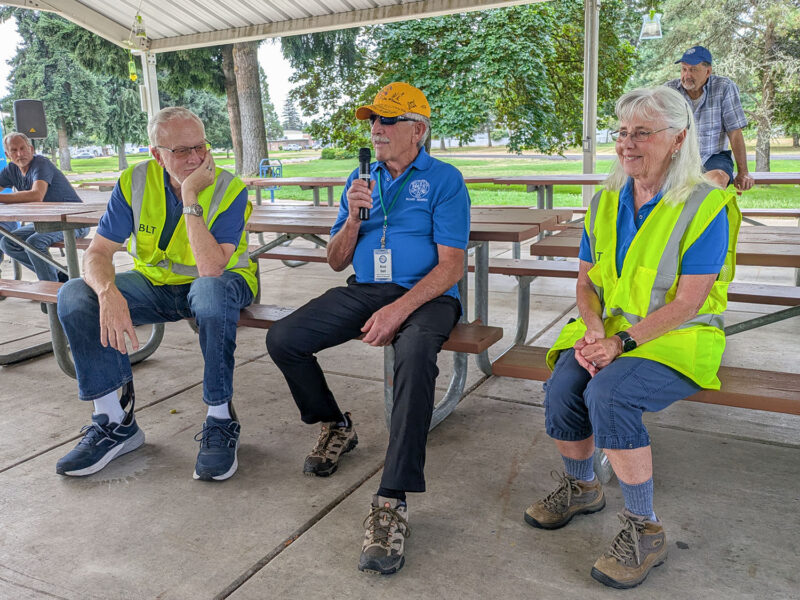
BLT is not a membership organization. It has a board of directors, which Sell described as a “working board – every single person on that board has a passion; they all contribute because they want to, not because they have to.”
Most of the participants are at or nearing retirement age, he said. They’re dedicated.
Last week, when Sell returned a reporter’s phone call, he had just returned from installing benches at River Park, where the city had completed a path that was part of the master plan.
Sell said BLT volunteers are busy. They have planted more than 400 trees along newly constructed trails, most recently 40 at Marks Slough and River Park.
“We’re going to start watering those,” Sell said, noting that various work groups like to adopt names, like “Bucket Brigade.” Those volunteers will hand-carry two five-gallon buckets per tree during watering, which will last three years for each tree.
“Then they’re on their own,” Sell said. “The number of trees (being cared for) doesn’t change much because we keep planting new trees.”
BLT has installed 52 benches, with more coming. Plus, the Lebanon Rotary Club has funded doggie bag stations that BLT also has installed.
Sell, who led BLT for well over a decade before stepping down as president, although he’s still a leader, said it’s hard to put a number on the exact number of volunteers involved.
“Different people like to do different things,” he said, adding that the organization has a website and sends out emails to alert volunteers of opportunities. BLT puts significant effort into outreach and public information efforts.
For the River Park bench installation, “we didn’t even advertise and we had people show up,” he said.
It’s satisfying work, he said, and the group has gained trust by delivering results, which helps BLT’s fundraising efforts and grant requests. Success has come through determination and working together, he said.
“You don’t have to have a lot of education, a lot of money, a lot of status,” Sell said. “If you have passion, you can find likeminded people who want to contribute to the community.
“It’s a great thing to give back and create a trail. There’s nothing like going out to a place with blackberries and brambles all over it, and walk through it the first time and decide you you want to build a trail.
“Then you do it.”