
Volunteers turn out for wetland restoration project

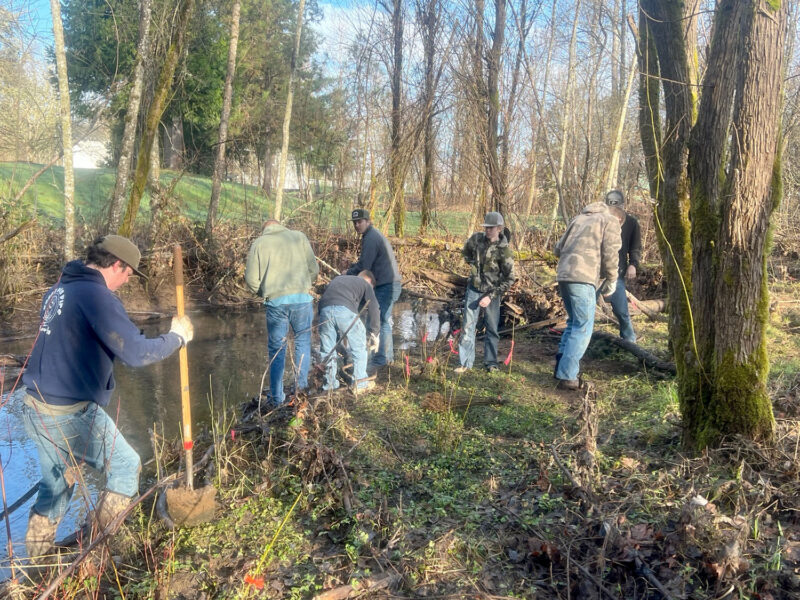
Sweet Home High School forestry students and teacher Zech Brown, left, plant native trees and shrubs along the bank of Ames Creek last week. Photo by Scott Swanson

In the east shoulder of Sankey Park, a place where few tread and invasive plants thrive, a number of volunteers gathered together to stick twigs in the ground.

Tyrell Styhl gives the restoration project area one last look after a team of people spent two days planting nearly 2,000 cuttings of native plants on the south shoulder of Sankey Park. Photos by Sarah Brown

It was Thursday and Friday morning, Feb. 5-6, when members of the City of Sweet Home, Park and Tree Committee, South Santiam Watershed Council and Sweet Home High School Forestry class donned clothing suitable for muddy conditions and made their way through the relatively small section of park with the worthy intention of restoring the wet meadow.

According to South Santiam Watershed Council’s Ecological Projects Coordinator Tyrell Styhl, that three-acre area on the east side of Ames Creek, situated behind the Sweet Home Senior Center, just last year was covered in Himalayan blackberry, reed canary grass and a smattering of English hawthorne and teasel, all invasive species.

Styhl noted that last spring the reed canary grass was taller than him.

“It completely shades out and out-competes all native grasses and sedges,” Styhl said. “Because of how wet this area is, this should have wetland plants in it and native grasses, native wildflowers.”

Black tarp covers a one-acre portion of Sankey Park where canary reed grass dominated the area as an invasive weed.

The city started the project in October when it mowed down the grass and placed black silage tarp over one acre of the area to prevent regrowth.

“Reed canary grass is a really invasive weed that is hard to control unless you are just using a lot of herbicides,” Styhl said. “To try to reduce the amount of herbicides we have to use, we put this tarp down.”

They also mowed down the blackberry and other unwanted weeds, leaving a relatively open area ready for the introduction of desirable native plants.

Tyrell Styhl points out how Ames Creek water flowed through the area during a recent flood.

And that’s what this group of volunteers worked on last week, digging about 2,000 small holes along the creek bank and floodplain forest area. In each hole were placed cuttings of various native plants which the city hopes will out-thrive the unwanted species.

They include: grand fir, vine maple, bigleaf maple, red alder, serviceberry, coyote brush, buckbrush, redstem ceanothus, snowbrush, Pacific dogwood, red osier dogwood, twinberry, western crabapple, osoberry, mock orange, ninebark, black cottonwood, bitter cherry, Oregon oak, cascara, red flowering currant, nootka rose, thimbleberry, salmonberry, Pacific willow, McKenzie willow, Scouler willow, blue elderberry, red elderberry, spiraea, western red cedar and oval-leafed viburnum.

For the next couple of years, the city will maintain the area, carefully spraying any blackberry growth with herbicide in an effort to give the native cuttings a chance to grow.

Then, said Styhl, “the native plants will come up and shade out the invasive species.”

When the tarp is removed next fall, the city will return to fill the bare area with more native seeds and wetland plants.

Once established, the plants will benefit the area by cleaning and cooling Ames Creek, and increasing the habitat area for birds, deer, pollinators and other wildlife.

“Managing invasive weeds and planting native species in floodplains helps bring these areas back to life,” Styhl said. “When we remove aggressive weeds and replace them with native trees, shrubs, flowers and grasses, we improve habitat for fish, wildlife and pollinators, stabilize stream banks, and help filter runoff to keep water cleaner.”


Total
0
Share