


By Satina Tolman
For The New Era
A free Wildfire Safety Open House, hosted April 30 by Pacific Power at the Lebanon Chamber of Commerce, offering residents information on wildfire preparedness, power reliability and emergency planning ahead of what experts say could be a higher-risk fire season.
The come-and-go event allowed community members to meet with Pacific Power’s wildfire safety and prevention teams, connect with local public safety partners and ask customer service questions via video calls while enjoying light refreshments.
Power Outages Explained
A key concern raised by attendees was the potential for power outages during wildfire season. Drew Marine, a Pacific Power communications specialist, said confusion often arises between two types of outages.
“What there is often a common confusion about is the difference between a public safety power shutoff and outages due to our enhanced safety settings,” Marine said.
Public safety power shutoffs are planned, preventative outages used during extreme weather conditions such as high winds and dry fuels. Marine said the company aims to notify customers 24 to 48 hours in advance, when possible, and to provide updates throughout the outage.
“When we deem the weather is not in our favor, we can alert the public and say we are planning on doing an outage,” Marine said. “In those situations, it can be unpredictable, so we like to give people updates as necessary and as we can.”
Enhanced safety settings, by contrast, are built into equipment in high-risk fire areas and can automatically shut off power within fractions of a second if interference is detected.
“That can be anything from debris to a squirrel or anything that can cause a spark,” Marine said. “In the case of an outage due to enhanced safety settings, we actually have to have a crew go out there and physically inspect the line and make sure it is safe to turn the power back on.”
Marine said public safety shutoffs are relatively rare.
“We actually haven’t had a public safety power shutoff where we intentionally shut off the power as a planned operation since 2022, so it is not a typical or frequent thing we do,” she said. “Enhanced safety settings is something people may experience more if they are in a high-risk fire area.”
Wildfire Monitoring
Pacific Power also highlighted its Wildfire Intelligence Center in Medford, which opened last year. Staffed mostly by former firefighting professionals, the center monitors wildfire activity across the region to inform operational decisions.
“We want to make sure our first responders are safe, can get near their equipment, and we are not adding on to any of those fires,” Marine said.
How to Prepare
Linn County Emergency Management Coordinator Jackie Nerski said preparation at home is one of the most important steps residents can take.

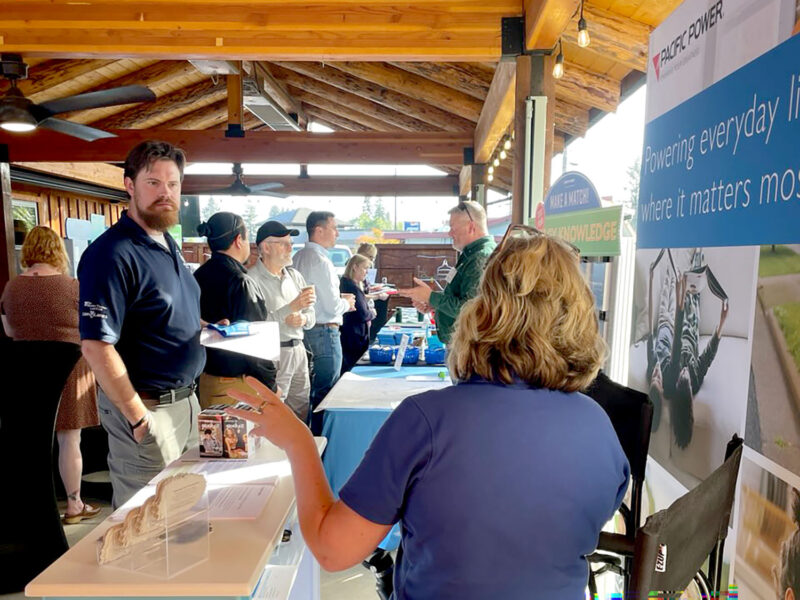
agencies chat with members of the public at the Wildfire Safety Open House. – Satina Tolman photos
“For us it is making sure you’re prepared at home. Do you have an outage kit? Do you have an evacuation plan?” Nerski asked.
Nerski also emphasized the importance of planning ahead for those who rely on electricity for medical needs and notifying Pacific Power in advance.
Customers with medical needs, such as medications requiring refrigeration or devices like respirators, are encouraged to contact Pacific Power and provide a medical certificate so their accounts can be flagged.
“There are multiple things we can do if someone is power dependent,” Nerski said. “If they let us know that they are medical certificate customers and what needs they have, we will then flag their account and we can give them advanced notification.”
Nerski said those customers may receive additional call notifications in the event of a public safety power shutoff, giving them extra time to prepare. She added that Pacific Power also offers assistance programs, including a backup generator rebate for qualifying customers.
Officials emphasized the importance of keeping contact information on their Pacific Power account up to date to receive outage alerts and emergency notifications.
Stay Informed
Residents are also encouraged to follow local public safety agencies on social media, prepare emergency “go-bags” with essentials such as food, water and medications, and sign up for local alert systems, including Linn-Benton ALERT.
According to data from the National Oceanic and Atmospheric Administration, Oregon’s snowpack is at 29% of normal, tying with 2015 for the worst level since 1981. The low snowpack and dry conditions are expected to increase wildfire risk this year.
Sweet Home Police Chief and City Manager Jason Ogden recommended using technology to stay informed.
“I have found the phone app called Watch Duty is very informative,” Ogden said. “Watch Duty is a real-time wildfire app that shows live fire activity, evacuations, and conditions using verified updates from firefighters and experts so you can know exactly what’s happening near you.”
Evacuation/Livestock Safety
Emergency officials advise residents to know multiple evacuation routes, plan for pets and livestock and prepare early rather than waiting until conditions worsen.
For farmers and ranchers, early evacuation of livestock is critical. Options include coordinating with neighbors, using pre-arranged transport and utilizing facilities such as the Linn County Fair and Expo Center, which may serve as a shelter during emergencies.
If evacuation is not possible, officials recommend moving animals to cleared or irrigated areas, ensuring access to water that does not rely on electricity and leaving gates open so animals can move away from danger.
Community Response, Training
The Linn County Sheriff’s Office Community Emergency Response Team, or CERT, a volunteer-run program, also participated in the event, offering information on training opportunities in disaster preparedness, fire safety and emergency response.
“After the disaster, you have to take care of yourself first because if you can’t take care of yourself, you can’t help anyone else,” said Paul Thompson, a volunteer trainer. “So it’s ourselves, our families, our immediate neighborhood and then we branch out from there.”
Thompson encouraged residents to get to know their neighbors, understand the resources around them and consider what they can offer in an emergency.
“Do you have medical personnel in your neighborhood, an IT person, people who are good with tools?” he said.
He said immediate neighborhoods often become the first line of support during a disaster, as emergency responders may not be able to reach every area right away.
CERT offers training twice a year and can provide additional sessions for groups of 10 or more. More information is available on the Linn County Sheriff’s Office website.
Protecting Your Home
Local officials also stressed the importance of home preparedness, including creating defensible space by clearing vegetation at least 30 feet from structures and maintaining roofs and gutters.
“Clearing away debris around your home, cleaning off any pine needles off the roof, or cleaning up the gutters will all help,” said Ben Dudik, Pacific Power vegetation manager. “It will take time, but each project will help reduce your home’s risk to damage or loss because of wildfire.”
Looking Ahead
Sweet Home Fire Chief Nick Tyler said early preparation will be especially important this year, particularly for communities like Sweet Home that border forestland.
“Here in Sweet Home, we live right up against the wildland — that’s part of what makes this place special — but it also means wildfire preparedness is everyone’s responsibility,” Tyler said.
He emphasized that small, proactive steps around the home can make a significant difference, especially given how wildfires behave in the area.
“In our area, embers can travel well ahead of the fire — so what’s right around your home matters most,” Tyler said.
Tyler also encouraged residents to take advantage of local resources designed to help reduce risk.
“The Sweet Home Fire and Ambulance District also offers a Home Assessment Program,” he said. “Our personnel can come out, walk your property with you, and provide practical, site-specific recommendations to improve defensible space and reduce wildfire risk. It’s a simple step that can make a big difference, and we strongly encourage residents to take advantage of it.”
He said changing conditions this year make early preparation critical.
“Sweet Home is no stranger to wildfire risk,” Tyler said. “The difference this year is how early things could dry out. The best thing our community can do right now is prepare early — because when a fire starts, it’s too late to catch up.”
Residents can sign up for outage alerts, view outage maps and find preparedness resources through Pacific Power, as well as access local alert systems and emergency information through city and county agencies.