




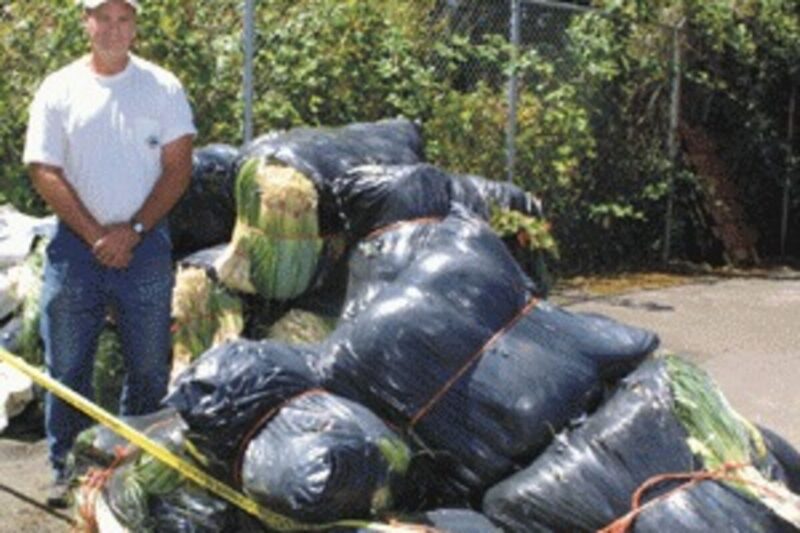
Sweet Home Ranger District recovered two tons of illegally harvest bear grass on July 25.
The bear grass was harvested on Forest Service Road 1509, along the border between the McKenzie and Sweet Home ranger districts.
Sweet Home Ranger District does not issue permits for commercial bear grass harvesting any more, Special Forest Products Coordinator Robb Ginn said. It does permit harvesting through contracts.
“They do a lot of resource damage when they do illegal harvesting because they’re in quick,” Ginn said. Most harvesters, illegal and legal, come from Washington where they export the bear grass, which is often used in floral arrangements and, Ginn has heard, to make beer.
Bear grass grows in harsh, dry sites, Ginn said. The district has thousands of acres of it.
Bear grass harvesters are intelligent about which rare plants are being sold, and they dig those up too, Ginn said. “The plant can be damaged by removing the center on a continual basis. It will eventually kill the plant. A lot of people consider it a hardy plant, no way you can destroy it.”
In Washington, there is evidence that bear grass is being destroyed, Ginn said. “My concern is other activities. If they’re illegally harvesting bear grass, they’re illegally harvesting something else.”
The district stopped issuing permits for commercial bear grass harvesting because it is difficult to manage, Ginn said. “It’s just a tough row to hoe because we can’t keep them in one area.”
Individuals are allowed to harvest bear grass for personal use with a permit available at the district office, Ginn said, but harvesters are rarely harvesting for personal use.
The bear grass market works like other commodities, Ginn said. The price fluctuates rapidly. It may be 20 to 30 cents per pound at the beginning of the day and a nickel per pound at the end of the day.
Harvesters camp out all summer, and each one must harvest upward of 300 pounds per day to make money.
Illegal bear grass harvesting is theft from legitimate contractors and the Forest Service, Ginn said.
In this case, Ginn spotted strands of bear grass along the roadway. He noticed a vehicle and hiked off the road to find the suspects at work harvesting bear grass.
This is the largest illegal harvest that Sweet Home Ranger District has caught, Ginn said. Most, usually three to four a year, are roughly 500 or 600 pounds. Most of the time, the district will have four or five bear grass camps.
Harvesting is normally done from September through May or June, Ginn said. He was surprised to see such a harvest in July. The bear grass is harder to pull up during the dry summer months.
“It’s a constant battle,” Ginn said. He asks that the public assist in curbing illegal harvesting of bear grass and other forest products. If a member of the public sees something suspicious, Ginn asks to be contacted at 367-9236.
The names of the arrested suspects and charges were unavailable at press time.